Introduction to the Taipei Green Diet Series Courses
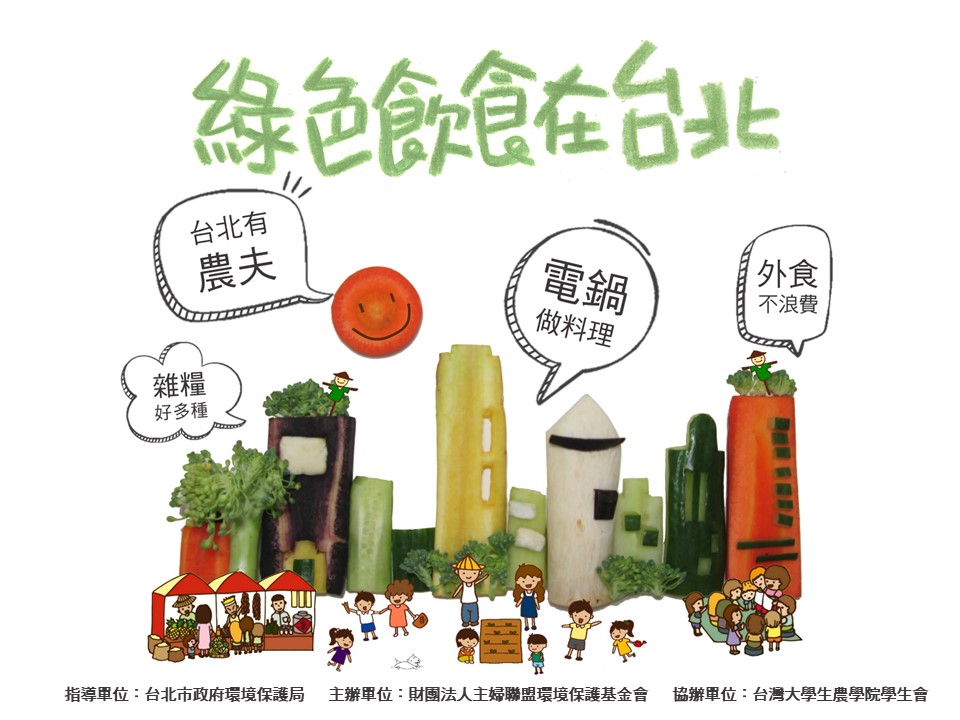
Are you tired of days when every meal is either from a restaurant or a convenience store, loaded with oil, sugar, and salt? Do you want to create a green diet experience for your daily meals that "moves you to happy tears"? From May to June, this course will invite experts, scholars, homemaking specialists, and farmers to share food-and-farming related knowledge with participants, along with fun and interesting food-and-farming tasks, gradually guiding participants to understand Taipei's green diet resources, and how to build a green diet lifestyle and network, thereby deepening their understanding of the concept of a green diet living circle and strengthening their motivation to practice it in daily life.
In addition, after the course ends, participants are expected to work in groups to complete one of the following tasks and share the results publicly at the September results presentation:
1. Write a green diet information guide for university students, in any format (such as a checklist/quick guide/map, etc.)
2. Help restaurants identify the causes of food waste when eating out and feasible solutions
Event name: "Green Diet in Taipei" Series Courses
Dates: May 5, May 19, June 2, and June 9, 2018 (all Saturdays)
Venue: 5F-1, No. 4, Lane 160, Section 3, Tingzhou Road, Taipei City (above Lianglianghao on Tingzhou Road)
Time: 0930-1630
Target participants: University students and members of the general public interested in this project, 25 to 30 people
Registration website:[Full series registration] [Single session registration]
Contact person: 02-23686211*12 Ms. Shen [email protected]
Organizer: Homemakers United Foundation Environmental Protection Foundation
Co-organizer: Student Association of the College of Bioresources and Agriculture, National Taiwan University
Advisory organization: Taipei City Government Department of Environmental Protection
Activity content:
| Date | Time | Content | Speaker / Host | Description |
|---|---|---|---|---|
| 5/5
(Sat) |
0930-1030 | Project introduction and welcome gathering | Shen Baoli, Senior Specialist, Homemakers United Foundation Environmental Protection Foundation
Representative of the College of Bioresources and Agriculture Student Association |
Introduce the project, its origins, and goals, and use interactive games to help participants form groups and get to know each other |
| 1030-1200 | Cooling the planet by eating? -- The story of a group of mothers | Shen Baoli, Senior Specialist, Homemakers United Foundation Environmental Protection Foundation | Share the relationship between diet and climate change, practical methods for a low-carbon diet, and the role of women in climate change | |
| 1200-1300 | Lunch | |||
| 1300-1430 | Where does food waste happen? | Shen Baoli, Senior Specialist, Homemakers United Foundation Environmental Protection Foundation | Share the causes of food waste in Taiwan and its relationship with climate change, and ways to reduce food waste in daily life. | |
| 1430-1600 | Invisible imperfect produce + imperfect agricultural product creation | Wang Xinyu, Founder of Extraordinary Meaning | Share the causes of food waste in Taiwan's fields or the appearance of ugly fruits and vegetables, and how to use ugly fruits and vegetables for cooking and creation. | |
| 1600-1630 | Group discussion: Where are the food-saving restaurants? | Shen Baoli, Senior Specialist, Homemakers United Foundation Environmental Protection Foundation | Introduce the food-saving restaurant project, and discuss in groups how to find 2-3 food-saving restaurants in Taipei City that meet the project criteria within the next two weeks. (See Appendix 2 for evaluation criteria) | |
| 5/19
(Sat) |
0930-1030 | Group reports: Report on the results of lobbying food-saving restaurants | Shen Baoli, Senior Specialist, Homemakers United Foundation Environmental Protection Foundation | Groups report on the results of finding food-saving restaurants over the past two weeks. |
| 1030-1100 | Meeting farmers in Taipei 1: Getting to know the Water Garden Farmers' Market | Representative of Water Garden Organic Farmers' Market | Share the relationship between the farmers' market and farming friends, its development history, and how to promote to consumers the importance of friendly farming to the environment. | |
| 1100-1130 | Farmers' market treasure hunt | Groups conduct short interviews with farming friends at the market and purchase ingredients | ||
| 1130-1330 | Low-carbon cooking DIY: One pot, three dishes | Chen Shuyu, Senior Volunteer Instructor, Homemakers United Foundation Environmental Protection Foundation | Introduce household energy consumption in the kitchen, how to carry out energy-saving actions in the kitchen or during cooking, and groups report the results of interviewing farmers at the market. | |
| 1330-1530 | Eating rice to fight global warming? + Rice dish DIY | Huang Zhaoyi, Senior Volunteer Instructor, Homemakers United Foundation Environmental Protection Foundation | Share the relationship between rice cultivation and climate change, Taiwan's rice food and festival culture, and learn about different types of rice | |
| 1530-1630 | Group discussion: Where are the coarse grains? | Shen Baoli, Senior Specialist, Homemakers United Foundation Environmental Protection Foundation | Groups discuss how to find and record 36 kinds of coarse grain-related foods over the next two weeks. | |
| 6/2
(Sat) |
0930-1030 | Group reports: How much coarse grain do you eat? | Shen Baoli, Senior Specialist, Homemakers United Foundation Environmental Protection Foundation | Groups report on their 36 kinds of coarse grain dietary records and experiences over the past two weeks |
| 1330-1530 | Farmers' seed preservation and climate change | Guo Huaren, Emeritus Professor, Department of Agronomy, National Taiwan University | Introduce Taiwan's coarse grain varieties, and share the importance of seed preservation for farmers, biodiversity, and site-appropriate cultivation as climate change becomes increasingly severe. | |
| 1230-1330 | Lunch | |||
| 1330-1530 | Taipei's kitchen: 24 hours of agricultural production and marketing | Xu Boren, Deputy Manager, Planning Department, Taipei Agricultural Products Marketing Corporation | Share the process of fruit and vegetable production, marketing, and transportation, and the role and importance of Taipei First Fruit and Vegetable Wholesale Market | |
| 1530-1630 | Group discussion: Where does food come from? | Shen Baoli, Senior Specialist, Homemakers United Foundation Environmental Protection Foundation | Groups discuss how to track the journey of one kind of food from production site to dining table within the next week. (Tentative) | |
| 6/9
(Sat) |
0930-1000 | Assembly and registration | ||
| 1000-1200 | Meeting farmers in Taipei 2: What is friendly farming? | Xue Lanying, Founder of Yuanji Organic Vegetable and Fruit Farming Learning Farm | Share the journey of practicing friendly farming in Taipei, the impact of climate change on crops, seasonal and in-season food types, and a farm tour | |
| 1200-1330 | From farm to table: Gathering organic ingredients and cooking lunch | Participants personally carry out farming experiences, identify and gather ingredients, and use farm ingredients to make lunch. | ||
| 1330-1430 | Can wild vegetables by the roadside be picked? | Learn about the types and uses of wild vegetables, and use the farm's wild vegetables to make simple snacks. | ||
| 1430-1530 | Group discussion: Drawing a green food circle map | Shen Baoli, Senior Specialist, Homemakers United Foundation Environmental Protection Foundation | Organize the learning results and reflections from the past few months, and mark the learning journey in the form of a map. | |
| Date and time to be set by each group | Pre-meeting for the final presentation | Prepare and divide the work for the day of the final presentation. | ||