This kind of aloe is rarely seen in flower markets, expensive yet endearing.
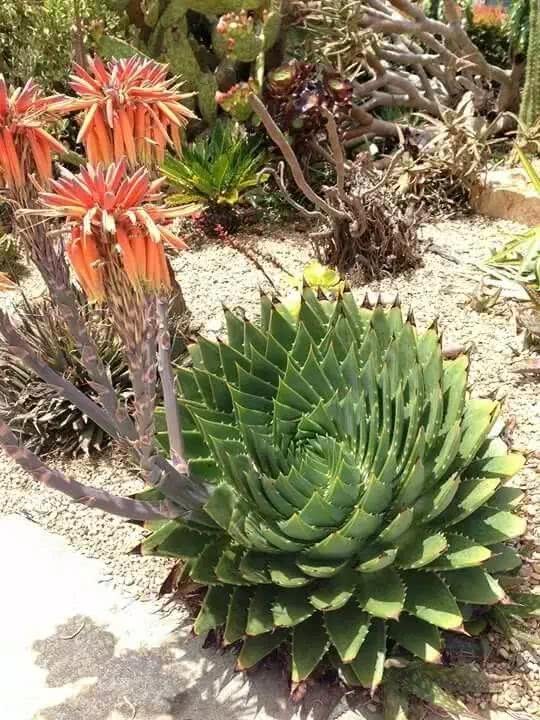
The aloe below only grows best in tropical regions; of course, in a greenhouse it can be grown anywhere. This aloe has a very geometric beauty, and people call it "spiral aloe" because its leaves form a whirlpool.
(They must grow for at least 10 years before they have a chance to bloom, so growing this requires plenty of patience.)
But it can also be grown in the subtropics, just not as well. It is actually a very tough variety and quite easy to keep; it is drought-tolerant, tolerant of poor soil, heat-tolerant and sun-tolerant, with all the virtues of cacti.
The photo above shows its flower; even in close-up it is very beautiful. It has not fully opened yet, but the mix of orange and blue-green is already lovely.
(The photo above shows spiral aloe in its native habitat in Africa, where digging them up is prohibited.)
In fact, it is cultivated all over the world, but the plants in its native habitat were secretly dug up until none were left. Now, to buy this aloe you have to grow it from seed, and there are still some gardening enthusiasts who love these cute spiky aloes.
(This one is also 10 years old and is about to bloom.)
A small plant already has 50 leaves? That is still quite astonishing. It really likes sandy soil, and planting it in a well-drained yard works well.
(The photo above shows spiral aloe in a greenhouse.)
Although this plant is heat-tolerant, in summer it still needs appropriate shade and protection from rain, and especially must not sit in water; water collecting in the center of the leaves easily causes rot.
It likes a dry, cool summer and a mild winter, similar to an oceanic climate. But it is not too delicate either, and gardening enthusiasts can keep it alive, though the price is really steep: a single seed costs more than ten yuan or even several tens of yuan.
(A gardening enthusiast's spiral aloe seedlings.)
As for small seedlings or mature spiral aloes, the price is even higher! No wonder people call it the "queen of aloes" or "queen aloe."
The landscaping effect of spiral aloe feels similar to that of yucca and agave, but spiral aloe's leaves are more compact, its plant shape is very elegant, it has a geometric beauty, and its blooming is simply wonderful!
Their flowers can be seen in summer and autumn, though this also depends on chance, especially a large patch of aloe flowers, which is very striking to see. It really is a once-in-ten-years sight.
Because they like loose, well-drained sandy soil, you should raise the flower bed as much as possible and make sure drainage is especially good before growing spiral aloe.
In winter, if this aloe does not get enough sunlight or gets too much rain, it is prone to root rot; more light can help prevent infection.
It is clear that spiral aloe cannot lack light, needing at least 8 hours of light per day so that it has enough warmth to grow.