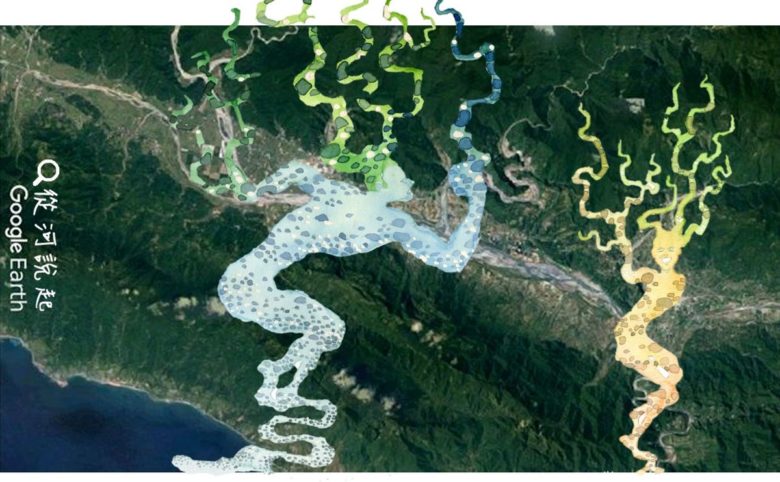
Stream Gods Come in Different Forms In recent years, some urban rivers and streams have been reshaped into canal-style landscaped waterfront spaces. Many city dwellers see the clear flowing water and assume the restoration has been a success. But do we really know what the streams of Formosa were originally meant to look like?
The large streams of Hualien and Taitung are like valiant warriors; the creatures hidden in their deep green, rushing waters are fierce, strange and uniquely gifted.
Eastern Taiwan has steep terrain, and the large streams formed among the great mountain ranges display a raw, violent majesty.
Originating from the Central Mountain Range, streams gather and rush down swiftly from several mountain hollows, carving magnificent deep gorges through the great mountains. They burst out from the peaks into the rift valley, spreading out freely into broad river channels. After a long horizontal journey running parallel to the mountain range, they swiftly and nimbly turn left and right from the mountain god's soft spot, round the valleys of the Coastal Mountain Range, and empty into the blue Pacific Ocean. The dance of eastern Taiwan's great rivers is like that of a warrior full of primal power, displaying bravery and skill in facing trials even amid rugged terrain.
The warrior's battle robe is composed of totems piece by piece, each full of symbolism. The base tone is made up of deep green surging rapids and plunging waterfalls over deep pools. The upper reaches are inscribed with the Taiwan shovel-jaw carp symbolizing abundance and vitality, and the mysterious swamp eel; the middle reaches feature the silver-armoured giant of the Cyprinidae family–the Hsu's spiny barb, predators far larger in number and size than in other river systems–the large-snout goby, and the upstream-struggling migratory algae-eater–the Japanese torrent catfish; the lower reaches are graced by grey mullet swimming in schools of hundreds, and the massive snakehead, along with the silhouettes of Amis fishermen; the estuary carries a slightly weighty grey-green, symbolizing the convergence of nutrients. Here the substrate is already mostly fine sand and gravel, with no shortage of peculiar decorations such as the dragon-mouthed snake eel and the sand shark that prefer to hide in the sand, while the ferocious great barracuda of the Pacific also catches the scent and comes to wreak havoc, accompanied by the rhythm of waves and stream water striking the cobbles, closing this hem with a bizarre and breathtaking edge. The entire battle robe is covered everywhere with hymns to the power of life, and is at the same time a story of life-and-death adventure with one climax after another.
So what about the "great rivers of the west" that flow through several counties and cities? In the next installment, we'll continue our visit~
Text/Illustration: Li Cheng-lin (This article was written with the support and collaboration of the Renhe Foundation and Aveda)