What Is a Tree-and-Rock Bonsai? A Complete Guide
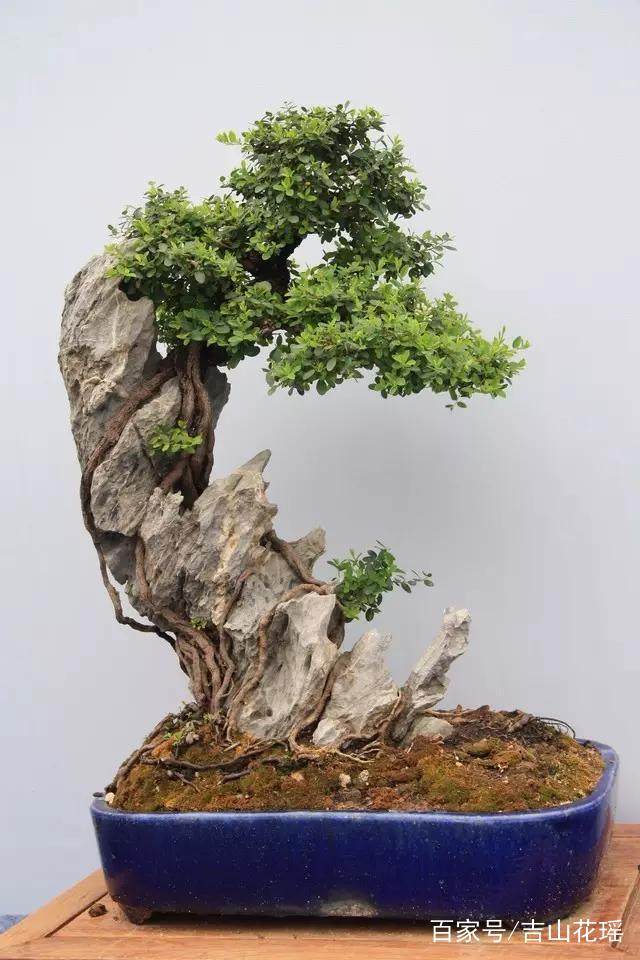
What is a tree-and-rock bonsai?
A tree-and-rock bonsai (Figure 1) is a bonsai artwork in which trees are planted on rocks, the rocks are placed in a pot, trees are the main subject, rocks are supplementary, the trees grow attached to the rocks, the trees have posture, the rocks have momentum, and trees and rocks blend into a seamless whole.
Using multiple tree trunks in combined compositions, accompanied by rocks, flowers and grasses, pavilions and towers, figures, birds and beasts, to form bonsai landscapes in countless forms and full of poetic charm, is gradually becoming a new trend in current bonsai creation. This type of bonsai is mainly composed of tree trunks (multiple specimens) combined together, while also paired with stone materials and other elements to form a landscape, so it is called tree-and-rock combined bonsai. It is a bonsai modeled landscape with a certain spatial extent, formed by combining 3 or more tree trunks and pairing them with stone materials and ornaments, and its main modeling materials are tree trunks and stone materials.
The tree trunks in tree-and-rock bonsai are not trees in their original form; they are artificially formed modeling art materials with a certain style and posture. In other words, when creating tree-and-rock bonsai, the tree trunk material is a tree trunk with a certain modeling style. Because it is artificially formed, its form in the combined composition reflects a certain rise and fall and sense of rhythm, fitting the concept even more closely.
The landscape styles of tree-and-rock combined bonsai are extremely rich, but in terms of modeling and combination techniques, they are generally divided into 3 types: water-and-dry style, dry style, and rock-attached style.
In form, tree-and-rock bonsai integrates trees and rocks into one, with lively forms; it can fully display the miniature effect of the landscape and can also appropriately express the creator's emotions, the so-called "poetic charm."
Although it has not yet been verified in which year tree-and-rock bonsai originated, their early forms can be found in some historical books. For example, Chen Mingzi's "Hua Jing" during the Kangxi period of the Qing Dynasty. Shen Fu's "Six Records of a Floating Life - Leisurely Feelings and Amusing Pastimes" during the Jiaqing period also contains records.