What plant is the Kuhschellen pasque flower?
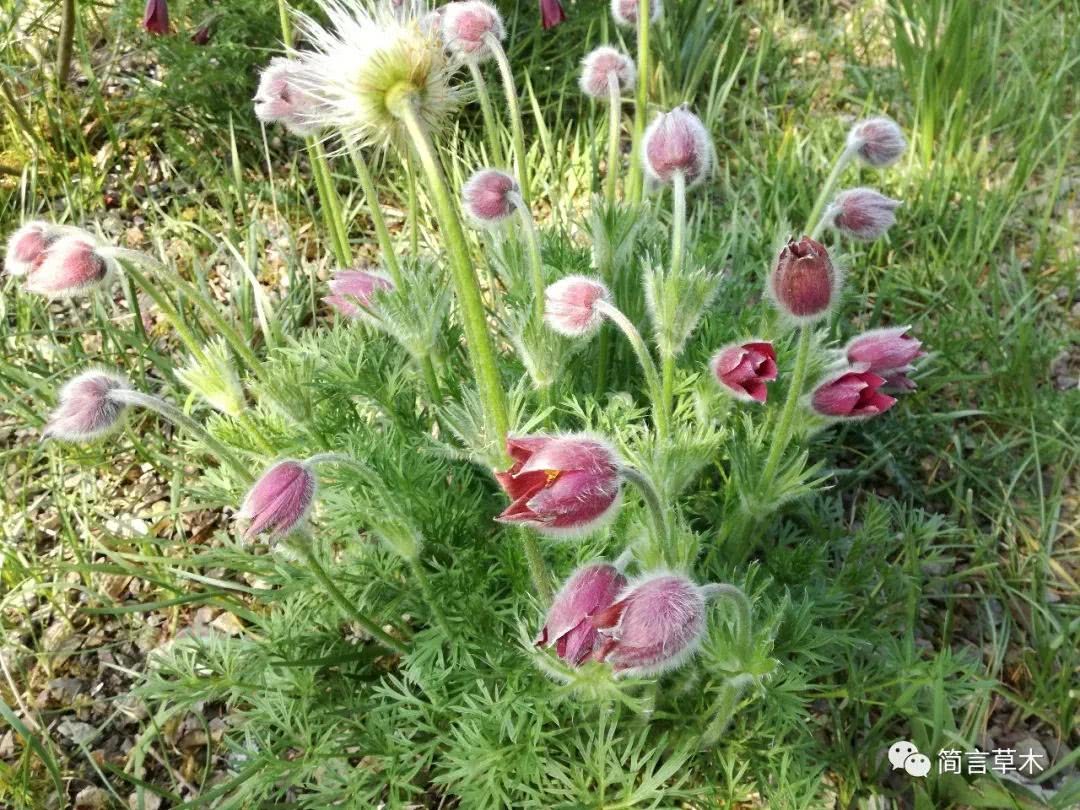
Every year from March to May, the pasque flowers perfectly enact the transformation, in the blink of an eye, of a dashing youth into a weathered old man; sensitive people will sigh again that the days ahead are not long, and that times always change...
Fortunately, the pasque flower is a perennial plant; its cycle needs only one spring, summer, autumn and winter.
Pasque flower (Pulsatilla)
Ranunculaceae family (Ranunculaceae), Pulsatilla genus (Pulsatilla)
A beautiful young man with a rosy face, a white-haired old man with crane-white hair
Red European pasque flower
Pulsatilla vulgaris rubra29.04.2017 Hermannshof, Weinheim
Perennial, herbaceous, blooming in early spring; the leaves and stems of the above-ground part are soft and hairy. These fine hairs can protect the pasque flower from the severe cold of early spring. The gorgeous part we see is not petals but the calyx, mostly purple, covered outside with fine white hairs, quite playfully cute. Of course, ecologically, in dry native environments, these fine hairs prevent excessive evaporation of water from the calyx. The striking yellow stamens contrast sharply with the corolla and are a powerful lure for bees. The cluster of pistils in the center is equally eye-catching; it is precisely the styles of this pistil cluster that will later transform into a head of silver hair.
European pasque flower
Pulsatilla vulgaris 11.04.2018 my garden
The genus Pulsatilla has about 33 species, native to meadows or steppes of the Northern Hemisphere: Europe, Asia and North America all have native species. The genus name Pulsatilla comes from the Latin Pulsare, or pulsāta, pulsātus, meaning 'to beat repeatedly, to ring incessantly, to shake a bell', referring to the fact that the flowers of this genus mostly look bell-shaped or bell-like and sway incessantly in the wind. Linnaeus originally placed the pasque flower in the genus Anemone in his 1753 Species Plantarum, naming it Anemone pulsatilla, which literally means pasque-flower anemone. But plants of the genus Pulsatilla have obviously specialized feathery-tailed achenes, which led later botanists to establish it as a separate genus.
European pasque flower
Pulsatilla vulgaris 11.04.2018 my garden
In English, the pasque flower is commonly called pasque flower or Easter flower, referring to their flowering period around Easter; it is also commonly called wind flower or meadow anemone (meadow anemone, meadow sea-anemone flower), confusing the genus Pulsatilla with the genus Anemone :), which shows their kinship. In Germany, the pasque flower has a very vivid and down-to-earth name, Kuhschellen, cowbells. I found a picture online of grazing in the Alps; come, compare the just-opening buds of the pasque flower with the big bells on the cows' necks. Do they look somewhat similar?
European pasque flower
Pulsatilla vulgaris rubra "Rosen Glocke" 11.04.2018 my garden
From the internet
The most commonly seen pasque flower in Europe is Pulsatilla vulgaris; the Latin species name vulgaris means common, popular, ordinary, named in 1768 by the English gardener Philip Miller, referring to this species being common in central and western Europe. The natural habitat of the European pasque flower is nutrient-poor calcareous grasslands, or calcareous hillsides. In German this species is commonly called Gew?hnliche Kuhschelle, common cowbell flower, common cowbell flower. With the development of modern agriculture, this once-common pasque flower is now listed as an endangered species in many regions. In 1996, the European pasque flower was chosen as Germany's Flower of the Year, to draw attention to the threat of extinction facing wild pasque flowers.
European pasque flower
Pulsatilla vulgaris11.04.2017Botanical Garden of the University of Heidelberg
Fortunately there are horticultural varieties, especially after the rock garden system became widespread, which brought the pasque flower from the wild into gardens; today white, pink and red varieties are also deeply loved by people. Whether in the youthful beauty of flowering or the flowing silver hair of fruiting, the pasque flower is a landscape in itself.
White European pasque flower
Pulsatilla vulgaris alba 11.04.2018 my garden
Pink European pasque flower
Pulsatilla vulgaris "Rosen Glocke" 11.04.2018 my garden
Red European pasque flower
Pulsatilla vulgaris rubra18.04.2018 Hermannshof, Weinheim
The 'white head' of the pasque flower is actually formed by countless achenes gathered together. After the flower completes pollination, the corolla and stamens dry up and fall off, while the pistil cluster develops along with the ovary; the styles continue to elongate, forming the long, fuzzy hairy feathery tails at the tip of each achene. This is the reproductive mechanism by which the pasque flower was selected by nature.
White European pasque flower
Pulsatilla vulgaris alba 28.04.2018 my garden
In dry weather, the wind can carry the single feather-tailed fruit pilots far away; and if the weather is humid, the long-plumed fruits may also stick to the coats of passing animals and be carried far away; moreover, research has found that the feathery tails of pasque flower fruits bend at a right angle when dry and windless, and when they encounter humid weather again they extend by slowly absorbing water. Through this physical process, the tiny achenes on the head-like receptacle can rotate once or twice, loosen, and fall off on their own at a distance of 10 cm or more from the mother plant. Once the tiny nuts land, they quickly 'bite' into the ground with the help of hygroscopic movement, so as to germinate there. Plants always have many such clever survival strategies :)
European pasque flower
Pulsatilla vulgaris 28.04.2018 my garden
The pasque flower, like all plants of the Ranunculaceae family, is poisonous! Once again, a reminder: never casually pick or pull unfamiliar beautiful plants, such as the pasque flower. Its damaged plants are extremely irritating to the skin and mucous membranes, causing blistering and burning pain. Mistakenly eating any part of a fresh pasque flower plant will cause gastrointestinal discomfort and nervous system poisoning, ranging from diarrhea and vomiting to coma and paralysis. Their highly toxic component is Protoanemonin, Anemonol; this component was first discovered in the Ranunculaceae genus Anemone, so a literal translation would be pro-anemone, and in Chinese this component is translated as protoanemonin. When dried, protoanemonin converts into the less toxic Anemonin, anemonin, which has antispasmodic and analgesic effects and can also resist fungal infections. This is precisely why various indigenous peoples of the Northern Hemisphere used the genus Pulsatilla as a traditional plant medicine.
Pink European pasque flower
Pulsatilla vulgaris "Rosen Glocke" 11.04.2018 my garden
In China, there are about 11 species of the genus Pulsatilla, accounting for 1/3 of all pasque flowers, among which the most common endemic species is the Chinese pasque flower, Pulsatilla chinensis. A good friend told me about growing up as a child following her parents in a corps unit in the Northeast; in early spring, the pasque flower was one of the few flowers visible there, called maoguduo flower. In her memory it was very special; she repeatedly wanted to plant it, but felt that those in the German flower market were never as beautiful and subtle as what she saw as a child. Presumably one reason is the difference between species, and another is that childhood memories are truly beautiful! What she knew was perhaps Pulsatilla dahurica. Unfortunately I have never had the chance to see a real-life native Chinese pasque flower.
European pasque flower
Pulsatilla vulgaris 11.04.2018 my garden
In traditional Chinese medicine, the perennial rhizome of the pasque flower is used as medicine, said to have the effects of clearing heat, detoxifying, dissipating nodules, and treating dysentery. So the folk legends about the pasque flower are mostly about someone with a stomachache who has no money for medical treatment, and then an old man with a full head of white hair appears, pointing out the way, digging up the underground stem of this herb to make a decoction, and the illness is cured as soon as the medicine is taken. The old man perfectly matches the full head of silver hair of this magical plant, and so this plant got the name 'baitouweng' (white-haired old man).
Pink European pasque flower
Pulsatilla vulgaris "Rosen Glocke" 28.04.2018 my garden
The most famous version is the story of the down-and-out Du Fu, suffering unbearable abdominal pain, meeting a white-haired old man who brought a white-haired herb to save him. It is said that Du Fu even wrote a poem for this: 'I pity myself as a white-haired one whom no one asks about; I pity others, and so become the white-haired old man.' Unfortunately I could not find the source of the original poem; saying that he named the pasque flower is presumably fabricated. However, Du Fu's self-description as a white-haired old man does appear repeatedly in his verses: 'Not yet a guest with pearl-decorated shoes, already seen as a white-haired old man', 'An old friend obtains a fine line, and gives it alone to the white-haired old man', 'Following each other for ten thousand miles of days, always becoming white-haired old men.'
White European pasque flower
Pulsatilla vulgaris alba 28.04.2018 my garden
Unlike Du Fu's sorrowful and gloomy tone, Su Shi, in adversity, wrote the image of the white-haired old man with much more calmness and heroic spirit: 'A thousand qing, all mirror-clear, reflecting green peaks. Suddenly waves rise, tossing and dancing a single leaf of a white-haired old man.' And Li Bai, probably the most innocent of poets and lyricists, when writing of the white-haired old man even picked one and compared it to his own temples in the mirror :) 'How is it that among the green grass there is also a white-haired old man? I break one off to face the bright mirror, just like my graying temples.' The writing is truly like the person; even when sighing over advancing age, one can still be romantically mischievous like an old child. Suddenly I think again of his 'I do not know in the bright mirror, where the autumn frost comes from' - how he must have loved looking in the mirror :)
European pasque flower
Pulsatilla vulgarisrubra28.05.2017 Hermannshof, Weinheim
In the blink of an eye I have already reached a very, very great age, and even the anxiety I felt a few years ago when I first realized I had wasted time has completely vanished :) I secretly remind myself that youth is gone, and in the days ahead I should do more of what I like, with more focus and steadiness, so that when I reach old age I can be at peace... This is written with the pasque flower as a token!