In mid-April these flowers bloom most profusely, the perfect time to admire them
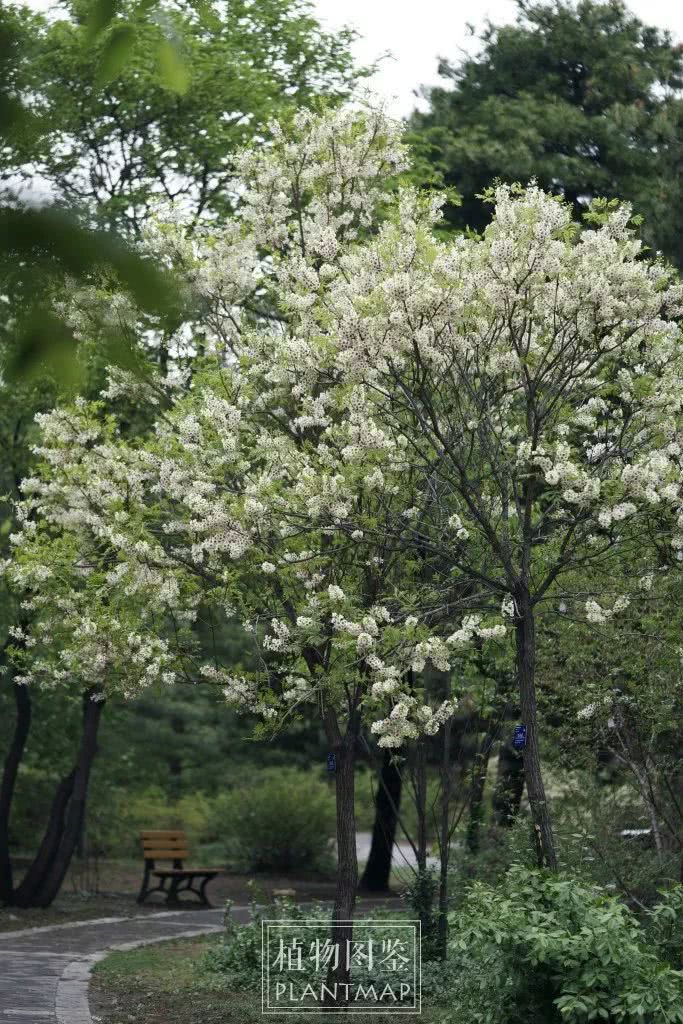
Xanthoceras sorbifolium is a northern plant; quite a few are grown in Beijing, and it grows wild in the provinces and regions of the northwest and northeast.
Beijing Botanical Garden
[ Xanthoceras sorbifolium] Sapindaceae >> Xanthoceras
I misidentified Xanthoceras sorbifolium several times. The first time I saw it was in the Old Summer Palace. It was October, and the tree had no flowers, only some shriveled, split-open fruits; together with those pinnately compound leaves, they made me think this was a plant of the walnut type. Later I asked a friend from the north, and only then did I learn that this is a common northern plant - Xanthoceras sorbifolium.
So those were all Xanthoceras sorbifolium. I don't know whether the Xanthoceras sorbifolium in the Old Summer Palace has existed since ancient times or was planted in modern times. In any case, the number of Xanthoceras sorbifolium in the Old Summer Palace is considerable, planted in great swaths on those earthen platforms that once belonged to palace halls, or on the hillsides that were once burned to nothing.
Xanthoceras sorbifolium in autumn
From early April to mid-April is the season when Xanthoceras sorbifolium is in full bloom. Someone posted photos of Xanthoceras sorbifolium on social media, and I mistook them for Vernicia fordii; the flowers of two plants from different families can actually look so much alike. Xanthoceras sorbifolium belongs to Sapindaceae, which I never would have guessed, though the fruit structure of Xanthoceras sorbifolium really is somewhat similar to that of its relative in the same family, Koelreuteria paniculata.
Image taken from the internet, illustrating the fresh fruit and seeds of Xanthoceras sorbifolium
The flowering of Xanthoceras sorbifolium is in no way inferior to that of Vernicia fordii in the south. I would very much like to know what the Old Summer Palace looks like when Xanthoceras sorbifolium is in full bloom; perhaps it is even prettier than Yuyuantan in cherry blossom season.
Gradient-colored inflorescence
Beneath such a grand flowering display, we must not overlook the beauty of the details of Xanthoceras sorbifolium.
The flowers of Xanthoceras sorbifolium form long inflorescences, and one very interesting point is that the "younger" flowers at the tip of the inflorescence are yellow, while the flowers at the base are red. The flowers in the middle are orange, between red and yellow. The flower colors along the whole inflorescence form a soft gradient.
Bisexual inflorescence
Inflorescences may be terminal or on branches, and some grow in leaf axils. Flowers borne on inflorescences in different positions are also different.
The flowers on terminal inflorescences are bisexual flowers capable of setting fruit; you can clearly see a large green ovary in the center of the flower, surrounded by 8 stamens.
Male inflorescence
The flowers on axillary inflorescences, however, are all male flowers, and the center of the flower is naturally all stamens. (They really do look so much like Vernicia fordii flowers)
Xanthoceras sorbifolium is also often written as "wenguan guo" (scholar's cap fruit), possibly named because the flower or fruit resembles the cap worn by civil officials in ancient times, but this explanation is somewhat far-fetched.
It also has relatively high economic value; the seeds have a high oil content, and it is known as the "northern oil tea." According to friends from the north, the seeds of Xanthoceras sorbifolium are edible, processed in a way similar to chestnuts, and taste about the same.
Author: Jiang Mouren
Images: Jiang Mouren (unless otherwise noted)
This work is licensed under the (CC BY-NC-ND 4.0) license agreement; please retain this statement when reposting.
iPhone users can tip the author via the QR code below