Why fuss over lighting when keeping arowanas?
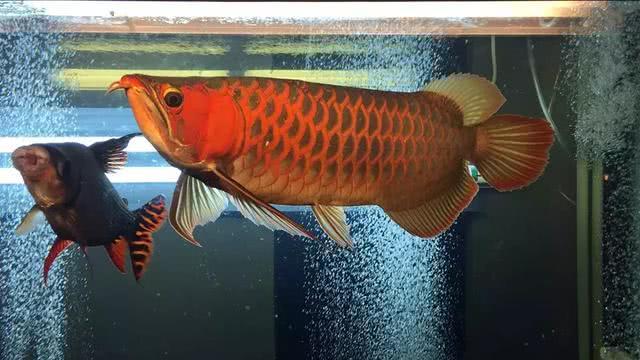
Compared with other ornamental fish, arowanas have exceptionally large scales. When struck by light, the brilliance and color they reflect are more beautiful, which other tropical fish do not have, and at the same time the importance of color development is self-evident.
The principle of color development in arowanas (taking the red variety as an example):
What plays the main role in arowana color development are the pigment cells (chromatophores) in the dermis beneath the scales and the guanine on the outermost surface. Various cells are scattered throughout the dermis and can stretch and contract as light intensity and the environment change. The various pigment cells have the function of absorbing and reflecting light wavelengths. Therefore, in different lighting environments, arowanas will display a variety of different colors.
Many fish keepers ask, at what size does an arowana start to develop color?
There is actually no exact time. Generally, when an arowana reaches a body length of about 25 cm, there will be signs of color development beginning. Of course, the most important determining factor for arowana color development is still bloodline.
However, the effect of the environment on arowana color development cannot be ignored. Arowanas are veritable "chameleons". Whether golden arowana or red arowana, after the lights are turned on, the color development effect will be twice as good with half the effort, and the ornamental value will also be greatly improved. Many people have found through practice that the stronger the light and the longer the duration, the faster the arowana's color development will be. With long-term irradiation of the arowana's scales, the speed at which the frames appear will increase, and the colored area on the gill covers will gradually expand. Under conditions the environment allows, the arowana's color will also deepen.
Why fuss over lights when keeping arowanas?
1. Reasonable lighting can promote arowana color development
Arowana color development requires sufficient illumination. This illumination is not a cosmetic touch; it is effective output of ultraviolet rays. Light irradiation can stimulate the production and accumulation of pigment layers, promoting fish growth and color development, provided of course that it has a sufficient bloodline to guarantee it.
2. High-quality lighting and correct placement can prevent arowanas from dropping their eyes and from uneven color development
Whether the arowana light has strong penetrating power, whether the light-emitting area is large, and whether the distribution is even are all very important. Lighting that is too strong will stimulate arowanas to drop their eyes. You can imagine looking directly at the sun at noon. A soft color-inducing wavelength band is very important for lighting!
Lighting that is too strong will cause eye drop, and incorrect placement of the lights will also cause eye drop. Using only an underwater light will cause overly strong side illumination. The common problem is also first swimming to one side, then eye drop. Sometimes arowanas also develop bilateral eye drop even when we do not use an underwater light; this situation is often caused by top lighting that is too strong. Underwater lights are best used together with top lights to ensure uniformity of the lighting environment inside the aquarium and avoid the occurrence of eye drop.
If the position of the lighting fixture is not properly arranged, it can also cause one side of the arowana's body color to be darker and one side to be lighter. Usually this problem can be solved by pairing one underwater light at both the front and rear sides of the aquarium.
3. Safe electricity use
Using lights in an aquarium involves electricity and water. Electrical safety is very, very, very important!
It is necessary to ensure that the arowana light uses reliable materials, has overvoltage protection and unstable current protection, and prevents damage from poor contact of the lamp tube; the lamp tube has a highly sealed design, can be used both in water and on land, and is waterproof and leak-proof; it is high-temperature resistant, resistant to collision and breakage, and reduces heat generation from the lamp body; the plug and wires meet standards; and it has a waterproof protective sleeve.
If the lamp tube temperature is too high, it will severely test the quality of the lamp tube. Once leakage occurs in the aquarium, besides the whole tank of fish being threatened, household electrical safety will also be affected! Ensuring continuous and stable light output from the lamp tube, extending service life, and being safe and reliable, this is very important!
4. Others
For example, the suction cups of the lamp tube are strong and effective, which can ensure that the lamp tube stays in any position without falling off; because aquarium lamp tubes are used for long periods, it is necessary to ensure they are highly efficient and energy-saving, low-carbon and environmentally friendly.
If you want to identify whether a light is good or bad, you can turn on your phone camera, point it at the aquarium, and observe whether the light in the aquarium has screen flicker. A good light does not flicker.
How long should arowana lighting be kept on?
It is still best to stay close to nature and divide day and night. If you want to pursue faster color development, you can slightly increase the time and intensity of the light, but do not strengthen it too much. Let the fish have a process of adaptation, and the ecological clock does not need to be changed too much. If an arowana achieves good color development through long-term intensified light irradiation, it will also inevitably decline after a long time, the same principle as baking color in golden arowanas. Nothing should be forced too much.
Of course, factors such as feeding and water quality are also greatly related to arowana color development. I hope the vast number of fish keepers can reasonably apply every detail, so that in the end their own fish all achieve the color development they are most satisfied with. But, the effect of good lighting on arowanas is visible to the naked eye!
[Statement: This article comes from the internet, and the copyright belongs to the original author. If it infringes on your rights and interests, please leave a message to contact us for deletion.]