Mount Fuji succulent looks like a light bulb, do you know it? Flower-growing tips shared
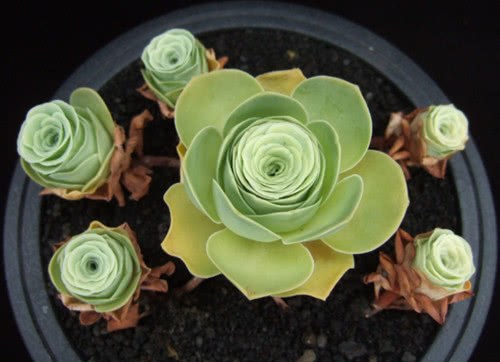
In spring, all things revive, and rare flowers and exotic plants bloom in competition, adding infinite joy to an already beautiful life. People seize the opportunity to buy all kinds of flowers and small succulent plants to cultivate, to cultivate their sentiments and beautify the environment. But have you planted a beautiful little succulent plant like a light bulb?
1. Mountain Rose
Mountain Rose is a general term for succulents formerly in the Crassulaceae family, genus Mountain Rose, now classified under the genus Aeonium. Its growing season is in spring and autumn; when the winter temperature is below 5°C, growth slows or stops. The root system of Mountain Rose is relatively tough, and the "water thoroughly when dry" method can be used, or bottom watering can be used, but the time should be short. Propagation methods include division, sowing, and cuttings. Beheading cuttings are suitable for autumn. The potting soil is generally a mix of garden soil or peat soil, volcanic rock, and perlite. The flowering period of Mountain Rose is from late spring to early summer, with racemes and yellow flowers, very beautiful. After flowering, as the seeds mature, the mother plant gradually withers, and offspring continue through side shoots at the base of the plant.
2. Mount Fuji
Fuji succulent belongs to the Crassulaceae family, genus Pachyphytum. The leaves have a faint white powder, and the leaves are arranged in a small rosette shape. Around February to March each year, behead it; after beheading, dry the wound, care for the stem normally, and buds can appear in about two weeks. When the young seedlings grow to more than 2cm, cut them off, dry them for about a week, and place them in a shaded area. When the soil is completely dry, bottom water it, keep the soil slightly moist, and after rooting, normal care can be resumed. After the seedlings root, bottom water them shallowly once every ten days to half a month; do not soak through, as too much moisture will cause root rot. When Mount Fuji blooms, the rosette extends upward and sends out an inflorescence; it is a variety that dies after flowering. To prevent the plant from dying, the flower spike can be removed in the early flowering stage.
3. Miracle of Spring
Miracle of Spring, also called fuzzy-leaved sedum, like many succulent plants, has thick and plump leaves. Miracle of Spring grows extremely quickly and can grow rapidly in a short time. During the growing season, keep sufficient sunlight to ensure the plant's absorption through photosynthesis. In summer, because outdoor sunlight is strong, try to place it indoors for care and pay attention to shading. Miracle of Spring is relatively drought-tolerant; watering twice to four times a month is enough. The flowering period of Miracle of Spring is from February to March, and the flowers are pink, very cute.
4. Millet Star
Millet Star is a perennial succulent herbaceous plant. The plant grows upright and clustered, with fleshy stems, and the stems of perennial plants gradually become semi-lignified. The fleshy leaves are gray-green to light green, with slightly red leaf margins. It needs a sunny, cool, and dry environment. It tolerates partial shade, fears waterlogging, and avoids stuffy heat and humidity. It has the habit of growing in cool seasons and going dormant in high summer temperatures, and can tolerate low temperatures of around minus 2°C. The flowering period is from April to May, with white, star-shaped flowers, clustered, often blooming all over the branches, quite gorgeous, and it will not die after flowering.
Besides these four lantern-like little succulent plants, what others do you know? You are welcome to share your views in the comment section below. If you like this article, you might as well subscribe, and more wonderful articles will be shared with you.