A four-season flowering plant with flowers that look like peonies - is there any plant that is easier to grow than it?
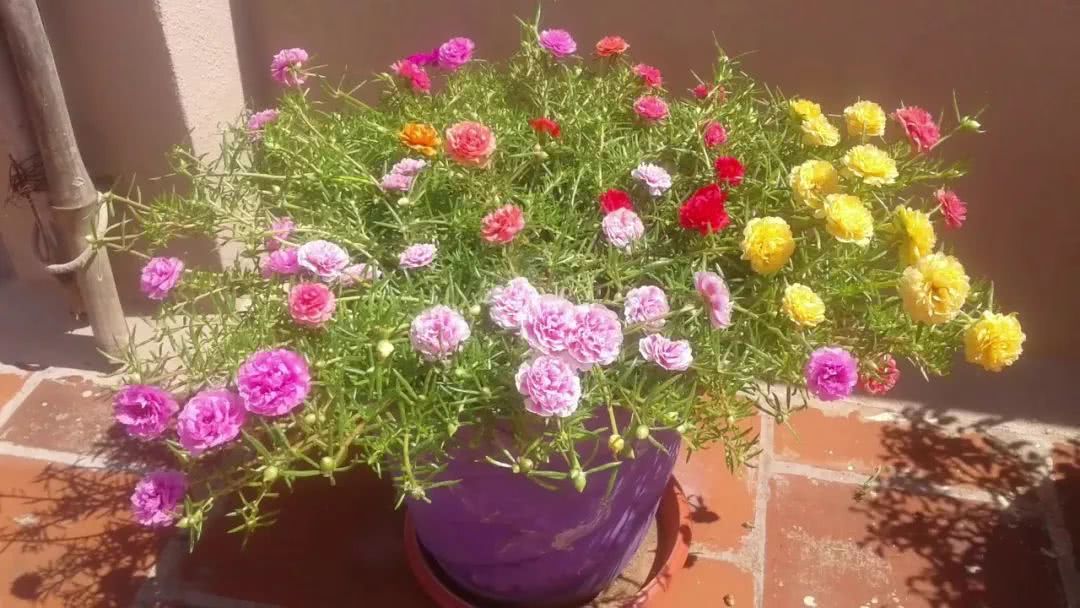
Some friends have already guessed which plant I am talking about. It is the moss rose, also called purslane, a particularly resilient four-season flowering plant. As long as it is given a year-round warm, slightly moist environment and plenty of sunlight, the moss rose will keep growing and blooming, and its flowers basically never stop.
The leaves and stems of the moss rose are very succulent, which is why it is so drought-tolerant. Even if you often forget to water it and it gets sun every day, the moss rose can still grow vigorously, and it will produce even more flowers. Compared with other potted flowers, it is far easier to grow.
The moss rose actually has a great many varieties, in all different colors, including the common pink, yellow, red, orange, white and purple, as well as some mixed-color varieties. The flower shape resembles a miniature peony or rose.
There are nearly a hundred varieties of moss rose, including the common large-flowered purslane. In some places, although the moss rose is grown as an annual, it can self-seed and reproduce; the seeds fall to the ground on their own, take root and sprout by themselves, and it easily grows into a large patch.
Moss rose plants generally grow to more than 20 cm tall. Of course, if they are not pruned properly, their branches will keep growing and may even cover the entire ground; it is only a matter of how long it takes.
The moss rose needs more than 6-8 hours of light each day, as this is what allows it to grow most vigorously and bloom more beautifully. Without light, the moss rose can still grow, but it will be very difficult for it to bloom. Many friends may have noticed that on cloudy and rainy days the moss rose basically does not bloom, and at night its flowers close up. It only blooms when there is sun, so its name truly fits.
To grow moss rose, you can choose to sow seeds directly. Scatter the seeds directly into the soil, cover them with 2-3 cm, water to keep the soil moist, place them in a spot with scattered light, and keep the temperature at around 20 degrees. They will sprout in a few days. Water the seedlings carefully to avoid knocking them over, and in two to three weeks they will grow into sturdy plants.
Next, the moss rose will keep producing branches. You need to cut off some of the weaker branches. When the main stem grows to 15 cm, pinch off the top, remove the tender buds at the top, and do not keep any flowers either. Do not worry that the moss rose will die; as long as you avoid waterlogged soil or freezing, it is basically impossible to kill.
After three to four weeks of care, the moss rose will begin to bloom continuously. After that, if you want it to grow even more vigorously, you can keep pinching off the tops; as soon as the branches grow a little longer, cut them off. This promotes continuous branching, and the cut branches can be stuck directly into the soil and will survive.
To grow moss rose, use loose, fertile, well-drained soil, not heavy soil with poor drainage. The moss rose is extremely drought-tolerant, and it is completely fine not to water it for a while, but it will grow better with regular watering. Avoid waterlogged soil, and do not water directly onto the flowers, otherwise the flowers are likely to become deformed.
After that, propagating the moss rose is even simpler. You can directly cut off branches of the moss rose and insert them into the soil together with the flowers; it does not matter. It is one of the few plants I have seen that can be propagated by cuttings without removing the flowers. The flowers can still open normally the next day, all because its branches and leaves are full of water.
The moss rose has very few pests and diseases. If it is overwatered, it is prone to aphids, and a humid environment easily attracts snails and slugs. So the most suitable approach is to water only after the potting soil has completely dried out each time.
The moss rose is also very suitable for planting in the yard. As a great ornamental garden plant, it can creep along the ground. The plant is short, its ornamental value is especially good, it is easy to care for and needs no management, and its flowering period is especially long.
Some friends say that the moss rose they grow at home blooms very little. It is very likely due to a lack of pruning. You should pinch off the tops often, give it as much light as possible, and in spring and summer you can give it a dilute organic fertilizer solution once every 2-3 weeks, which can also do a good job of promoting flowering.