Pruning techniques for potted shrubs are the most basic skill for any gardener.
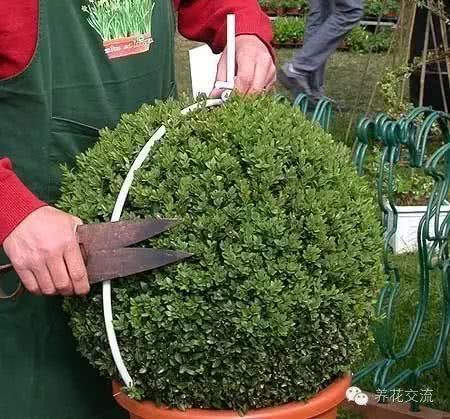
Trees trimmed into specific shapes are becoming increasingly popular. One reason is that today's courtyards are getting smaller and smaller, so tall, large trees cannot be planted; small trees trimmed into special shapes can then highlight the character of the garden.
For example, an evergreen tree clipped into seven or eight small round balls can visually pass for a dense, old shade tree.
In addition, in cold regions, when winter is bleak and bare, small trees clipped into patterns can also stand out in the garden.
I. The History of Shrub Pruning
Shrub pruning has a long history. In the gardens of some villas, trees have already been clipped into various animal shapes or specific forms.
In parks, trimmed tree shapes are also often used to achieve a focal point or to beautify the space. It is just that in recent years it has also begun to be adopted by ordinary households in their front and back yards.
In fact, the art of pruning trees has long existed in our country, allowing trees to appear appropriately within a larger environment. Besides matching in size, it has also evolved into small bonsai; for example, a small juniper whose foliage is clipped into clusters shaped like clouds is a miniature form of shrub pruning.
II. Which Common Shrubs Need Pruning?
The trees commonly used for trimming are mainly evergreens. The leaves should be small and dense, or needle-like, to be suitable. Large-leaved trees are not suitable.
So the most common ones are boxwood, cypress, yew, juniper, crape myrtle, privet, small-leaved holly, euonymus, ficus, and so on.
III. How Do You Carry Out the Pruning?
Generally, these specially shaped trees are trimmed and sold by garden centers; designing and trimming one yourself is relatively difficult. This is because it requires special training and an artistic eye, which not everyone can achieve.
However, even if you buy an already-trimmed tree, you still need to regularly trim it back to its original shape, otherwise the branches and leaves will quickly grow out in all directions and it will lose its original appearance.
If you are making a shrub topiary yourself, you can, as in the attached illustration, keep the leaves you want and cut away the branches and leaves of the remaining parts. At first the leaves will be very sparse, and you will have to wait one or two years, or even longer, before the leaves reach the shape you want.
IV. The Various Shapes of Pruning
1. Upright shape pruning
Some trees do not have many side branches, such as broadleaf trees like boxwood and privet, and these can be pruned along a single trunk, upward, into a vertical tree shape.
The simplest is a single trunk with all the side branches cut away, and then the leaves at the top clipped into a round ball shape. This type is called the lollipop shape. You can also leave several side-branch positions at intervals along the trunk, keep the leaves on these side branches, and clip them into round shapes one by one.
When first clipped, the branches and leaves may be relatively sparse; the more frequently you trim, the faster the branches and leaves will grow in densely.
For this type, you only need to occasionally trim the round ball, or half-round ball, at the top back to its original shape. The more frequently you trim, the easier it is to maintain the original shape.
2. Spherical shape:
Another common type of tree trimming is to clip the leafy parts into round balls one by one. This type is suitable for evergreens with many side branches, such as juniper and cypress; those whose branches spread out in all directions are more suitable, and the small round balls sit on each branch, which is very aesthetically pleasing.
A method between the upright and the spherical style is to choose an upright evergreen, keep the main trunk but also retain the side branches, and then clip the foliage at the tips of the branches into round balls.
3. Spiral shape:
Another method is the spiral cut, using the main trunk as the axis and cutting a spiral pattern along the main axis. This type of plant must have only one main trunk and many horizontal side branches covered with leaves.
Cutting a spiral yourself is also easy: first cut the whole tree into a neat pointed cone shape, and only then cut the spiral pattern. The proper way is to cut from the top down; when cutting the spiral, cut the groove close to the trunk so that the groove is obvious, but be careful not to cut into the bark.
4. Other shapes:
This type is left to the owner's creativity to cut into any shape. Most people choose to cut them into animal shapes or various geometric figures.
If it is a complex animal shape, you must first wrap wire around the tree body to make the figure, and then, following the shape of the wire, cut away the excess parts. If there are gaps that are not filled, you have to wait for the branches to continue growing to fill them in. So it is not necessarily possible to see the shape you need immediately.
The trees most suitable for trimming into different shapes are still boxwood, privet, and the like, because their branches are soft and their leaves are small and numerous, making it easier to "shape" them.
V. When Should Shrubs Be Pruned?
Landscape shrubs must be pruned regularly, otherwise they easily lose their proper shape. For generally rougher figures, they should be pruned at least once a year; if it is a fast-growing species, it may need to be cut several more times.
Just like trimming a hedge, you cannot put it off too long. For some more delicate patterns, such as animal patterns, you should even trim once every 3 to 4 weeks, otherwise they easily become deformed.
Usually plants begin to grow in March and April, and by May and June they have already begun to "lose shape." Therefore it is best to trim once in June. If you trim too early, the leaves and branches are too tender and you may damage the branches, so the first trim each year should be after mid-June.
Then, if necessary, trim once more in autumn. Some plants grow faster, so they must be trimmed more frequently. If you wait until they are too deformed before trimming, it may be difficult to cut them back into their original appearance. As for some spherical patterns, you can trim them from time to time to keep the shape unchanged.
When trimming for the first time, it is best to cut only a little each time, then stand farther back, look carefully, and only then continue cutting, so as to avoid cutting too much at once and making a mistake.
If the figure is too large, the leaves inside may wither because they cannot get sunlight. Therefore an overly large figure may not be able to be maintained for very long, or it may become hollow. So it is best to avoid overly large figures.
Once shrub leaves have been trimmed, there are sometimes fewer leaves, which affects photosynthesis, so you must pay attention to their health. First, they must be planted in a spot with ample sunlight; do not let the soil become too dry in early spring. In late autumn, it is best to spread a layer of mulch or organic soil on the soil surface.
If it is potted, pay attention to whether the pot is large enough, so that the branches do not lean to one side. Be careful that the potting soil does not dry out completely; it is best to replenish the soil surface with better soil from time to time. When potted, it is best to repot into a larger pot every two years.
VI. How Do You Prevent and Control Pests and Diseases?
As mentioned earlier, trimmed trees may have photosynthesis slightly affected, but otherwise there are no special pests or diseases.
However, because many trimmed trees are boxwood, and boxwood sometimes gets leaf blight, which is caused by fungi, if it is not treated after infection it will spread and cause large areas of leaves to wither.
Once discovered, all diseased leaves must be cut off, and they must be isolated, meaning they must be thrown into the trash bin, not the compost bin.
Diseased leaves on the ground must also be dealt with immediately; do not leave them on the ground, because they will all spread the disease. Then spray a fungicide on the plant. (The image below shows the result of leaves turning withered and the interior drying out.)
To avoid the leaves becoming diseased, in addition to maintaining good ventilation and ample sunlight, you should also avoid planting in places with strong north winds. In addition, when the leaves are too dense, you can prune the central part so that sunlight can enter.
In the early stages of trimming, the problem may be that the leaves are not dense enough, but after the shape is formed, the problem may be that the leaves are too dense. Handle it according to the situation.