Move your succulents to the balcony this season and they will grow beautiful and sturdy
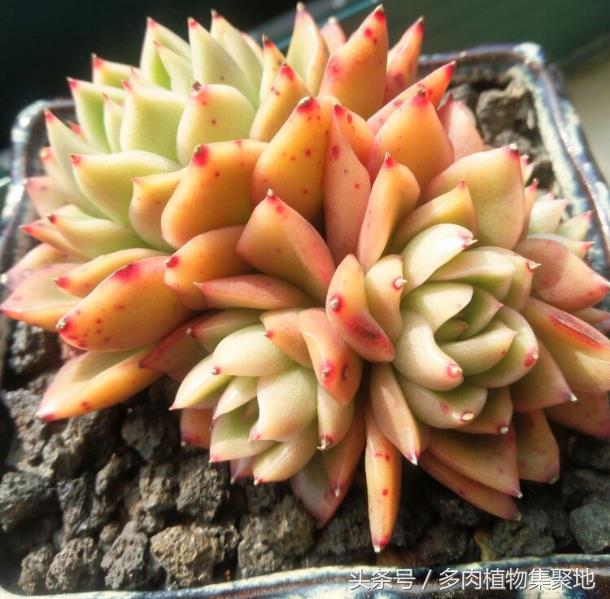
Temperature has an important effect on succulents changing color. Generally speaking, coloring happens faster in a low-temperature environment. Why is that? Chlorophyll is not resistant to low temperatures. After the temperature drops, there is less and less chlorophyll in the leaves, and then new anthocyanins are synthesized to resist the cold weather and enhance the plant's cold resistance. This is a form of self-protection. Another reason is that dark colors absorb more light energy, and the same goes for plants. In order to gain more heat and raise their own temperature, they may turn their leaves a darker color.
Using light to color succulents is the most common method and also the fastest to show results. Many growers who keep their succulents outdoors find that after just a few days of sun, the beautiful colors already come out. In autumn and spring, when the temperature difference is large, move the succulents outdoors. Within just a few days, the succulents can grow very beautiful and very sturdy. If you keep succulents indoors, however, the color change is slower, and with the glass blocking the sunlight, the leaves of the succulents will stay relatively green.
If you want succulents to look good, they need long-term buildup. A watering rhythm of big swings makes the leaves grow uneven in length, and once pests, frost damage or sunburn leave scars, a very long cycle of metabolism is needed until they recover. In addition, air humidity and ventilation need to be considered together. Generally speaking, winter does not have such high ventilation requirements, so apart from airing them out at noon on sunny days, they can stay enclosed the rest of the time.
Compared with growing and propagating succulents, sowing succulents is generally done in spring and autumn. The reason these two seasons are suitable is that the best sowing temperature for succulents is between 20°C and 25°C. If the temperature is too high, the seeds rot easily, and even if they germinate, the seedlings easily turn to mush.
Of course, people today are very capable of changing the environment. If you can provide a constant temperature, then it does not matter what season you sow in. If you cannot, then you still need to consider the sowing season. Of course, the range of succulents is very broad. What we discussed above is mainly Crassulaceae. If you are sowing cacti and the like, you can also sow in summer.
When a plant has just been potted, the roots will inevitably be damaged, so acclimating the seedling is really about acclimating the roots. When the roots have not fully recovered and cannot normally absorb nutrients and water, the plant will rely on consuming the nutrients stored in the outer old leaves to maintain normal physiological functions and the growth of new tissue. So what shows is that the stems and leaves are limp, and the outer old leaves gradually shrivel and fall off. At this point you do not need to worry at all that something is wrong with the plant's health. Once the roots recover, the old leaves will stop shriveling and dropping, and then the plant's growing points will begin to show activity and start growing.
This is a gathering place for succulent lovers, sharing succulent care tips. Welcome to follow and join the discussion.