A new concept for orchid growing media: choosing the right medium is key
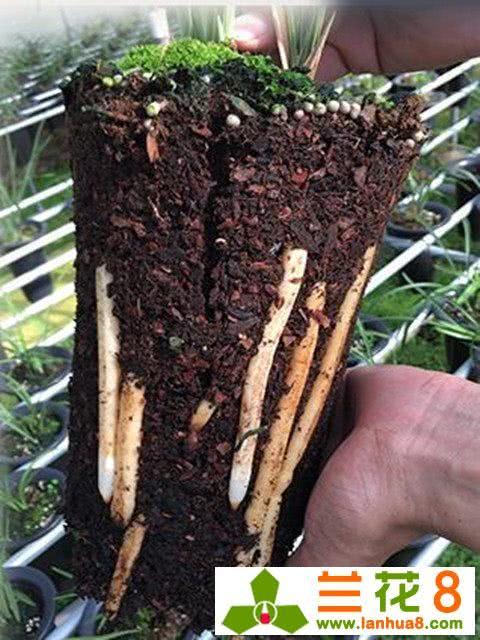
You cannot grow orchids without growing media, so the discussion about growing media never stops, and the related writings are as numerous as ox hairs. There is really no need to add more words here, but over five years I have tried many types of growing media for orchids, and it has been a mix of joy and worry. To this day, I have a little less reverence and a few more doubts, and I cannot keep them to myself.
1. Drainage and aeration - the longstanding standard for orchid growing media
Looking across all the discussions and explorations of growing media, "drainage and aeration" has always been the "four-character true scripture." This is because orchid roots are fleshy roots, and stuffy, wet conditions very easily cause orchid root rot, leading to failure in orchid growing. Almost every orchid grower has experienced lessons in this regard. In my first three years of learning to grow orchids, I often made this mistake. Even today, sometimes I still cannot help making it.
Around "drainage and aeration," people have chosen all kinds of growing media and explored all kinds of ratios, all with success, and they have classified growing media as hard, medium and soft for orchid growers to imitate, but beginners often have to go through failure before succeeding. I know an orchid grower, Mr. W, who has more than 100 pots of orchids, and after more than ten years he is still troubled endlessly by growing media. When he first learned to grow orchids, he heard that red soil was good, so he used red soil for all of them, but the result was not ideal and many orchids died; later he used Xiantu plus willow bark, but because it was crushed too fine and he had too many pots, watering often did not penetrate through; later still he used coarse particles of Xiantu plus willow bark, but in summer evaporation was too fast and he had to water almost every day, often so tired that his back and waist ached. With the slightest slackness, the water would not penetrate, and he could only soak the pots; now he is adding vegetable garden soil to the growing medium, and no one knows how that will turn out. Over these years, it is fair to say that he has not succeeded with growing media for orchids, and naturally the returns have not been very good either. It is said that at the beginning he took out a loan to grow orchids, and to this day he still owes nearly 1 million yuan. If judged by the principle of "drainage and aeration," he should have been most satisfied when using coarse particles of Xiantu plus willow bark, but he grows orchids on a rooftop, watering frequency increases in summer, and he is busy dealing with it from morning to night. Where is the pleasure in that, let alone cultivating the mind.
As it happens, an orchid grower surnamed J, purely a hobbyist, does not really understand that growing media need "drainage and aeration" at all. His growing media are all a hodgepodge begged from here and there, and one third of it is dust. This year he used it to grow orchids on a balcony and succeeded. The shoot production rate per single plant was more than two shoots, and the roots grew well too. But his growing medium truly cannot be called "drainage and aeration," which left W stunned, not knowing whether to laugh or cry.
2. How much water to drain and how much air to let through - the confusion of orchid-growing beginners
People often say that using growing media well equals half the success of growing orchids. Experiences and lessons like those of the two orchid growers above happen again and again, so why exactly is that? First, it must be reaffirmed that orchid growing material must "drain water and let air through." There is nothing wrong with that; it is determined by the characteristics of orchid roots. The key to the problem is how much water to drain and how much air to let through is most suitable?
This question should have arisen after orchids were first failed at in home cultivation. But after more than a thousand years, orchid-growing beginners today still do not think about this question. Because although it is the most direct and simple, it is a matter of rational reflection, not a sensory appearance, and without several years of practice it cannot be understood.
If we associate this a little further, we will make new and different discoveries. In daily life, we often grow orchids and also grow other flowers, grasses and trees. Orchids need to breathe through their roots; do other flowers, grasses and trees need to as well? The answer is yes. Orchids fear long-term dampness; do other flowers, grasses and trees fear it? The answer is also obvious. In other words, other flowers, grasses and trees, like orchids, also need "drainage and aeration" in their growing media. This is the same as with people: whether men or women, old or young, yellow-skinned or white-skinned, they all belong to the primates and naturally share common attributes, and in "clothing, food, housing and transportation" there will not be too great differences. Orchids and other flowers, grasses and trees all belong to plants, and air, sunlight, water and nutrients are all needed by them, and likewise none can be missing. If in nature, orchids may have no other demands for their living conditions than other plants. It is only after they arrive in human homes, especially when not planted in the ground, that differences certainly appear. Because a handful of soil cannot hold water and store air, still less contain heaven and earth, and people need to pamper and care for them more.
How much water drainage counts as just right, and how much aeration is most suitable? There has never been a fixed standard or accurate measure. For an orchid expert, one look and one touch is enough to know, while for an orchid beginner, it may take several years of exploration and paying a certain amount of tuition before it can be done. Because this involves many factors such as environmental temperature, humidity, pots and orchid species, and fully and thoroughly considering and handling their interrelationships requires experience and lessons.
3. "Drainage and aeration" and "moisture retention and clinging to soil" - a new concept for orchid growing media
"Drainage and aeration" often gives people an illusion, making them think that orchid growing media should strive for drainage without paying attention to moisture retention, and strive for aeration without paying attention to orchid roots "clinging to soil." (Clinging to soil is a saying from my hometown. It holds that plants are born and grow in soil, and if roots do not combine with soil, they become a tree without roots and will not survive well.)
And people make the greatest effort to drain water and let air through, so that orchids often cannot get a sufficient water supply and their growth is affected, and orchid roots do not "cling to soil" and root formation is affected. I suddenly remember once talking on QQ with Xiaoye Orchid Garden about whether plastic pots for orchids need added aeration holes. He thought it was not advisable to enlarge or increase the aeration holes. At the time I was deeply influenced by the theory of "drainage and aeration" and did not agree, but thinking about it now, it makes quite a lot of sense. Especially for growing orchids on balconies and rooftops, it may have its rationality and applicability.
How can orchid growers, whether beginners or veterans, accurately grasp the key points of orchid growing media? I believe the following points should be achieved.
1. Learn to think dialectically about problems and return to the inherent nature of orchid survival.
From the above, it is not hard to see that overemphasizing "drainage and aeration" has a suspicion of overcorrection. In fact, every orchid grower is reenacting a practical course that people have followed for thousands of years in growing orchids: from not knowing - knowing very little - being familiar with it - blending with it. This is like how the embryonic development of a human reenacts the evolutionary process of humankind. If you do not pay attention to changing your thinking and concepts, but merely repeat what the book says and follow what others say, then even if you have grown orchids for twenty years, you still count only as a beginner, like the orchid grower W mentioned earlier. If you do not worship only books or only superiors, and pay attention to accumulating your own bits and pieces of experience and lessons, you will certainly quickly become an expert.
Starting from the common characteristics of plants, I believe orchid growing media should achieve "drainage and aeration" and "moisture retention and clinging to soil." Because orchid roots are fleshy and orchid leaves are leathery, and in addition they have relatively large pseudobulbs that can retain a certain amount of water, but if the growing medium is too drainage-oriented and aerated, it is also not good for orchid growth. Water is the source of life, and orchids, as green living beings, naturally cannot leave water. Therefore the growing medium must have a certain water-retention capacity. People often see some orchids growing very vigorously, and this is related to the moderately appropriate water retention of the growing medium. Only moderate "dryness," in other words, only moderate "wetness," that is, "moisture," can grow orchids well.
2. Establish a new standard for orchid growing media
For a long time, people have divided growing media into three major categories: hard, neutral and soft, or into two kinds: organic and inorganic. These classifications themselves are not wrong. It is just that the key to the problem has not been found. "Watering takes three years of skill," and the hardest part of growing orchids is watering. If we think from this angle and change the banner of the standard for classifying orchid growing media to water retention, then we will certainly arrive at a distinctive classification. I think it can be divided into three kinds: wet-type, moist-type and dry-type growing media. Wet-type growing media refers to growing media whose water retention is especially good, such as pure pine needle soil, sphagnum moss, etc.; moist-type growing media refers to growing media whose water retention just appropriately meets the growth needs of orchids, such as an appropriate ratio of Songli Wang, Xiantu, snake wood, fired soil and Er leaves; dry-type growing media refers to materials whose water retention is relatively poor and cannot meet the normal growth of orchids within a certain period, such as small stones, fired soil and other growing media.
Of course, there is an important factor worth considering here - the orchid growing environment. Different growing media in different environments may be classified into the same type of growing medium, and the same growing medium in different environments may also be classified into different types. For example, when small stones are used to grow orchids, if on a rooftop or balcony they may be classified as dry-type growing media, while if in a greenhouse or planted in the ground, they may be regarded as moist-type growing media.
Establishing standards and classification methods in this way is not my momentary whim or odd innovation, nor is it novelty-seeking to court attention. Its advantage lies in drawing orchid growers' focus and main effort to the fundamental issue of growing media, without overcorrecting. It keeps people always thinking about the eternal proposition of orchids and water, and makes people strive to explore how to make soil-cultured orchids achieve twice the result with half the effort and obtain more and better results. The most practical benefit is reducing water use and labor.
3. Choose suitable moist-type growing media
Different orchid growing environments have different requirements for growing media. In short, they must drain water and let air through, retain moisture and cling to soil. This requires each orchid grower to decide according to the specific situation, and it cannot be generalized. Below I will discuss a little of my own experience and lessons in balcony orchid growing.
(Basic situation) Environment: urban building balcony, semi-enclosed. Humidity: annual average 60. Temperature: 5°C in winter, 30°C in summer. Growing media: Xiantu, snake wood, fired soil, Songli Wang. Orchid species: Chun Jian, Chun Lan, Lian Ban, Xia Lan, Hui Lan. Pots: clay pots, plastic pots.
(Lessons) 1. Using clay pots, they dried too fast in summer; 2. Switching to plastic pots, the pot surface dried too fast in summer, increasing watering frequency, while the bottom was very humid, orchid roots rotted, and Da Xue Su seedlings collapsed; 3. Using pot-surface water, orchid leaf tips scorched.
(Improvement measures) 1. Add aeration holes to plastic pots; 2. Use a taller hydrophobic cover inside; 3. Fill the bottom with stones below; 4. Allow dust in the growing medium; 5. Cover the pot surface with sphagnum moss; 6. Add a water storage tray; 7. Soak the pots once every half month.
(Effect) Orchids grow normally, especially rooting is good, and the crystal tips of the roots have not shown blackening, for example, this year's new shoots of Jian Yang Die can be expected to grow into large seedlings. There are many flower buds.
(Experience) 1. Songli Wang growing medium is good for orchids, and adding Xiantu is even better; 2. Plastic pots should emphasize pot-surface moisture retention, and a certain amount of fine soil or sphagnum moss can be used; 3. Large-particle Xiantu and Songli Wang are generally not used to fill the bottom of orchid pots; snake wood or stones can be used, because after being soaked through they hold too much water and easily rot roots; 4. Mix large and small particles and use them without layering, so that orchid roots fully cling to and fit the soil.
(Still existing shortcomings) 1. In summer the pot surface and pot bottom have inconsistent humidity, which is difficult to solve under natural conditions; 2. Single seedlings' new shoots grow slowly; 3. Balcony dust is heavy, and washing leaves in summer is difficult.
(Conclusion) Striving to create the internal and external environment of moist-type growing media makes orchid growing basically successful, but it still needs continuous improvement.
The above are my shallow views, and there will certainly be many inappropriate points. I respectfully ask everyone to criticize and correct them. I publish orchid knowledge and pictures every day, taking you to understand orchids in depth and teaching you to grow orchids easily. If there is anything about orchids you do not understand, you can ask me at any time or leave a message below. If my knowledge has brought you help, I hope you can give me a like or repost it to help more people!