Why the pomegranate flower is praised as mature beauty
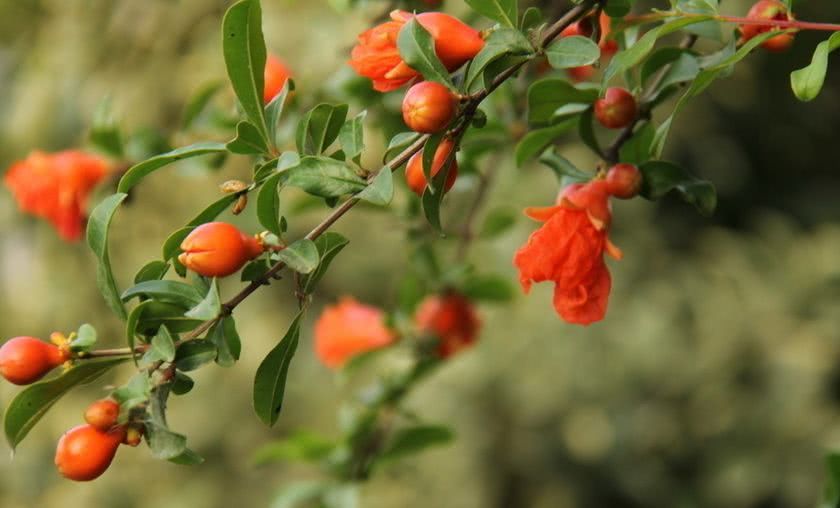
Pomegranate flower, the flower of the pomegranate, a deciduous shrub or small tree; it belongs to the genus Punica. The pomegranate trunk is grayish brown with flaky peeling, the young branches are yellow-green and smooth, often four-angled, the branch tips are mostly thorn-like, and there is no terminal bud. The pomegranate leaves are simple, opposite or clustered, oblong or obovate, and the new leaves are tender green or bronze. The flowers are borne several together at the branch tips or in the leaf axils; the calyx is bell-shaped, fleshy, with 6 lobes at the tip, smooth and waxy on the surface, orange-red, and persistent. The petals are 5 to 7, red or white, single or double. Pomegranate flowers are commonly propagated by methods such as cuttings, division and layering. They have medicinal value such as astringing to stop diarrhea and killing insects, and can be made into dishes such as stir-fried pomegranate flowers. Their flower language is: mature beauty, wealth and honor, and a house full of children and grandchildren.
Pomegranate flower
Also known as An pomegranate, golden poppy, golden pang, Tulin, heavenly syrup, pearl fruit, ruo pomegranate, dan ruo, shanli leaf and so on (the pomegranate flower needs the character for flower added). Family and genus: Punicaceae, genus Punica. Native to Iran and Afghanistan in Central Asia. The pomegranate flower is the national flower of the North African country Libya. It is also one of the city flowers of Zaozhuang City in Shandong Province, Shiyan City, Huangshi City and Jingmen City in Hubei Province, Xinxiang City in Henan Province, Xi'an City in Shaanxi Province and Hefei City in Anhui Province in our country.
The pomegranate flower is a bisexual flower (that is, monoecious), and depending on the degree of pistil development it is divided into complete flowers and incomplete flowers. Complete flowers are gourd-shaped or tube-shaped flowers, commonly known as "big-bottomed fruit flowers"; the calyx tube of incomplete flowers is trumpet-shaped, called "bell-shaped flowers" or "pointed-bottomed false flowers", and they cannot be fertilized to set fruit.
Pomegranate
The pomegranate is a deciduous shrub or small tree. The plant is 2 to 5 m tall, up to 7 m. The trunk is grayish brown, the young branches are yellow-green and smooth, with flaky peeling, often four-angled, the branch tips are mostly thorn-like, and there is no terminal bud. The leaves are simple, opposite or clustered, oblong or obovate, 2 to 8 cm long, entire, smooth on the surface, short-stalked, and the new leaves are tender green or bronze. The flowers are borne several together at the branch tips or in the leaf axils; the calyx is bell-shaped, fleshy, with 6 lobes at the tip, smooth and waxy on the surface, orange-red, and persistent. The petals are 5 to 7, red or white, single or double. The berry is spherical, yellow-red. The seeds mostly have a fleshy outer seed coat, and the fruit ripens from August to October. Cultivated pomegranate varieties fall into two main groups: fruit pomegranates and flower pomegranates.
The pomegranate flower is valued both for its flowers and for its fruit. Small potted plants are used for display on windowsills, balconies and in rooms, while large potted plants can be used to decorate public places and meeting halls; pomegranates planted in the ground are suitable for green landscaping in scenic areas.
Pomegranate flower
The pomegranate has a long history as a medicine, and it is recorded in various ancient medical texts. Through clinical practice, physicians of past dynasties held that the pomegranate is cool in nature and has effects such as clearing heat, detoxifying, strengthening the stomach, moistening the lungs, astringing the intestines and stopping bleeding. Among these, the most commonly used medicinally is pomegranate peel, usually applied after being fried. The pomegranate flower has the effect of stopping nosebleeds, vomiting of blood and bleeding from external injuries, and can also treat excessive white vaginal discharge. Used externally, it can treat otitis media. Tender pomegranate leaves strengthen the stomach and regulate the intestines, disperse food stagnation and aid digestion, and used externally they can treat eye diseases and skin diseases. Modern medical research holds that pomegranate peel contains "pelletierine", which has an inhibitory effect on various bacilli and skin fungi. Sour pomegranate contains more tannins, has an astringent and sterilizing effect, can treat diarrhea and dysentery, and can stimulate the appetite and aid digestion. The root bark of the pomegranate tree contains tannins and has the effect of expelling tapeworms and roundworms.