Pothos has very strong growth habits, no wonder it is called the flower of life
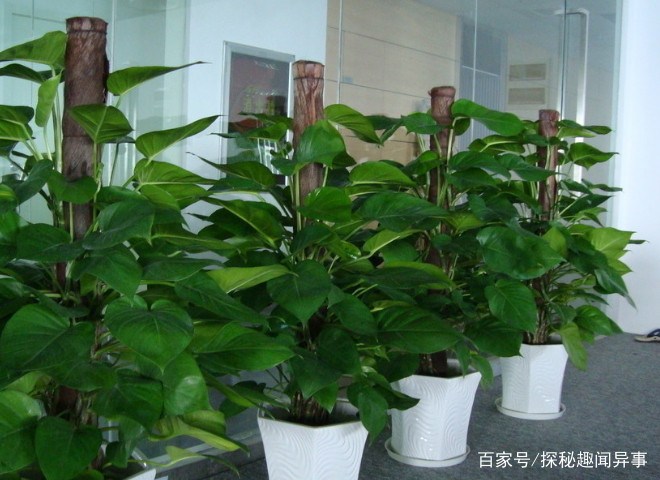
Pothos (scientific name: Epipremnum aureum), belonging to the genus Epipremnum, is a large evergreen vine that grows in tropical regions, often climbing on rocks and tree trunks in rainforests. It has strong twining ability and well-developed aerial roots, and can be grown in water.
On mature branches, the petioles are thick and strong, 30-40 cm long, slightly enlarged at the base, with the upper joint 2.5-3 cm long and slightly thickened, bearing a broad groove on the ventral side. The leaf sheath is long, and the leaf blade is thinly leathery, emerald green, usually (especially on the leaf surface) with numerous irregular pure yellow patches, entire, asymmetrical ovate or ovate-oblong, with a short acuminate apex and a deeply cordate base, slightly thick, slightly raised on both surfaces.
Morphological characteristics: Petioles 8-10 cm long, with sheaths on both sides reaching the top; the sheath is leathery, persistent, nearly 1 cm wide on each side at the lower part, gradually narrowing upward; the lower leaves are large, 5-10 cm long, the upper ones 6-8 cm long, papery, broadly ovate, short acuminate, cordate at the base, 6.5 cm wide. On mature branches, the petioles are thick and strong, 30-40 cm long, slightly enlarged at the base, with the upper joint 2.5-3 cm long and slightly thickened, bearing a broad groove on the ventral side. The leaf sheath is long, and the leaf blade is thinly leathery, emerald green, usually (especially on the leaf surface) with numerous irregular pure yellow patches, entire, asymmetrical ovate or ovate-oblong, with a short acuminate apex and a deeply cordate base, 32-45 cm long, 24-36 cm wide, with 8-9 pairs of primary lateral veins, slightly thick, slightly raised on both surfaces, forming an acute angle of 70°-80° (-90 degrees) with the strong midrib, between which the secondary lateral veins are relatively slender, the veinlets are faint, and they are reticulate with the primary and secondary lateral veins.
Growing environment: Pothos is a shade-loving plant that prefers scattered light and is fairly tolerant of shade. It comes alive upon contact with water, and because of its tenacious vitality, it is called the "flower of life." The trailing green branches and leaves are very easy to please. When grown indoors, whether in pots or by breaking off a few stems for water culture, it can grow well. It can be allowed to climb on a column wrapped with palm fiber, or trained into a hanging form and placed in a study or on a windowsill, or simply potted and displayed directly. It is a beautiful flower that is very suitable for indoor growing.
Propagation methods:
Cutting propagation: Propagation uses cuttings and stem layering. Select robust pothos vines, cut them into sections with two nodes, being careful not to damage the aerial roots, then insert them into plain sand or coal cinder to a depth of 1/3 of the cutting. Water thoroughly and place in a shaded area, spray water on the leaf surface daily or cover with plastic film to maintain moisture, and keep the ambient temperature no lower than 20°C. The survival rate is above 90%.
Water cutting propagation: Pothos can also be propagated by water cutting with terminal buds. The method is: cut a tender, robust stem vine into a 20 cm to 30 cm section, insert it directly into a bottle filled with clean water, change the water once every 2 to 3 days, and it can take root and survive in more than 10 days. Because potted pothos is limited by the potting soil, after being cultivated for too long it is easy for the plant to age, with leaves becoming smaller and falling off. Therefore, after 2 to 3 years of cultivation, it must be repotted or pruned for renewal.
Variety classification:
Green-leaf pothos: The leaves are entirely green, without patterns or variegation.
Yellow-leaf pothos: The leaves are light golden yellow, and the leaf blades are relatively thin.
Variegated pothos: Variegated pothos refers to pothos whose leaves have patches of different colors. Based on the color and characteristics of the patterns, 3 varieties have been found so far.
Silver pothos: The leaves have creamy white patterns and are more robust than the original variety.
Golden pothos: The leaves have irregular yellow stripes.
Tricolor pothos: The leaf surface has green and yellow-creamy white patterns.