Its journey is to the stars and the sea
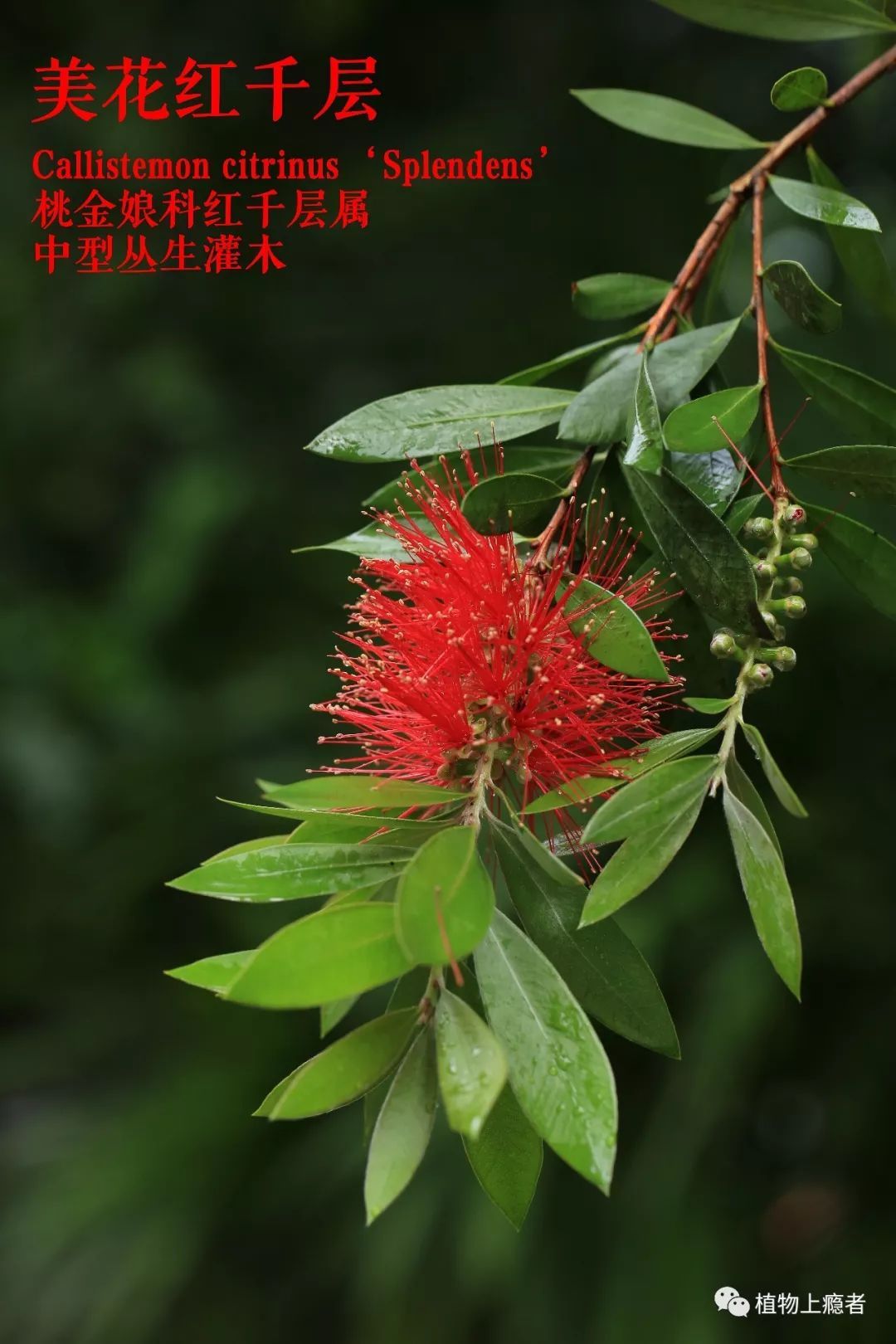
Last week, I saw the crimson bottlebrush (Callistemon) in bloom with my own eyes for the first time.
This plant is considered rare in Chongqing, not often seen. Its exotic and gorgeous beauty deeply conquered the hearts of onlookers. Every time I took my mom to see it, she couldn't help but exclaim again and again: This flower is so beautiful! So beautiful!
On a morning in the residential community, many elderly women buying groceries, exercising, or walking their grandchildren passed by it. Their reactions were exactly the same as my mom's: amazement, novelty, praise without end, but not knowing what flower it was. After I told them, they earnestly asked which characters the name was written with, and noted down the name.
Bright red is precisely the color that elderly people love most.
Shrub, taller than a person, much branched
The crimson bottlebrush is also known as the bottlebrush tree, or simply called the "toilet brush flower," which is quite vivid. Those red "bristles," one by one, are actually its stamens. The stamens are magnificent and completely overshadow the true petals in presence, which is a typical characteristic of the Myrtaceae family. The genus name Callistemon is composed of the Greek roots kallos meaning beautiful and stemon meaning stamen, referring to the extremely beautiful red stamens.
Stamens numerous, filaments red, 2.5 cm long, much longer than the petals
True petals do exist, but they are very small, green like the calyx, fuzzy on the surface, existing unobtrusively. After the stamens have all fallen off, they can be seen relatively clearly. The style is also red.
Petals 5, ovate, green
It has no pedicel; the stout calyx tube grows directly on the flowering branch, forming dense spike-like inflorescences. When the small flowers bloom in perfect unison, a bright red bottlebrush emerges. At first glance, some red brushes even look as if they have been sprinkled with gold powder, elevating the sense of splendor once again. I initially thought these were golden anthers, but upon closer inspection, they were indeed anthers, yet they only turned yellow after pollination. Before pollination, the anthers, like the filaments, are also red.
What is rather interesting is that at the tip of this brush there is also a cluster of tender leaves, which will continue to grow as the flowers bloom.
Spike inflorescence, borne at the apex of branchlets
Anthers dark red
Turn yellow after pollination
The one planted in the residential community is the showy bottlebrush (also called stiff bottlebrush), one of the cultivated varieties of the crimson bottlebrush (Callistemon citrinus).
I identified it through leaf characteristics, using the process of elimination. Among the several species of Callistemon introduced in China (mainly in South China), most have slender, linear leaves, while this one has broader, oblong leaves. Secondly, both its branches and leaves are hard in texture. Based on this characteristic, one can rule out species of the same genus with soft, drooping branches such as the weeping bottlebrush (Callistemon viminalis).
Branches and leaves both hard, hence also called stiff bottlebrush
Its flowers are beautiful in full view, while its leaves are beautiful in a winding, hidden way. Under the night light, I held up a leaf of the showy bottlebrush, and through the light, I suddenly discovered that the leaf surface was densely covered with bright little dots, like a vast sky dotted with stars. The edges of the leaf also sparkled as if inlaid with a ring of crushed diamonds. This unexpected discovery deeply amazed me and quite fascinated me as well.
In that instant, I was completely convinced by a sentence written by Mr. Han Shaogong: "A fallen leaf is a thousand-mile mountain range, or a ten-thousand-mile desert."
Mr. Han is a fascinating person. He once "took the corner of a barren slope ahead as his destination, booked a free boat ticket or free plane ticket, and thus overlooked Huangshan from a stone in his hand, discovered the Greater Khingan Mountains in the weeds, and touched the Pacific Ocean in a clear pool by a stone brook beside him"; "casually find some place to squat down, sit down, lie down, stay long enough, and with the help of gazing plus a little imagination, you can plunge into another splendid universe." As I grow older, I increasingly appreciate the pleasure of that "another universe" he describes.
Another universe
These bright little dots are actually oil glands. After crushing the leaves, one can smell a rich fragrance. Its species epithet citrinus means "lemon-scented." I crushed a few leaves to smell them and found the scent not much like lemon, but rather closer to the smell of eucalyptus leaves. The old leaves of the showy bottlebrush are hairless on both sides, but the slightly pink young leaves are densely covered with white soft hairs. It is said that each of its leaves can live 3 to 6 years, a very long lifespan.
Young leaves pink, fuzzy
The homeland of the genus Callistemon is Australia; the entire genus has 38 species, all native to Australia. Because they are deeply loved, countless hybrids and horticultural cultivars of the genus Callistemon have now been bred.
According to historical records, the original variety of the showy bottlebrush, the crimson bottlebrush, was one of the first Callistemon species to leave Australia and go out into the world. In 1789, the famous Sir Joseph Banks introduced it to London, England, and it subsequently spread rapidly throughout Europe.
Today, the genus Callistemon is already very common in California, Florida, and New Zealand. In China, the crimson bottlebrush is also a quite popular ornamental flowering tree species, and has now been listed by our great Chongqing as well as Shanghai, Guangzhou, Kunming, Shenzhen and others as one of the excellent new varieties for landscaping.
Besides the crimson bottlebrush, there is also the paperbark tree (Melaleuca). They are all called bottle brush, but to distinguish these two genera, looking only at flower color is risky. Because the genus Callistemon also has white-flowered species, and the genus Melaleuca likewise has red-flowered ones. The key to distinguishing these two genera is to look at one characteristic: whether the stamens are free or bundled. The stamens of the genus Melaleuca are bundled opposite the petals, while those of the genus Callistemon are usually separate and arranged in a ring.
Wild white callistemon, stamens free
Callistemon viminalis "Wilderness White"
Image: australianplantsonline
The golden paperbark (Melaleuca bracteata), very common in Chongqing and commonly known as "qiancengjin," is a kind of Melaleuca, but I have never seen them bloom.
Golden paperbark, stamens bundled
Zhang Yongmei. Photographed at Xiamen Botanical Garden
The article and plant images (unless otherwise credited) are all original works by the author
If you like it, please share. Thank you for your support ^_^
Plant Addict
WeChat ID: plantfiend
Discovering the unique beauty of every plant