The real secret weapon of succulent care is moist soil
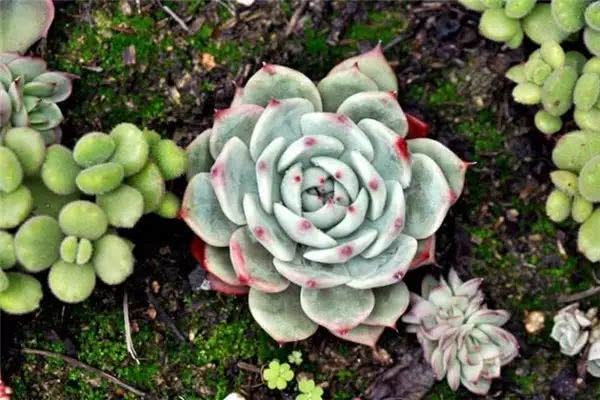
During stretches of consecutive rainy days, there is a lot of muggy, humid weather, which is especially hard on succulent growers in the Jiangnan region. In such weather, the rule of "water thoroughly when completely dry" seems to no longer apply.
Not watering is not an option, but the moment you water, the entire pot of soil turns soggy and takes forever to dry out.
If only you could pour in just a tiny bit of water and the whole pot of soil would turn moist. What is one to do?
Growers with some experience know that moist soil is actually a good thing. Becausemoist soil has several qualities that succulents really love.
First, there is moisture inside it, which means the succulent can drink water and the roots will not dry out from lack of water.
Second, the moisture content is just right, so the soil does not become overly wet and lose its air permeability.
Third, it can keep water in a state of being present but not quite enough, which stimulates the succulent's instinct to store water and protect itself from the sun, making it plumper and more beautiful.
So what kind of soil state is moist soil, exactly?
First, the soil needs to have moisture, with a clear damp feel when you grab it. Then, the soil particles should not stick to each other because of the water; after you squeeze it into a ball and let go, it should immediately fall apart, and your hand should not have soil crumbs stuck to it after grabbing the soil; after lightly patting your hands, others will not be able to tell you just grabbed soil without washing your hands.
Soils of different compositions have different water contents when in the moist-soil state. For example, yellow clay soil is always either mud (wet soil) or hardened dry powder (dry soil); it stays in a moist state for only a very short time, so yellow clay is not a suitable growing medium for succulents. Pure sand also does not easily show a moist-soil state; fine sand sticks together as soon as you water it, which is how sand sculptures are made, while sand with too-coarse particles can only hold a little water on the surface of the grains and quickly returns to a completely dry state.
Many succulent growers understand moist soil as being wetter than the moisture level succulents actually need. If you bury a hygrometer in moist soil, the hygrometer should show a humidity of 70%~80%. If the hygrometer buried in the soil already shows 100% humidity, then the moist soil is too wet and will not produce the effect we want.
We often hear about the method of potting in moist soil. Why pot in moist soil instead of watering after potting? Because it is very difficult to achieve the moist-soil effect by watering. So we can artificially mix the soil wet and then pot, creating a moist soil environment for the newly potted succulent.
By using the dough-kneading method of stirring while adding water, we can turn any composition of growing medium into moist soil, and this is very simple. But after potting, it is very difficult to create moist soil again, because you lack the means of stirring.
Growers who have kneaded dough know that after pouring water into flour, if you do not stir it, the water will not slowly soak into the flour, but will keep gathering where you poured it, forming a puddle, while the flour elsewhere is still completely dry.
Does flour not absorb water? Obviously it does. It is because the particles of flour are extremely small, which gives a huge number of flour particles an enormous surface area. The surface tension of water restricts the flow of water, preventing it from soaking into the flour and instead making the water gather into droplets.
Soil with too many crumbs, such as peat soil, is similar in form to flour, which makes it impossible for you to turn the soil into moist soil by watering only a small amount.
Another example from daily life is washing rice to cook it. For a pot with completely dry raw rice at the bottom, as long as you add a small amount of water, soon all the rice is wet.
The particle size of rice is just right; it not only does not restrict the flow of water, but also encourages the water film to spread along the gaps between the rice grains. However, raw rice does not absorb water, so the water all gathers between the grains.
This situation is just like wet sand. Either it is too wet and the grains stick together, or there is too little water and it cannot stay moist for long.
The moist soil we expect is actually more like cooked rice (assuming the grains do not stick to each other); there is no water between the grains, but there is a large amount of water inside the grains. As the water evaporates, the water inside the grains is continuously released, allowing the whole bowl of rice to stay moist for a long time.
So, if you want to create moist soil by watering, then the soil needs to meet two important conditions.
First, there cannot be too many crumb-type growing media, as this affects the ability of water to soak into the soil. Peat, coconut coir (long-fiber coconut husk is much better), plant ash and the dust of various granular growing media all count as this type.
Second, the particles in the soil must have internal pores, so that they can absorb the water between particles, preventing inter-particle water from sticking the particles together and turning the soil into wet soil. Akadama, Kanuma soil, pumice, diatomite, volcanic rock and the like all belong to this type of growing medium.
So when you find that your soil always needs a very large amount of water for every corner of the pot to have moisture, it means the soil has too many crumbs. As long as you add the internal-pore granular growing media mentioned above, they can significantly improve the situation where the soil is not easily soaked.
Akadama, which experienced succulent growers often strongly recommend, is a growing medium that very easily becomes moist soil.
Growers who have Akadama on hand can do an experiment together: fill a small black square pot with a small amount of Akadama, then pour a little water on the surface, not much. Then wait quietly for 10 minutes and tip the Akadama out. You will find that the whole pot of Akadama is in a very evenly moist state. This is the advantage of this lazy-person soil like Akadama: if you want to water it thoroughly, no problem; if you want the soil to become moist, no problem either, just water a little less. Unless the amount you water each time is too small, you will not get the situation where it is not watered through, so the top is wet and the bottom is dry, and the roots grow upward.
Akadama really is a very good thing; when mixing soil formulas, the water-absorbing and water-retaining abilities can be compared against Akadama. For growers who mix their own soil, if you are not sure whether your mix is good enough, you can also compare it with Akadama, and you will easily be able to judge the level of your soil mix!