Gardeners plant these plants on shelves, and the home easily transforms into a small garden
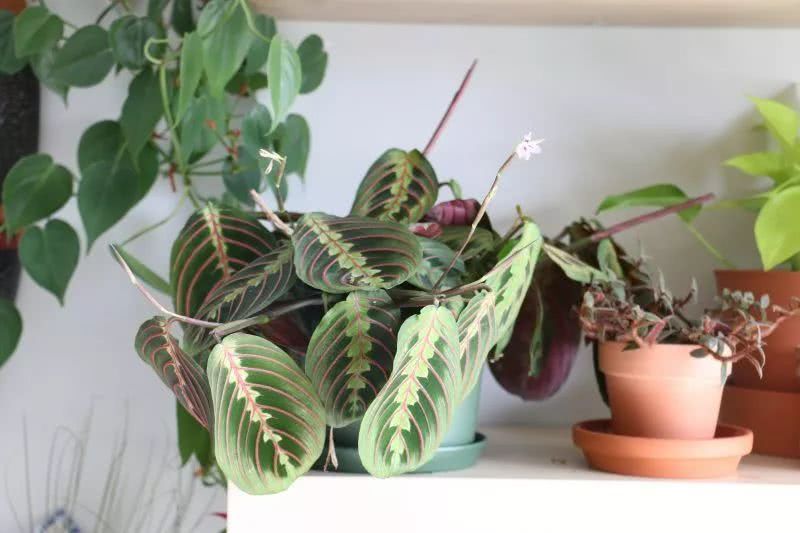
Today I want to introduce the plant arrangement in a gardener's home, where some potted plants are grown on shelves. How do you get foliage plants grown indoors to bloom, and how do you care for them so they grow vigorously? Do you know what needs attention?
1. Red-veined calathea (Calathea picturata)
The red-veined calathea above has already produced very small white flowers, many of them looking very delicate; though inconspicuous, they are still a pleasant surprise. To care for this kind of foliage plant, you must keep a year-round bright light environment, maintain fairly high air humidity, and keep the environment ventilated. It is best to give it a little scattered light so its leaves grow vigorously. In addition, in spring and summer, give a dilute organic liquid fertilizer once every two to three weeks, which promotes growth and also helps flowering.
2. Variegated rubber tree
The foliage plant above is the variegated rubber tree. It looks brighter than an ordinary rubber tree, and its leaf margins have red or white markings. Newly grown young leaves have red margins, and as the leaves gradually age they turn white, so much so that some people mistake them for yellowing leaves. This rubber tree likes light a bit more, so when caring for it you can place it by a south-facing windowsill; during the growing season keep it in a year-round warm, moist environment, and water thoroughly once the potting soil has dried out.
3. Arrowroot plant (Calathea lancifolia)
The plant above is the arrowroot plant. This very ornamental foliage plant likes a year-round warm, humid environment, and some people also call it the lance-leaf calathea. During care, maintain fairly high air humidity and keep a ventilated, year-round warm environment.
4. Black-leaf alocasia (Alocasia amazonica)
The plant above is the black-leaf alocasia, also a foliage plant well suited to indoors. Its leaf undersides are purple, and the leaf surfaces are black when they first grow out, gradually turning green over time. It is also a foliage plant that likes a year-round warm, humid environment, but its sap is toxic, so care must be taken when handling it.
5. Rhipsalis cactus (Rhipsalis)
Many people may not recognize the plant above. It is actually the ribbon plant, cactus stick, also called the Rhipsalis cactus, a plant that likes a year-round warm, slightly dry environment. It needs a little scattered light during the growing season, and overwatering must be avoided; water only when the potting soil has completely dried out. Give it appropriate scattered light, which helps promote flowering.
6. Anthurium
The plant above is the common anthurium, and the foliage plant on the left is the Swiss cheese plant (Monstera deliciosa). Their leaves look somewhat similar when they first grow out, but the leaves of the Swiss cheese plant split as they grow. Caring for anthurium is relatively simple. I like to use a red clay pot for it, as this gives very good drainage and breathability, so there is no need to worry about waterlogging in the soil. When caring for anthurium, you can give appropriate scattered light every day, and during the growing season give organic fertilizer once every two to three weeks, which promotes flowering.
7. Bright red crab cactus (Schlumbergera)
The plant above is the bright red cactus that buds in spring; many people mistake it for the Christmas cactus. Its leaves are wavy, with red markings along the leaf margins, and the flowers look somewhat similar to those of the Christmas cactus.
8. Water-grown spider plant
Above is a spider plant I tried growing in water. It has grown many offshoots; cut the offshoots straight off and soak them in 1 to 2 cm of water and they will take root and sprout. Avoid letting the leaves of the spider plant soak in the water, otherwise they rot easily. Before rooting, generally change the water once every 2 to 3 days, and in about two weeks they will take root and sprout.
9. Water-grown succulents
I also tried some water-grown succulents. Basically, take a cut segment of a succulent stem, remove the leaves at the bottom, then leave it in a ventilated, bright spot for about three days. Once the wound has dried, it can be soaked in about 3 cm of water. Water growing makes rooting very easy, but be careful to give it a little light, otherwise the stems and leaves will easily become leggy.
The above are the potted plants on the shelves, and there are also water-grown plants, some in cute little test tubes, which look very special, such as the two lucky bamboos above, which are also grown in water.
On the other side, on the wall near the windowsill, some water-grown plants and hanging plants are also grown. Some are simply a flower pot placed in a bag and used as a hanging plant, while others use small light bulbs converted to grow spider plant seedlings, which look quite ornamental.
Finally, let's look at the rack on the desktop. It is filled with all kinds of potted plants and looks like a small garden. For trailing plants, variegated creeping fig, inch plant (Tradescantia zebrina), Rhipsalis cactus and string-of-pearls were chosen, while the potted plants are mainly foliage plants, because the light is not too abundant; commonly grown ones include ornamental calathea, pothos, aloe, aluminum plant (Pilea cadierei), rubber tree, variegated weeping fig, staghorn fern and silver queen (Aglaonema).