Leilei on "bonsai" for inspections: It would be bizarre if they passed inspection without being reported
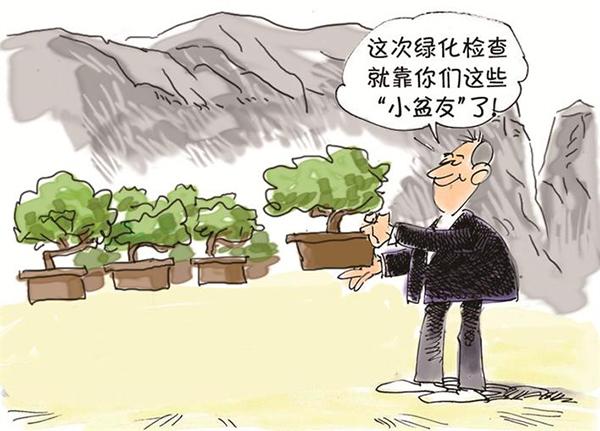
#"Bonsai" for inspections (file photo source: Shenzhen Special Zone Daily)
Author: Leilei
Recently, a set of photos from a quarry in Shanzao Town, Xiangxiang City, Hunan Province sparked controversy. In the photos, rows of green "bonsai" are placed on the quarry's hillside, and were said to have been placed specifically to welcome an inspection. (Beijing Youth Daily, April 24)
On the bare mountain body, densely placed, thriving "bonsai" are undoubtedly a jarring sight.
As for the reason behind this operation, everyone surely knows it as clearly as a mirror. The definition of bonsai is an artwork that uses plants and rocks as basic materials to express a natural landscape within a pot, praised by people as "three-dimensional painting" and "silent poetry." Such an elegant thing, placed on a bare hillside, hardly shows its value. Serving as a decoration for a show is surely the greatest consensus.
For whom are these bonsai, so out of place with the barren mountain, displayed? The local authorities need to give a clear explanation. The whistleblower said these "bonsai" were placed earlier to welcome an inspection. Whether viewed via satellite or looking up from the foot of the mountain, these "bonsai" closely resemble freshly planted saplings. The photos show that beside many "bonsai," green plastic netting had also been laid. If it really was to cope with an inspection, transporting bonsai up the mountain at such cost of labor and money truly shows painstaking scheming. This "green ecology" that cannot withstand close scrutiny, one wonders whether it helped the local authorities smoothly pass the inspection. Regardless of whether this artificially created "green" blinded the eyes of the inspected party, formalism remains the fundamental problem fully exposed.
A sound ecological environment is the fundamental basis for the sustainable development of humanity and society. Environmental governance, as a systematic project, must be firmly grasped as a major livelihood issue. However, in some places, the posture shown is still that it is important when spoken of, loud when shouted about, and in neutral when it comes to action. In May last year, someone reported that three quarries, including this one, had severely damaged the ecological environment. The reported contents included "causing geological disasters such as mountain collapse, barren vegetation, and flash floods and mudslides; air pollution, constant noise," and so on; every single item involved livelihood issues. Regulatory authorities cannot merely issue rectification orders; they must also promptly look back and focus on urging corrections. Otherwise, the final result of repeated violations after repeated corrections will only be increasingly weak rectification effectiveness, increasingly deteriorating ecological environment, and increasingly disappointed public expectations for livelihood.
Laying green plastic netting on the mountain body around the quarry, or filling it with densely packed bonsai, such methods of coping with inspections are hardly ingenious. Yet some places do exactly this, and not just once or twice. Is the inspected party too careless, or is the party being coped with too shrewd? The superiority is immediately clear. The most frightening thing is that no one wants to offend anyone, so you make your "fake ecology," and I play my "intoxicating pose." This mutual collusion of "you're fine and I'm fine" indulges those who damage the ecological environment to still go their own way, and at most to repeat the same trick during inspections and bluff their way through.
Engels said: "Let us not, however, flatter ourselves overmuch on account of our human victories over nature. For each such victory nature takes its revenge on us." When disaster strikes, any superficial restoration will eventually surface. Just recently, a mountain collapse occurred at the Manwang Quarry in Yangguanlin Town, Fengrun District, Tangshan City, causing 3 casualties. The local government's statement could not be called anything but resolute, immediately launching a sweeping investigation.
However, no matter how resolute the statements or how severe the accountability afterward, in the face of lost lives, they always seem insignificant. In English proverbs, "the elephant in the room" is used to describe facts or feelings that exist shockingly but are blatantly ignored or even denied. In the process of urban construction, establishing quarries to extract sand and gravel materials is a practical necessity, but in some places resource development has evolved into "development-oriented destruction." Blind mining that violates science, unrestrained over-mining, and rule-breaking mining that touches the bottom line are all living beyond one's means.
Carrying bonsai to cope with inspections cannot be addressed merely by investigating the problems as they stand, otherwise it is very easy to fall into the rut of treating the headache only where the head hurts and the foot only where the foot hurts. The profound connotation that "destroying the ecological environment is destroying productivity, protecting the ecological environment is protecting productivity, and improving the ecological environment is developing productivity" must be solidly turned into concrete practice, with no room for any empty showmanship.
[Statement: This article represents the author's personal views, does not represent the position of Qilu Network, and is for reference only.]