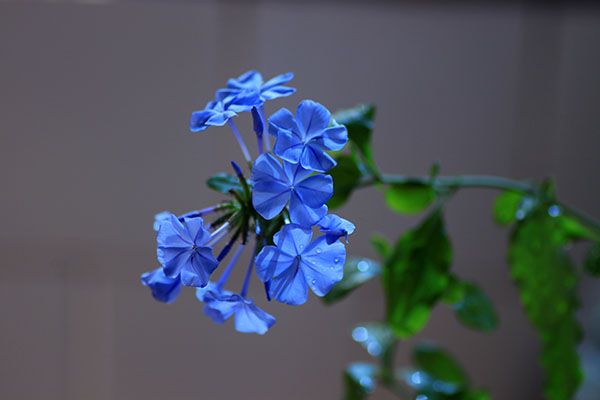
How to care for blue plumbago (Plumbago auriculata) so it bursts with blooms? A full guide to care tips
I. Environment
We need to give it the environment it likes, so that it can grow well. Generally speaking, the soil it lives in needs to be slightly acidic, and the planting depth must not exceed the top of the seedling in the pot. In addition, the temperature we give it needs to be in the range of 17 to 26; if the temperature goes above that, it is still fine, but it must stay below 35 degrees. As for winter, it should be kept in an environment above 7 degrees; when the temperature is relatively high, we should open the doors and windows often, since a ventilated state is better for it.
II. Light
We need to place it in a sunny spot, because more light or higher temperatures can promote branching for it, but in summer we need to be careful not to let it get sunburned.
III. Watering
When it is growing vigorously, we need to water it more, and if necessary we can spray some water on its leaves; in winter there is no need to water too much, and each watering should soak through.
IV. Fertilizing
Fertilizing is a very important point for making it burst with blooms. During its growing period, we need to fertilize once every 15 days. When it has just sprouted, the main fertilizer is nitrogen fertilizer; around May we add phosphorus and potassium fertilizer for it; in September nitrogen fertilizer can no longer be applied, while potassium and phosphorus need to be applied two more times. In addition, a full-element fertilizer should be applied every week, and in winter fertilizing is not needed.
V. Repotting
In spring we need to repot it once, and only after that will it grow well. We take it out of the soil, then cut off all the rotten roots, and afterward replant it with new soil.
VI. Pruning
Pruning can help it grow better. We generally prune it together with repotting, cutting off the parts that have grown too dense or are relatively weak and small. If it is an old plant that has been growing for a relatively long time, we need to prune it more, and afterward apply a top dressing. After flowering, we also need to cut off the withered parts. When its seedlings have grown relatively large, we need to pinch off the growing tips, and in this way the flowering period will also be delayed.