How do you create a Chinese plum (Sageretia thea) bonsai using Lingnan-school styling techniques?
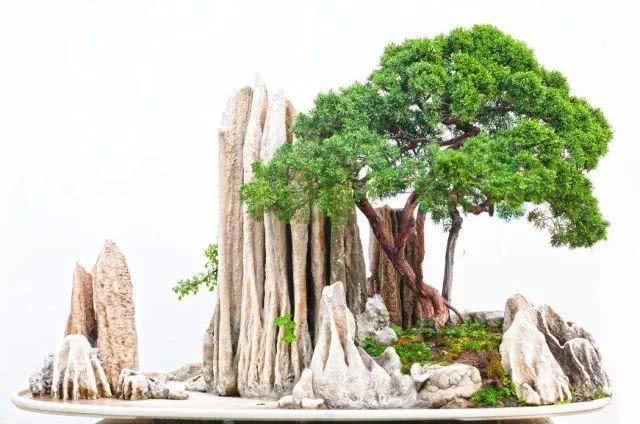
Naturally, dig deeper into bonsai,
gradually get to know the classifications and schools of bonsai.
When it comes to bonsai schools, one cannot fail to mention Lingnan-school bonsai,
because it is known as:
"a living Chinese landscape painting."
Three characteristics that set Lingnan-school bonsai apart from other bonsai schools
One
Its creative approach is unique, taking nature as its teacher.
It highlights branch and trunk techniques; shaping or composition layouts come from nature yet rise above nature.
It seeks an organic combination of natural beauty and artificial beauty, so Lingnan bonsai is hailed as
Two
It focuses on the shaping and selection of the scenery and the pot, striving for harmony and coordination between pot and scenery.
Three
It makes good use of pruning without revealing traces of the knife or scissors. This technique is the greatest characteristic of Lingnan bonsai, so people generally believe that Lingnan bonsai is purely cut and trimmed with knives and scissors.
By pruning branches and leaves, the plant is made to grow and develop according to human will; as time passes, the traces of artificial trimming gradually disappear, and every shape looks as if made by nature, with workmanship that surpasses nature itself.
Next, let's look at a case study: how to use Lingnan-school bonsai styling techniques to create this Chinese plum (Sageretia thea) bonsai.
Lingnan-school bonsai techniques for styling a Chinese plum (Sageretia thea) bonsai
1. First comes observation: before starting, find the front-facing tree appearance of the Chinese plum (Sageretia thea).
It can be seen that this Chinese plum (Sageretia thea) already has a basic tree form, so the creation mainly uses Lingnan bonsai production methods, with pruning as the main approach.
2. Be careful to prune the leggy branches around the Chinese plum (Sageretia thea).
3. Cut off excess branches at the roots; the ornamental quality of the roots needs to be emphasized.
4. The tree form after some branches have been pruned.
5. Cut off the unattractive dead trunk in front of the main trunk.
6. The effect after the dead trunk is cut away.
7. Prune the fine branches on the main trunks on both sides so that it does not feel excessively heavy when viewed and to increase light penetration.
8. The effect after pruning the main trunks on both sides.
9. Prune the fine branches at the top, cutting away crossing, overlapping, withered and other branches
10. The tree form after overall pruning; the overall tree appearance looks fresh and natural.
I don't know whether the editor explained it clearly and in detail enough. For readers who did not understand, the editor has specially composed an acrostic poem for you. It may not be well written, but it can help you find the editor.
More wonderful articles are all in an acrostic poem:
A light breeze gently strokes, flowers remain ever present
Walking at ease, wandering in spirit to the south of Nanshan
Seeking wonders and searching for cleverness at Bronze Sparrow Terrace
Planting reds and greens, rising above the blue clouds
--Come take the challenge: a four-line acrostic-and-tail poem; connect the first characters + connect the last characters, and you can get an eight-character motto to summon the editor's true self! When you come, remember to say: "Editor, your secret has been cracked by me!"