Zhao Qingquan on Literati Trees, Revisited: Spirit Revealed in Every Branch and Leaf
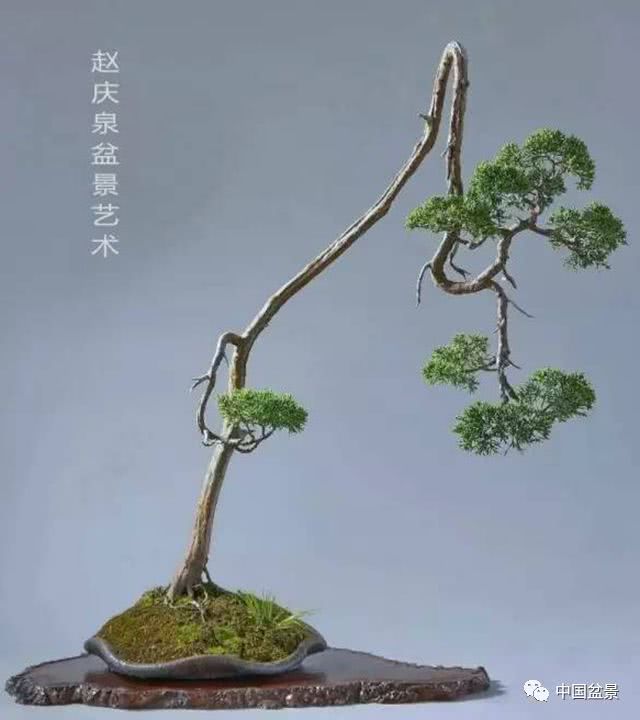
Spirit Revealed in Every Branch and Leaf - A Further Discussion on Literati Trees
Production, photography, and text by | Zhao Qingquan
Copyright belongs to Teacher Zhao Qingquan
I have long held a special affection for literati trees. At first, when I was reading painting manuals, I discovered that in ancient Chinese painting, especially literati painting, trees mostly had slender, sinewy trunks with sparse, airy branches and foliage, and rarely took the form of short, sturdy, full trees. For a long time afterward, I kept thinking about this question: painting is different from bonsai, and there is no difference in cost between painting a thick tree and painting a thin one - thick or thin, it is all the same - so why did painters rarely paint thick trees? In the end I finally understood that this was entirely due to the aesthetic orientation of Chinese literati, because in slenderness one sees more strength of character, and in slenderness one sees more spirit; a slender, crisp tree form better expresses the author's feelings. It is often said that bonsai should possess poetic sentiment and pictorial beauty, and should achieve both form and spirit - in fact, the literati tree is the best example of this.
"Gazing" (Black Pine, tree height 105 cm, tree age about 30 years)
"Standing Alone in Splendor" (Five-needle Pine, tree height 70 cm, tree age about 35 years)
"Strength of Character" (Shimpaku, tree height 115 cm, tree age about 30 years)
"Elegant Gathering" (Shimpaku, tree height 100 cm, tree age about 35 years)
"Lofty Spirit and Sterling Integrity" (Chinese Juniper, tree height 115 cm, tree age about 90 years)
"Flying to the Moon" (Shimpaku, tree height 85 cm, tree age about 30 years)
"Emerging from the Valley" (Five-needle Pine)
"Reaching the Clouds" (Shimpaku, tree height 132 cm, tree age 30 years)
"Clear Shadow" (Black Pine, tree height 84 cm, tree age about 25 years)
"Keeping Watch" (Five-needle Pine, tree height 85 cm, tree age about 25 years)
"Ancient Style" (Huangshan Pine, tree height 85 cm, tree age about 80 years)
"Clear Autumn" (Japanese Persimmon, tree height 85 cm, tree age about 10 years)
"Leaning on Each Other" (Shimpaku, tree height 110 cm, tree age about 30 years)
"Portrait of a Noble Scholar" (Five-needle Pine, tree height 95 cm, tree age about 30 years)
"Inviting the Moon" (Shimpaku, tree height 85 cm, tree age about 30 years)
"Sparse Shadow" (Plum Blossom, tree height 85 cm, tree age about 15 years)
"Sparse Shadow" (Plum Blossom, tree height 85 cm, tree age about 15 years) Snow scene close-up
"Heavenly Grace" (Shimpaku, tree height 65 cm, tree age about 25 years)
"Beyond the Dust" (Black Pine, tree height 106 cm, tree age 25 years)
"Gathering of Excellence" (Shimpaku, tree height 115 cm, tree age about 30 years)
"Facing the Void" (Shimpaku, tree height 86 cm, tree age 30 years)
"Heaven and earth have great beauty but do not speak"
- Appreciating Master Zhao Qingquan's Chaenomeles speciosa bonsai
Text by | Chen Hongkui (Bonsai Drunkard)
Beautiful! Chaenomeles speciosa. I cannot help but recall the lines of the great writer Su Dongpo: "The east wind gently stirs, spreading a radiant glow; fragrant mist veils the air as the moon turns past the corridor. I only fear that deep in the night the flower will fall asleep, so I burn tall candles to light up the red attire." Master Zhao Qingquan's Chaenomeles speciosa bonsai was once sent as a New Year card to many friends in the bonsai world. Now, at the New Year, it reveals its splendor once more, even more beautiful than before.
The work is 70 cm tall, a typical medium-sized bonsai, exquisite and gorgeously beautiful. Placed on a tall stand in a room, would it not delight the eye and gladden the heart, and bring glory to an elegant hall?
"Heaven and earth have great beauty but do not speak." The work's first characteristic is its natural flavor. The forms of the roots, trunk, and branches are plain and unremarkable, like a common natural tree; no trace of artificiality can be seen, there is no excessive shaping, and there is no arbitrary affectation - seeing it truly puts the heart at ease! With a small amount of tender green buds and leaves as accompaniment, setting off the lovely profusion of blossoms, it is exquisite beyond words, so beautiful!
Great skill appears clumsy; a plain tree has very strong expressive power. The trunk slants to the right, bends to the left at the middle, and then continues slanting to the right, giving variation within unity. The upper part of the trunk rises and slants toward the upper right, and the first main branch is raised slightly and extends far to the right, echoing the crown and also supporting the tree's momentum. The artistic handling of the leftward force in the work especially reveals skill: the root pulls powerfully toward the lower left, and the lower-left main branch appropriately presses down in balance, thus stabilizing the rightward-slanting force, and the whole achieves a very good aesthetic balance.
Within natural beauty and artistic beauty, the work also contains the beauty of youth. The tree in the pot is like a village girl, simple and beautiful. At more than 20 years old, it is just at a young maiden's prime, with a young texture (no tortoise-shell cracks, no hollows, no deadwood, no defects), brimming with youthful vitality. Looking across Master Zhao's bonsai, most express natural beauty, the beauty of life, and the beauty of youth; even the concise literati trees are rich in branches and leaves and full of vitality.
The writing reflects the person, and so it is with bonsai too. This beautiful Chaenomeles speciosa was cultivated over more than 20 years from a small branch cut from another bonsai tree material. Back then it was only as thick as a chopstick; through human nurturing and the accumulation of years, it is now as thick as a bowl's mouth. If back then it had not been kept on a momentary thought, how regrettable that would have been! Looking at this bonsai that has been completely transformed, what reason do we still have not to cherish life? What is the purpose of doing bonsai? To draw close to nature, respect life, harmonize the environment, and sing the praises of conscience. I urge friends in the bonsai world not to casually discard tree materials, and not to apply the knife and axe excessively in shaping - please, be merciful with your hand!
2018、3、14
Zhao Qingquan bonsai "Riot of Blooms"
Wonderful replay:
Chinese bonsai welcomes you!
Enjoyanytimethe bonsai exhibition hall
Promote bonsai culture, exchange bonsai skills!
Appreciate bonsai art, share a happy life!