This flower has elegant leaves and beautiful blooms, and when it flowers it can cover a whole wall.
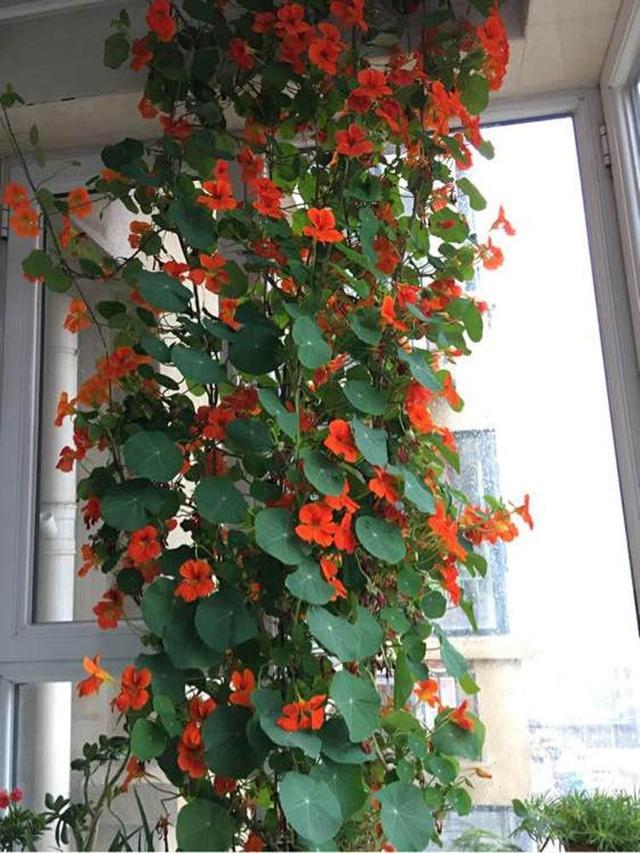
Nasturtium (Tropaeolum majus) gets its name because its leaves resemble those of the bowl lotus, yet it grows on dry land. Its leaves are elegant, its flowers are lovely, and its blooms are golden yellow, flowering continuously. When in full bloom, it looks like a swarm of butterflies dancing, set off against the green leaves; the flowers are large and brightly colored, and with good care, it can cover a whole wall with blooms.
For potted nasturtium, gardeners can mix a growing medium of 4 parts leaf mold, 4 parts garden soil, 1 part compost soil, and 1 part sand. Because nasturtium's trailing stems grow quickly, it needs to be properly trained and shaped from an early stage. Gardeners can train the nasturtium however they like as an ornamental potted flower.
During the growing season, apply a dilute organic nutrient solution once every 10-15 days to nasturtium, diluted 500 times with water and poured at the roots; during the flowering period, stop applying nitrogen fertilizer and switch to an 800-times diluted organic nutrient solution, applied once every 10-15 days. After the flowers fade, apply a 1000-times diluted organic nutrient solution once; stop fertilizing in summer, then apply a 500-times diluted organic nutrient solution once in late autumn to strengthen the plant's cold resistance and lay the foundation for the next year's growth and flowering.
When caring for nasturtium, the frequency and amount of watering should depend on the weather and the plant's growth. Water more during the trailing stem growth period: every other day in spring and autumn, once a day in summer, plus a spray of water on the leaves and stems in the evening; when flower buds appear, reduce watering frequency, but keep the potting soil alternating between dry and moist. After flowering, watering should be reduced.
When caring for nasturtium in spring and autumn, place it in a spot with plenty of sunlight; in midsummer, shade it appropriately and rotate the pot regularly so the plant receives even light. During the winter, if the room temperature can be kept at 12-16°C and fertilizer and water are controlled appropriately, it will continue to grow and bloom. Once spring arrives, simply replenish the nasturtium with organic nutrient solution in time.
If gardeners like nasturtium, they can sow seeds in September, and flowers can be enjoyed from late November of that year through the following spring; if sown in March, it can also bloom from July to September of that year. If choosing cuttings, they generally take root in 10-20 days after planting.