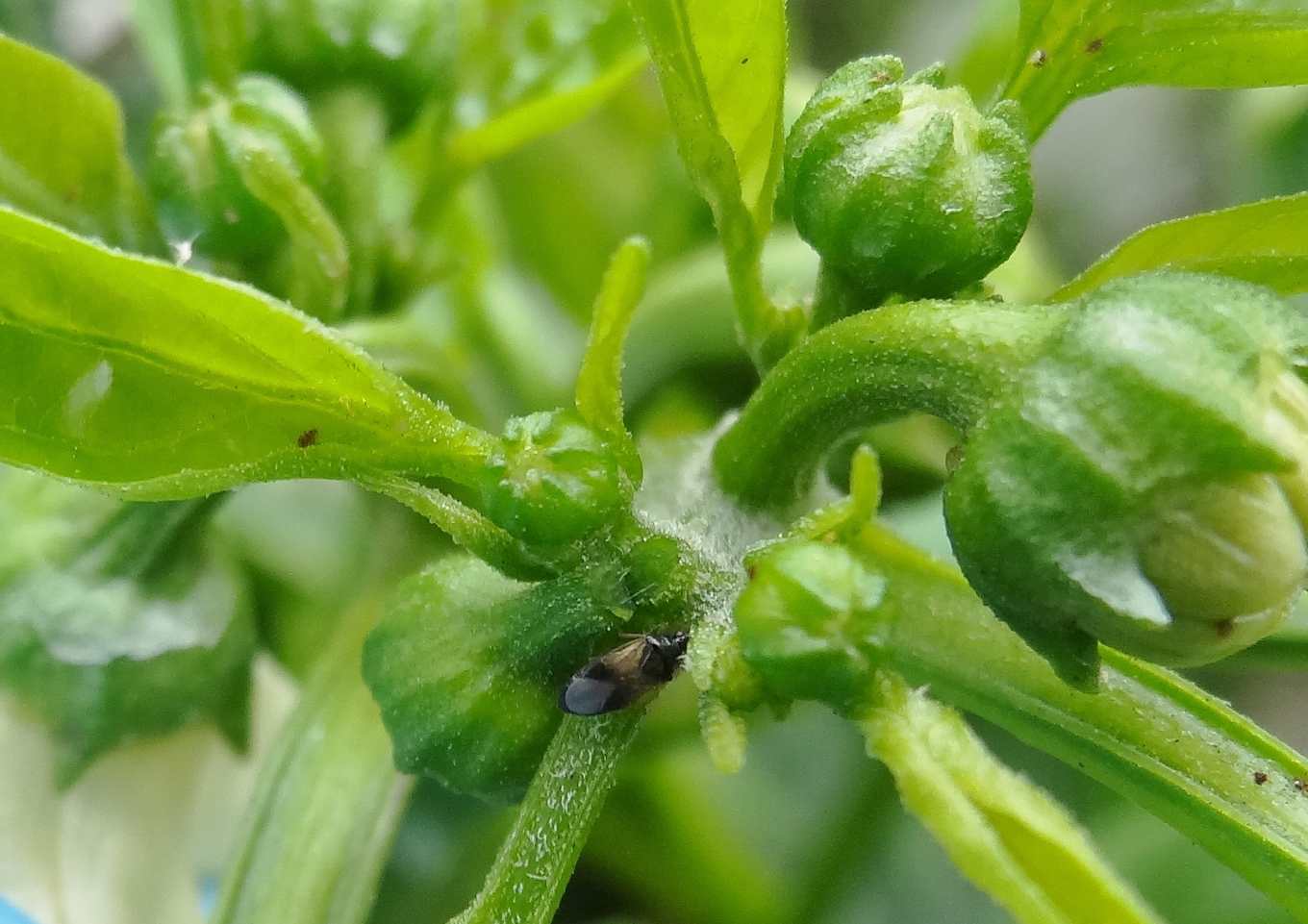
The natural enemy of thrips, the minute pirate bug Orius strigicollis, is suitable for sweet peppers, tomatoes, cucurbits, eggplants and strawberries
Bell peppers are very popular in the market, but because of their many pests and diseases, cases of excessive pesticide residues are reported from time to time. Research by the Taiwan Agricultural Research Institute (hereinafter "TARI") has found that releasing the natural enemy Orius strigicollis in bell pepper fields can effectively suppress the numbers of the key pest "thrips". Besides bell peppers, it is also suitable for tomatoes, eggplants, cucumbers, strawberries, cucurbits, beans, adzuki beans and more. The effect is more obvious in greenhouses, and it can also be used in open-field cultivation. Technology transfer is now open, and companies, farmer groups and individual farmers can all apply.
Thrips harm bell peppers, so the natural enemy Orius strigicollis is deployed to control them
TARI points out that "colored bell peppers" are a high-value crop newly emerging in Taiwan's protected cultivation, and thrips are the key pest harming bell peppers. On average, 2 thrips per flower will cause the heart buds or flower buds of bell peppers to brown and wilt, affecting flowering and fruit set and causing rough brown rusty spots on the fruit; if aphid densities are too high, they secrete large amounts of honeydew, which leads to sooty mold and contaminates leaves and fruit. Without proper control, such pests will seriously affect the yield, quality and market price of bell peppers.
Lin Fengqi, associate researcher in the Applied Zoology Division, said that TARI has studied Orius strigicollis for as long as 20 years, and in the past four years began IPM (integrated pest management) research on the use of natural enemies for bell peppers. Over the past six months, an organically cultivated bell pepper farm in Liujiao Township, Chiayi County, that was on the verge of being abandoned was used as the experimental site, and the application was found to work well.
In experiments, releasing Orius strigicollis at a ratio of 4 to 8 insects per plant in bell pepper greenhouses can control thrips and other small pests. When the density of Orius strigicollis is maintained at 1 per flower, thrips outbreaks can be suppressed. In addition, together with plant oil mixture formulations and lime sulfur mixture, aphids and tea tarsonemid mites can also be effectively controlled, and bell peppers can be grown without using pesticides.
Lin Fengqi explained that Orius strigicollis is a natural enemy native to Taiwan, and has long been a nemesis of thrips. It was not deliberately introduced from abroad, so it will not have an impact on the ecological environment or pose problems of ecological adaptability. It is completely unrelated to the "lychee stink bug" that harms lychees and longans, so farmers can use it with peace of mind.