The little wildflowers that used to grow in patches along the roadside have now become a rare sight. Do you know them?
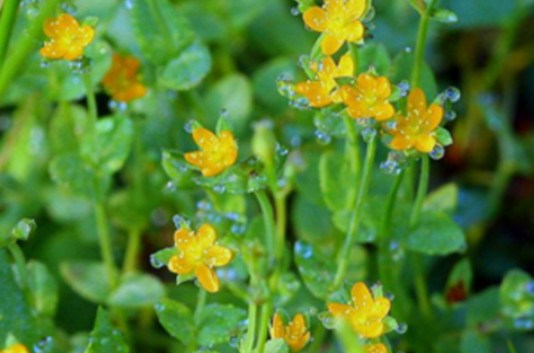
Tianjihuang is a plant of the Clusiaceae family, Hypericum japonicum, and it has many aliases: Di'ercao, Banjiuwo, Queshecao, Qicunjin, and so on. It grows at altitudes of 20 to 1000 m, mostly in dry wasteland, riverside mudflats, and sunny spots by the water, and is mainly distributed in Taiwan, China, Guangdong, Hainan, Guangxi, and other places.
Do you know why I introduced it right away? It is the rare thing I mentioned. Why do I say that? Tianjihuang is a Chinese herbal medicine. It is dry in nature, slightly bitter and cold, but it can clear heat and detoxify, drain dampness and reduce jaundice, and reduce swelling and dissipate blood stasis. It is used for damp-heat jaundice, intestinal abscess, red swollen painful eyes, and heat-toxin sores and swellings; recently it has been used for acute and chronic hepatitis, early-stage cirrhosis, liver area pain, appendicitis, mastitis, and lung abscess.
For external use, it treats carbuncles, boils, and swollen toxins, traumatic blood stasis swelling and pain, venomous snake bites, and shingles. Usage and dosage: 30-60 grams (double the amount for fresh product), decocted in water. External use with an appropriate amount of fresh product pounded and applied to the affected area is very effective.
Think about it: it was originally just a wildflower, but now it has been found to be so useful, and in an instant it has become a rare thing. I just do not know whether you have seen it or not?
Image source: the internet!