How to grow potted clivia? Only careful cultivation produces exquisite blooms
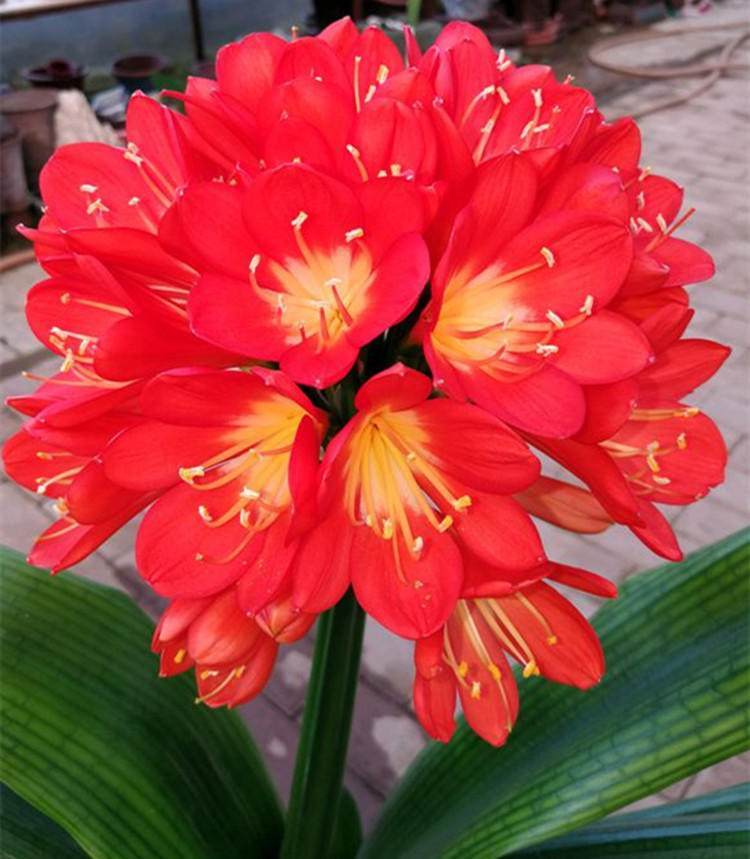
Clivia, once it blooms, hangs strings of bright red flowers on its stalks, especially eye-catching and beautiful. As one of the precious ornamental flowers, clivia requires attention to many details in its care, and cultivation must be meticulous, so that the flowers it produces will be exquisite.
1. For potted clivia, the best growing medium is forest-floor humus soil mixed with about 20% sand grains. Using 3 parts broadleaf humus soil, 2 parts coniferous humus soil, 2 parts base fertilizer, 1 part fine coal cinder granules, 1 part river sand, and 1 part bone meal plus roasted hemp seeds and sesame seeds mixed together to make the growing medium gives the best results.
2. For potted clivia, winter care requires placing it indoors in a sunny spot; after it is moved outdoors in spring and in autumn, it should receive half-light; in summer it should be placed in a cool, shady spot, and in hot weather water should be sprinkled on the nearby ground to increase humidity and lower the temperature.
3. Clivia likes fertilizer, but excessive fertilization can cause root rot. The usual fertilization method is to apply base fertilizer when repotting. The types of fertilizer given to clivia vary by season, with emphasis differing accordingly; generally, in autumn, nitrogen fertilizer is favored, and in winter, phosphorus and potassium fertilizers are favored, to help leaf veins form and make the leaf surface glossy. A 0.1% potassium dihydrogen phosphate or 0.5% superphosphate solution can also be used as a top dressing.
Foliar feeding can be done in all four seasons. Generally, an organic nutrient solution diluted 500 times with water is used for watering, with fairly noticeable results. Especially in summer, spraying the leaves with organic nutrient solution diluted 800 times with water not only provides nutrients but also helps lower the temperature; moist leaves can also enhance photosynthesis, enabling clivia to grow vigorously.
4. When watering clivia, you must master the principle of watering when dry and withholding when wet. In summer, place it in a cool, ventilated spot for care, spray water appropriately, and maintain relatively high air humidity; in winter, the potting soil should be kept appropriately dry, otherwise it will affect winter dormancy and be unfavorable for blooming the following year.
5. In caring for clivia, temperature plays a very important role. Generally, in winter and spring, room temperature is suitable at 15-20°C during the day and 10-15°C at night; in summer, room temperature is suitable at 20-25°C during the day and 18-20°C at night; in autumn, room temperature is suitable at 18-23°C during the day and 13-18°C at night; the overwintering temperature must be above 5°C.
In addition, different growth stages require different temperatures: during the sowing and seedling-raising stage for clivia, if the temperature reaches 25°C, seedlings emerge quickly and the emergence rate is high; during the seedling stage, 15-18°C is favorable for hardening the seedlings; during the flower stalk emergence stage, the temperature should be somewhat higher; during the flowering stage, if the temperature drops to around 15°C, the flowering period can be extended. A day-night temperature difference of 7-10°C is favorable for growth, bud formation, and flowering.
5. To make clivia leaves arrange neatly and beautifully, gardening enthusiasts also need to pay attention to the direction of light, so that the direction of the leaves is parallel to the direction of light, and turn the flower pot 180° every 1 week; using organic nutrient solution diluted 800 times with water to spray the leaves is best.