A Detailed Guide to Basic Bonsai Tree Forms, Essential Reading for Beginners
When many people who are new to bonsai get a sapling, they do not know how to start or what to do. One important reason for this is that they have no concept of basic bonsai tree forms in their mind.
The foundation of bonsai is "nature": fruit trees under the clear mountain breeze, sturdy pines standing on sheer cliffs, and miscellaneous trees growing in pursuit of sunlight. Bonsai condenses these scenes into a small flowerpot, making full use of the characteristics of each tree species to shape free and easy tree forms. Observing, summarizing, and generalizing the natural world is a very important thing.
Now here is a simple introduction to the basic bonsai tree forms:
You can write them down and compare them with natural trees. Only by having "a great tree in your mind" can you have a tree in your hands.
Formal upright: There is no bend in the trunk, and it is straight from the root base to the treetop. The roots are also important, and in this case it is generally considered best to have eight-direction roots. It generally indicates that this potted plant grew vigorously under superior conditions.
Slanting: The treetop leans toward one side, left or right. Although it is still mostly straight, there are still some bends, and as a whole it looks as if it has been blown to one side by the wind. The key is to have roots on the opposite side to provide a sense of stability. If branches also extend out on the downwind side, the atmosphere is even stronger.
Informal upright: It bends left and right from above the root base while also forming a certain pattern. The front-to-back bends are best if they lean slightly forward, and if the branches also have bends, it is even more pure. However, extreme bends sometimes instead seem affected. A shape roughly between formal upright and informal upright is called "upright tree."
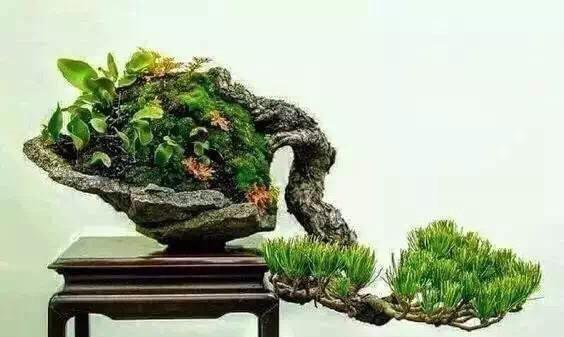
Cascade: When the trunk hangs downward from the root base, it is called "cascade," and if the branches hang down, it is called "semi-cascade." Because the trunk of a cascade is generally lower than the rim of the pot, a stand is needed when displaying it. The treetop should face directly forward.
Literati: A slender trunk paired with interesting bends, with few branches and leaves, but one branch grows very tall, emphasizing the thinness of the trunk. In order to show a bit of withered charm, it is better for the trunk to lean slightly.
Wind-swept: The feeling that the branches flow to one side with the wind is very similar to slanting, and the difference between the two is that all the branches of wind-swept style are fixed on one side.
Double trunk and others: When two or more trunks grow from above the root base, it is called "multiple trunk." One trunk is called "single trunk," two trunks are called "double trunk," three trunks are called "triple trunk," and five or more are called "multiple trunk." If the size difference between the two trunks is not great, it is called "husband-and-wife double trunk"; if the difference is great, it is called "parent-and-child double trunk"; if the difference is especially great, it is called "grandparent-and-grandchild double trunk."
Connected roots and group planting: Connected roots means there is only one root, while group planting means several mutually independent trees are planted together.
Coiled trunk: The trunk has extreme bends near the roots.