The Qing court's old collection of artificial bonsai is astonishingly valuable; a feast for the eyes at the Xinkong bonsai collection
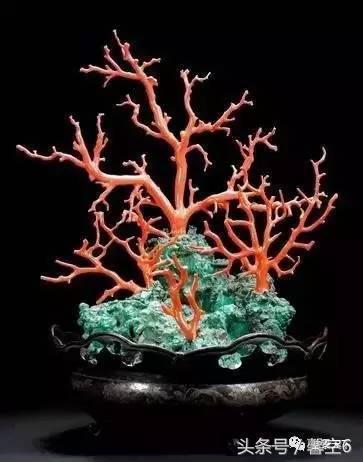
In the Qing dynasty court, ornamental scenes made from precious materials such as jewels, jade, jadeite, coral, gold, silver and agate, paired with pots crafted using techniques such as gold and silver work, enamel, jade carving, carved lacquer and inlay, were combined into a single piece known as a bonsai.
Qing court bonsai were mostly made by the inlay workshop of the Imperial Household Department's Workshop. On occasions such as the birthday celebrations of the empress dowager or the emperor, or the emperor's wedding, ministers and officials from various regions would also present bonsai as gifts. These bonsai often used symbolic meanings and homophones to represent auspiciousness, fortune and longevity, and peace.
▲Material-stone plum blossoms
Now in the collection of the Palace Museum in Beijing, formerly in the Qing court collection.
Qing dynasty, made by the Workshop, overall height 30.5 cm.
The pot is carved from agate in the form of a finger citron (Buddha's hand), with one large and one small finger citron clasping each other, and a butterfly deftly carved flying down onto the pot wall. Beneath the pot is a carved openwork wooden stand. On the pot, green silk thread is wrapped around copper wire and bent into branch shapes to form a plum tree; the silver-gilt calyxes and stamens of the plum blossoms are welded to the tips of the copper branches, and copper wire wrapped with red silk thread forms the pistils, while white jade and white material make the five petals of the plum blossoms, which are affixed between the calyxes and stamens. For the unopened buds, white jade or hibiscus stone is inlaid on the silver calyxes, and the leaves are carved from green jade. Among the plum blossoms are also a few ivory-carved chrysanthemums; due to the passage of time some petals have slightly fallen off, and the leaves are made of stained ivory with gold coloring outlining the leaf veins.
In this scene the flowering branches are gracefully sparse, elegantly spreading like a canopy, delicate yet not weak, soft yet containing strength; the colors are bright and fresh, and the tree of white plum blossoms and the agate pot bring out the best in each other, elegant and pure yet retaining a charming grace.
▲Stained-ivory narcissus and lake stone bonsai
Now in the collection of the Palace Museum in Beijing, formerly in the Qing court collection.
Qing dynasty, made by the Workshop, overall height 27.6 cm, pot height 6 cm, length 26.6 cm, width 17.3 cm.
Short feet are carved and joined from bamboo root; the four sides of the pot wall are incised with geometric kui-dragon patterns and stained, with the edges of the patterns outlined in dark lines. Inside the pot is a small scene of narcissus and lake stones: the narcissus bulbs are carved from boxwood, the leaves are made of green stained ivory, the flowers, centers and buds are all carved from ivory, and the receptacles are made of boxwood. The lake stones are carved from red sandalwood.
In this bonsai two lake stones stand in the middle, with two narcissus plants leaning at angles, their lines soft and varied. The ivory and boxwood are fine and soft in texture, while the red sandalwood-carved lake stones are rough and steep; the flowers and leaves are bright and vivid, while the lake stones are calm and weighty in color. The materials, colors and forms of the two set each other off, combining hardness and softness. The craftsmanship of this scene is exquisite, the objects realistic yet fresh and concise, and the style elegant, standing out as unique among the palace bonsai crafts that took splendor and intricacy as their specialty.
▲Immortal riding a raft
Now in the collection of the Palace Museum in Beijing, formerly in the Qing court collection.
Qing dynasty, made by the Workshop, overall height 39.5 cm, widest point 54 cm.
Natural tree roots are carved into the shape of a raft; beneath the raft painted clay sculptures of waves serve as a support, and holes are left in the waves to insert ivory-carved lotus flowers, lotus leaves and lotus seed pods. At the head of the raft is a gilt-copper four-lobed mallow-petal champleve enamel pot, in which a small tourmaline peach tree is planted. In the middle of the raft sits an old man carved from stained ivory, with a long beard reaching his chest, one hand resting on his knee and the other holding a scroll, his expression serene. Before the old man is a cloisonne enamel round dish filled with grapes, and behind him is a champleve enamel hexagonal vase holding ivory chrysanthemums and the like. Around the tail of the raft is entwined gilt-copper wisteria, curling upward like a dragon's tail and covering the area above the old man, from which hang small white jade gourds and cloisonne leaves, delicate and lovely.
The immortal raft originates from mythological legend. In Zhang Hua's Bowuzhi of the Jin dynasty, it is recorded that someone rode a raft out to sea and drifted away, unexpectedly meeting the Cowherd and the Weaver Girl. Later generations attached the story's character to Zhang Qian, saying that he rode a raft to seek the source of the Yellow River. The earliest known figure to use the immortal raft as a craft subject was the famous Yuan dynasty silversmith Zhu Bishan, whose silver raft has been handed down to the present. During the Ming and Qing dynasties the immortal raft was incorporated into the system of auspicious motifs; similar to subjects such as the Eight Immortals Crossing the Sea, it was endowed with the meaning of birthday congratulations, much treasured by the imperial family, and was one of the common subjects in Qing dynasty palace crafts. This scene is well-proportioned in structure, with the elements arranged in an orderly yet varied way, rich in decorative interest. The carved materials are diverse, the colors abundant, and the techniques complex, making it a classic work among pieces of its kind.
▲Bonsai with inlaid jade immortals offering birthday congratulations
Now in the collection of the Palace Museum in Beijing, formerly in the Qing court collection.
Mid-Qing dynasty, made in Suzhou, overall height 7.3 cm, stand length 90 cm, width 37 cm.
A red sandalwood eight-foot free-form stand with hanging cloud patterns, its edges fitted with gilt-copper openwork railings of the "wan" character pattern. On the stand is a natural wood mountain, full of antique charm. In the mountain, lingzhi, immortal peaches, yao grass and fine orchids are made from white jade, green jade, agate, jadeite, tourmaline, turquoise and the like, hanging upside down and growing in clusters among the crevices and stalagmites, in a riot of five colors. On the mountainside is a round pavilion with a blue roof; seven immortal elders either stand on the mountainside, walk together through the mountains, or sit facing one another in the pavilion in lively conversation. A jade crane with a divine herb in its beak hovers at the mountaintop, while a jade deer lies beside the pavilion on the mountainside, gazing up at the divine herbs above.
This piece, with its meaning of immortals offering birthday congratulations, has a generous overall form, with the figures delicately depicted and each with a different expression. The flowers, plants, birds and beasts are clear and bright in color, spaced with a balance of density and sparseness, arranged in an orderly yet varied way and full of charm, making it a carefully wrought work among medium and large-scale scenes.
Xinkong 6 bonsai: bonsai has these classifications
Step into the "Number One Bonsai Garden of Japan" and unveil the mystery of Japan's "national treasure-level" bonsai...
Xinkong 6 bonsai! An illustrated guide to international silver award-winning bonsai works, recommended for saving! Memoirs
The rapid shaping method for azalea bonsai, Xinkong 6 practical tips
Painting realm, poetic realm, Zen realm -- literary tree bonsai lecture series (Part Four)
Xinkong 6 bonsai! The great way is simplicity, survival of the fittest! Survival 74 Fittest 74 Wild colors
Xinkong 6 bonsai! Wild cursive script, every mountain and every tree taken in at a glance, a cruel and gorgeous art, supreme bonsai
168 million? Orange jasmine (Murraya paniculata) hits a sky-high price! Recalling those jaw-dropping bonsai that appeared during past National Day seasons