A Detailed Guide to Making and Caring for Flowering Narcissus Bonsai
Common methods for making and caring for flowering narcissus bonsai
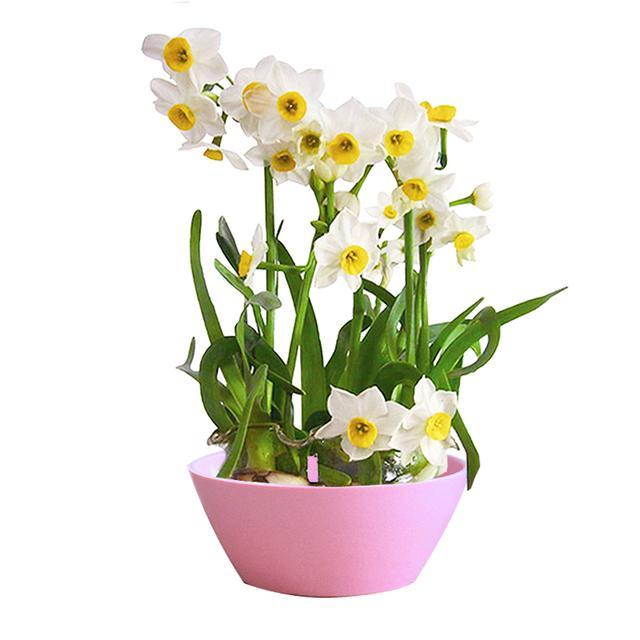
Narcissus is also known as Chinese narcissus, Nüshi flower, Lingbo fairy, flower in the snow, Peixuan, Yaonü flower, elegant guest, elegant garlic, and scallion; it is a perennial herbaceous flower of the Amaryllidaceae family. Figure 1 shows an elegant narcissus bonsai.
Narcissus is generally sold in baskets; the fewer bulbs per basket, the larger the narcissus bulbs. For pots, pottery pots, porcelain pots, and tile pots are all suitable. For water culture, glass containers can be used.
Narcissus prefers loose soil rich in organic matter with sufficient moisture. A pH of 5-7.5 is suitable. It is generally prepared by mixing loam, leaf mold, and fine sand.
1. Material selection
Chinese cultivars include Zhangzhou narcissus, Putuo narcissus, clove narcissus, Chongming narcissus, and others, among which Zhangzhou narcissus is the most famous. Foreign cultivars include perfume narcissus, lipstick narcissus, trumpet narcissus, yellow narcissus, cyclamen narcissus, and others.
2. Bonsai shaping
1) Peeling the scales. First scrape clean the soil and dead roots from the top of the narcissus bulb, and peel off the brown outer skin. At 2/3 or 1/2 of the bulb, use a knife to cut in along an arc parallel to the base, slit open the upper epidermis, then peel off the upper 2/3 of the scales layer by layer until the narcissus leaves are visible. Generally speaking, the narcissus leaves grow in a row.
(2) Shaving the leaves. After the leaves are fully exposed, begin shaving the leaves. Use a knife to carve away, one by one, the scale segments and leaf bud scales on both sides of the leaf buds. Be patient and careful, and never damage the leaf buds.
Shave from the head of the leaf toward the root, removing about 1/3. The fewer leaves removed, the straighter the narcissus grows. During this process, avoid a blunt knife, otherwise notches will form. Also avoid touching the flower buds.
(3) Cutting the leaf edges. The leaves of narcissus originally grow straight. To make both the leaves and flower stems grow into curved crab-claw shapes, they must be cut.
When cutting the leaf edges, use your fingers to apply slight pressure forward from the back of the leaf bud to separate the flower bud from the leaf bud, then insert the knife into the crack and evenly cut away 1/3-2/3 of the leaf edge from top to bottom and from the outer leaves to the inner leaves. The cut side develops scars from injured tissue and grows slowly, while the uncut side still grows vigorously; the uneven growth on the two sides causes the leaf to curve to one side into a crab-claw shape. During the operation, do not damage the flower bud in the middle of the leaf bud.
(4) Carving the flower stem. The upper part of the flower bud is the flower bud, and the lower part is the flower stem. Use a small carving knife to smooth the surface, carving the front into a rounded shape.
Carving the flower stem is relatively difficult, and the flower bud must not be broken. When carving the flower stem, cut about 1/4 deep from top to bottom. Whichever direction you want the flower stem to bend, carve that side of the flower stem.
The carving method for the side bulbs of narcissus is the same as for the main bulb. After carving, the bulb should be placed with the cut side down and soaked in clean water for a full day and night, then the mucus washed off, and then placed in a shallow water basin for care. Generally, carved narcissus blooms earlier and has a shorter flowering period. Bind the tray with the narcissus arranged in it, and untie it after flowering.
3. Bonsai care
(1) Light. Narcissus likes light. To allow normal growth and development, it needs at least 6 h of light per day. Insufficient light leads to spindly leaves, few and weak flowers, or no flowering. However, do not let it receive direct sunlight for long periods.
(2) Watering. Narcissus likes a moist environment and needs a large amount of water during growth and development; when it reaches maturity, metabolism slows and the water requirement decreases accordingly. For soil cultivation, water according to the principle of drying and wetting alternately: do not water when the soil is not dry, and once you water, water thoroughly until water leaks from the bottom of the pot. The best time to water is in the morning and evening; otherwise root growth will be harmed.
(3) Fertilizing. When cultivating narcissus, fertilization does not need to be too frequent. Applying some dilute human and livestock manure 1-2 times a month is enough to help the bulb store more nutrients. Water-cultured and sand-cultured narcissus are generally not fertilized; if conditions permit, some phosphorus fertilizer can be applied during the flowering period to ensure bright flowers.
(4) Overwintering. In winter, place the narcissus indoors to overwinter, and move it outdoors again after the Grain Rain season.