Why can exposed roots in bonsai enhance ornamental appeal?
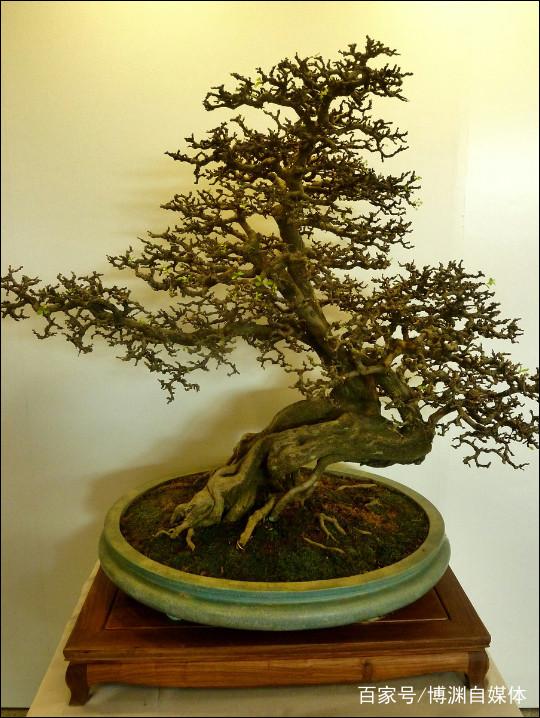
"Look at the tip of the pavilion's eaves, look at the foot of the bonsai" - a beautiful root spread will greatly increase the ornamental appeal of a bonsai. How do you get beautiful exposed roots? In the three-character motto, it is mainly achieved through three steps: expose, secure, and promote.
First, expose. For large stumps with good innate conditions, well-developed root systems, and roots naturally spreading in all directions with hanging roots and exposed claws, the root system has little plasticity. When growing the material or planting it in a pot, plant it directly in a deeper pot. After it survives, frequently use a bamboo stick or small knife to gently pry away the surface soil, prying away just a shallow layer each time, or use watering to wash and flush it, so that the roots are gradually revealed. Note that you should not expose too much at a time, nor too frequently; proceed step by step and do not try to pull up the seedlings to help them grow.
Second, secure. For stump material with many messy lateral roots, you can borrow the method used for root-over-rock bonsai: after pruning the roots, bind, braid, and fix them into a certain shape, then plant them in a pot. After the root system survives, gradually reveal the roots.
Third, promote. For some young broadleaf trees with rapid root growth and high root plasticity, when planting them in pots, cut off the main root and select and retain some roots of comparable thickness and vigor for cultivation, prompting them to grow longer and thicker downward. Each year when repotting, intentionally add a layer of growing medium at the bottom of the pot, then plant the stump material on top of it to raise the plant, and then trim the roots that rise above the pot surface so that the base roots are revealed. In this way, each year the roots grow a little downward and a little is exposed above, until the desired effect is achieved.