What does a "rotten-trunk style" bonsai mean? Let us introduce you to this bonsai form
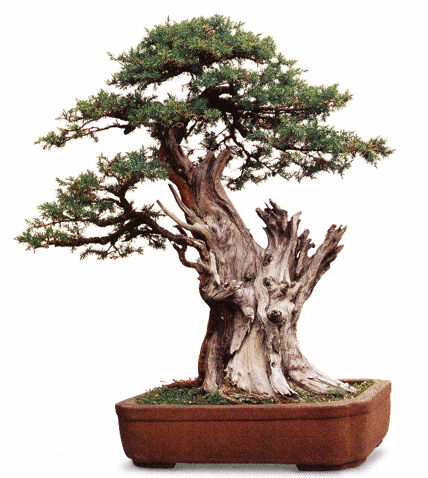
Rotten-trunk style bonsai. What is a rotten-trunk style bonsai?
Rotten-trunk style bonsai has two types: the cave type and the axe-cleavage type.
1. Cave type
(1) Morphological characteristics: the xylem of the swollen head and stem part has partly rotted away, leaving the cortex and forming a cave, displaying the great age of the tree and its doddering old appearance, giving people a sense of having weathered the vicissitudes of time.
(2) Key points of styling: according to the direction of the trunk and in combination with the root spread, make the cave the best viewing side as far as possible. Process the outline of the cave edge where it is too regular, so that both the outer contour of the cave and its shape have curvilinear variation. Arrange the branch pads according to the direction of the trunk; the bottom pad of the trunk rises upward, and the falling branch drifts downward and slanting, forming a contrast. The downward-falling branch and the tail end of the trunk, one above and one below, form a resisting force, increasing the sense of strength, and a second pad is set to break the straight-line flaw formed by the upper and lower branches and trunk. On the whole, one must ensure that the branches and branch forms are thick, short and vigorous, so as to match the agedness of the cave; the outer contour of the cave can be processed according to the intended image.
(3) Pot pairing: it is suitable to pair with a shallow oval pot or a round pot.
(4) Points for attention: branch nodes should be short rather than long, and flatness and straightness are taboo. The processing of the cave must not be too regular or too circular, so as to avoid appearing unnatural.
2. Axe-cleavage type
(1) Morphological characteristics: from the swollen base to the tree body, the xylem has largely withered and decayed, with the wood skeleton firm and peak-shaped, like an axe cleavage, appearing in a shari trunk state, with the bark at the edges remaining curled, the lines strangely curved, and the tree's bearing resolute and tragically noble, embodying an unyielding spirit of struggle. Jishan Huayao
(2) Key points of styling: sparseness is preferred, and simplicity is the principle. The drifting branch of the trunk falls by a large margin, branches emerge from high places, slanting out and rising upward, with the tail end curving and knotting upward, and the crown formed by scattered points; meanwhile, short branches extend horizontally to break the flatness and straightness, seeking variation. The overall shape needs no cloud-like green canopy; instead, with only a few branches, the tree's bearing is desolate and sparse, with dots of green leaves, expressing seeking glory within witheredness and standing firm tenaciously.
(3) Pot pairing: it is suitable to pair with a shallow round pot
(4) Points for attention: it is not suitable to have lush branches and leaves or to be top-heavy, which would make the trunk and branch styling uncoordinated and also violate the intended image of the design.