How to grow variegated-leaf orchids? Sharing my cultivation experience
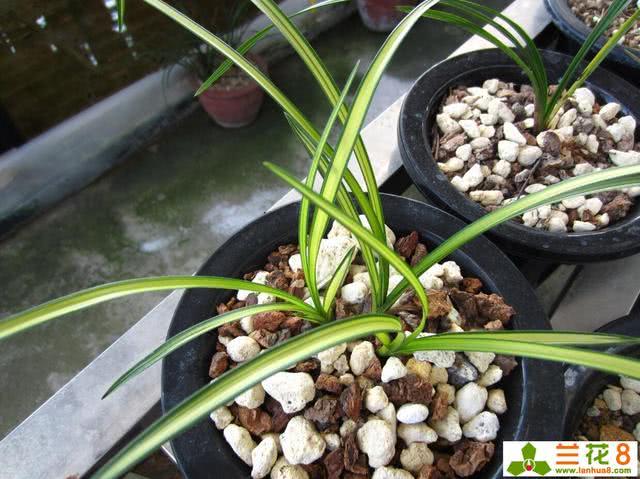
1. The amount of powdery silver. Powdery silver generally refers to those things that have not yet reached the stage of forming silver threads. It appears as a layer of grayish-white substance on the leaf surface and leaf underside of the orchid, like lime gently blown onto it, but it is not surface soil; rather, it is the kind of grayish substance that grows inside the leaf and cannot be washed off. If there is a lot of powdery silver, it will form a layer like pork fat, and this substance will play an important role in the later formation of variegation.
2. Silver and the position of the silver, surface silver and back silver. It is not enough just to have silver; the silver must be fine, dense and abundant. As for silver, the more the better, the denser the better, the finer the better. Generally, the silver seen is mostly located 1-2 cm down from the tip of the orchid leaf. If a large amount of silver is seen in this place, then this plant should be selected. Good silver is not only on the surface; it will also show on the back. As long as surface silver and back silver are expressed at the same time, such a plant should be selected. It may have even more cultivation potential than an obviously visible line variegation!
3. The distribution structure, flow and aggregation of silver. Just having silver in the orchid leaf does not necessarily mean it has good evolutionary potential. Some silver will never produce good variegation no matter how it is grown, while some silver can quickly produce variegation. The reason may be related to the distribution structure, flow and aggregation of the silver. Looking at stones in a river can give us inspiration. The larger the stones, because they cannot be moved by the water flow, always form a chaotic rocky shoal. This situation may be what books already refer to as ten-thousand-year silver. If the stones are very, very fine, fine enough to become river sand, then after being moved by water they form a sand belt. The silver in orchid leaves may follow the same principle: if the silver is very, very fine, it can flow; if it can flow, it may aggregate; if it can aggregate, it can form variegation belts and produce leaf variegation. Practical observation is also like this: fine silver can flow, and when it flows together it can gather. The place where multiple fine silver lines meet is the aggregation point, gathering into small coarse silver forms of different shapes. This is how to observe the flow and aggregation of silver.
Regarding the stability of variegated-leaf orchids, many orchid growers first ask this question: is such-and-such orchid stable? In fact, the question of stability depends on what it is measured against. Flower variegation emphasizes stability; no one dares to grow unstable flowers! If this year it is a plum-petal and next year it becomes a bamboo-leaf petal, then its value is gone! But for leaf variegation, you have to enjoy its variability. If a variegated-leaf orchid has no variability, it would be better to hang a painting at home. Only leaf variegation with variability is worth growing.
The understanding of the stability of leaf variegation is also the understanding of the variability (evolution) of leaf variegation. What kind of regularity does the variability of leaf variegation have? Generally speaking, there should be some. Under the conditions for selecting and breeding Cymbidium kanran leaf variegation mentioned above, the variability of leaf variegation has roughly several possibilities:
1. The variegation color becomes brighter and livelier with cultivation, the variegation becomes more abundant, the contrast becomes better, and it becomes more pleasing to the eye. This is what all orchid growers pursue, but it is not very realistic. Because variegation cannot advance endlessly; if it truly advances endlessly, this variegated orchid will ultimately come to an end. Within advancing variegation there is retreating; retreating is for the sake of better advancing, and that is the hard truth. Give high-variegation plants a little nitrogen, increase chlorophyll a bit to make them stronger, build up more nutrients, and store up a little for better performance in the next generation.
2. Loss of variegation occurs, meaning the variegation completely disappears on the new growth. This situation often appears during the care of leaf variegation. As long as the underlying foundation is good, losing variegation is only temporary, and when variegation returns it will be even better.
3. A shift from one variegation type to another. This situation occurs from time to time in variegated-leaf orchids. For example, from yin-yang striped variegation to claw-spot striped variegation, from claw-spot striped variegation to spotted striped variegation, from spotted striped variegation to central spotted striped variegation. A top-quality variegated-leaf orchid cannot have stable variegation; it may be changing at any time. Once it stabilizes, it has reached its end, and there is nothing left to enjoy! I publish orchid knowledge and pictures every day, taking you to understand orchids in depth and teaching you how to grow orchids easily. If you have questions about orchids, you can ask me anytime or leave a message below. If my knowledge has helped you, I hope you can give me a like or share it to help more people!