How to Tell Real and Fake Sterculia Apart? A Detailed Spring Identification Guide
About the author: One Hand Brush One Hand Flower, landscape architecture major, has deeply loved plants and nature since childhood, hopes to work in plant-related fields forever, in this world only beautiful flowers and delicious food are worth living up to, Weibo @One Hand Brush One Hand Flower
Sterculia monosperma and Sterculia lanceolata, their names differ by a single character, and both are little darlings under the genus Sterculia in the family Sterculiaceae, blooming gloriously with a tree full of spring color.
These two trees are quite common in Guangxi. On Wuxing Street here in my hometown, the real and the fake are planted side by side, blooming in response to each other. I photographed them last year, and this year as soon as the season comes the whole tree is bustling, and I couldn't resist adding a few new images to my phone.
Sterculia lanceolata and Sterculia monosperma trees look similar, but their flowers and fruits differ greatly
When Sterculia monosperma and Sterculia lanceolata are not flowering or fruiting, with a tree full of long oval leaves, wearing the plain and unremarkable appearance of evergreen broadleaf trees, I never stopped for them. But once they flower and fruit, they are like brides dressed in their finest, incredibly beautiful.
Sterculia monosperma
When Sterculia monosperma blooms, the terminal and axillary panicles hang in strings, cascading down like waterfalls, with densely packed flowers all displaying their splendor, and I could not move my eyes away under the tree.
The delicate flowers are about the size of a fingernail, split into five lobes to the middle, with the tips clinging together most exquisitely, like openwork wind chimes and little lanterns, or like tiny parachutes, truly fine handicrafts; every flower is a small world.
Image source see [1]
Through wind and sun, some Sterculia monosperma flowers can no longer hold their tips together and pop open with a snap, pretending to look like the five-pointed stars of Sterculia lanceolata, yet they are still betrayed by their slender bodies; the real cannot become the fake~ Sterculia monosperma's white is clear and elegant, the pink is tender and lovely, strings of little elves pour down, shaking their heads adorably in the wind, then drift down one after another, a ground full of exquisite gems.
Sterculia monosperma is also known as phoenix-eye fruit and nine-layer skin; those who know its other names naturally know how delicious its seeds are. Cooked, they taste like chestnuts, starchy and fragrant, and are very tasty in chicken soup or pork rib soup; Cantonese people probably know better how to eat them. I hear that in some places people also use Sterculia monosperma leaves to make snacks, which is quite distinctive too.
Sterculia monosperma follicles come in pairs of two
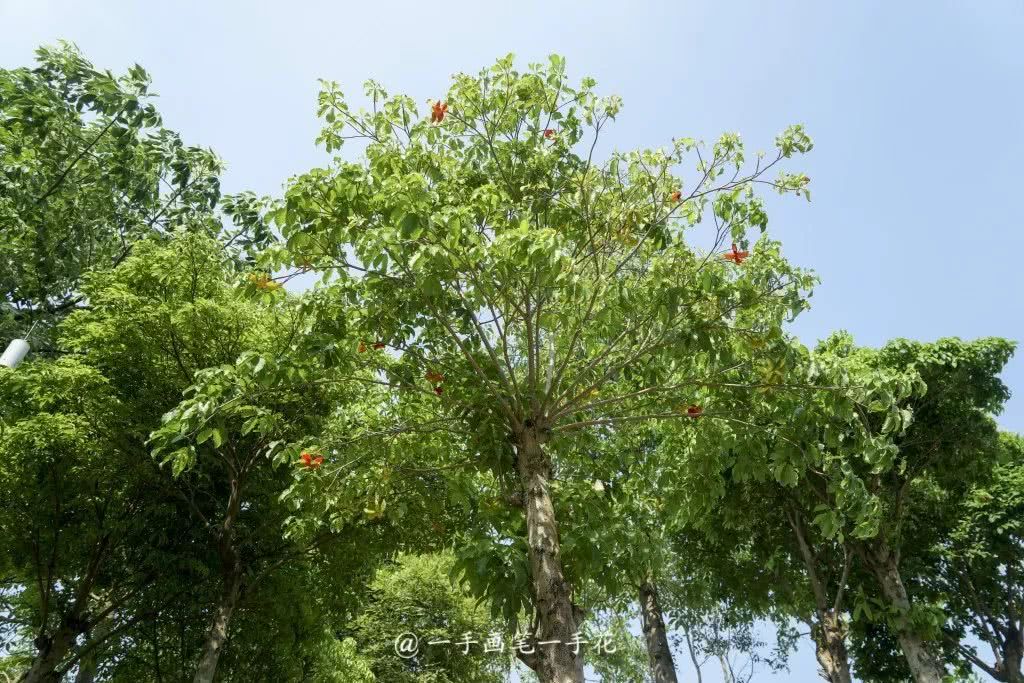
Now look at Sterculia lanceolata: the flowers poke their heads out from the dense leaves, waiting for people to look up at them from under the tree. Some are pure pink, some are pink-yellow tinged with green; looking at just the axillary flowers, the calyx is split into five lobes, a tiny five-pointed star, somewhat like Rangoon creeper.
Author: Marina Khaytarova, source see [2]
The fruit of Sterculia lanceolata is even more outstanding than its flowers. I was amazed long ago by photos of its fruit online, and seeing it in person made me even happier. The five narrow, elongated fruits start green-yellow, gradually turning orange-red, and when the fiery red fruit splits open, that is her most beautiful moment.
A single fruit pod of Sterculia lanceolata looks very similar to that of Sterculia monosperma, hence the name, but it is more slender. The two also have their own styles: Sterculia monosperma comes in groups of two, while Sterculia lanceolata comes in groups of five.
Sterculia lanceolata follicles come in groups of five
The seed pods, like starfish, hold black pearl-like seeds; the seeds are smaller than those of Sterculia monosperma, and have a somewhat magical look that is unforgettable. Fallen pods are like fallen flowers, red petal by petal, occasionally still holding a black pearl that has not dropped out. Picking up the seeds scattered on the ground, once the black seed coat is removed, the inside is orange-red. The seeds are also edible and can be pressed for oil.
The real Sterculia monosperma is not Sterculia lanceolata, and the fake Sterculia monosperma may be Sterculia lanceolata. Real and fake join forces, dense and bustling, stirring up spring.
The author photographing flowers
[1]http://taibnet.sinica.edu.tw/uploads/20150602161136_418327_0.jpg
[2]https://toptropicals.com/pics/garden/m1/Podarki_15/Sterculia_lanceolata_4_MKh.jpg
Author: One Hand Brush One Hand Flower
Images: One Hand Brush One Hand Flower / Jiang Someone / Internet
This work is licensed under the (CC BY-NC-ND 4.0) license agreement; please retain this statement when reposting.
iPhone users can tip the author via the QR code below