Which Succulents Are the Most Attractive? A Veteran Gardener Tells You the Answer
In recent years, green succulents have become increasingly popular. They are plump and fleshy. Though not as showy as flowers in full bloom, they have full leaves, a compact form, and a peculiar, cute shape, and they also have an anti-radiation effect. Placing a pot of succulents indoors lets you admire these little things after reading for a long time, which can also relieve eye fatigue. But growing succulents also has its particular requirements.
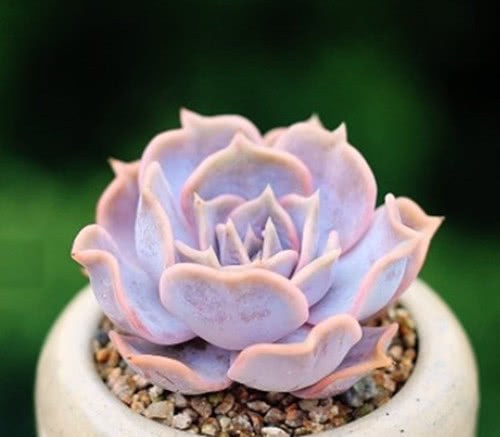
1. Echeveria 'Lilacina'
Echeveria 'Lilacina' is a succulent in the Crassulaceae family. Its leaves are arranged in layers in a rosette, like pink-blue lotus leaves, and it has ornamental value. Echeveria 'Lilacina' likes a warm environment, loves light, and is drought-tolerant but not moisture-tolerant. To grow Echeveria 'Lilacina', you need to choose breathable soil with good drainage; a mixed soil is generally best, such as charcoal ash and coal cinder. Spring and autumn are the growing seasons for Echeveria 'Lilacina'; at this time sunlight is abundant, so you can water a little more. When the soil dries out completely, you can water thoroughly once, but never pour water into the center of the leaves. In the high temperatures of summer, you need to restrict watering and place it in a cool, ventilated spot to gradually stop watering. The same applies in winter; when the temperature is below zero, reduce watering, but do not stop completely - you can give a little water at the roots. The suitable growing temperature for Echeveria 'Lilacina' is between 15°C and 25°C. It is propagated by leaf cuttings and beheading. Once you master the method, it is a very easy plant to grow.
The flower language of Echeveria 'Lilacina': eternal love, a fresh romance.
2. String of Pearls
String of Pearls is a type of succulent. Its leaves are fleshy, round and spherical, with a transparent longitudinal line in the center of each leaf and a slightly pointed tip at the end. The stems hang down or creep along the soil surface, so people often grow it as a hanging basket plant. From March to December each year is its growing period, with a brief dormancy in summer. If there is insufficient light, the plant tends to become leggy and the stems become fragile. Plants grown in a sunny spot have a creeping habit with sturdy stems and plump leaves. During the growing period, keep the soil slightly moist and avoid waterlogging. The soil can be coal cinder mixed with peat and a small amount of perlite. In winter, try to keep the temperature above zero; if the temperature is too low, the plant is prone to frost damage and death. For propagation, you can simply cut off a long section, take a healthy piece, let the wound dry, and insert it into moist sandy soil.
Plant flower language: jade beads, lover's tears.
3. Haworthia cooperi
Haworthia cooperi, in the Asphodelaceae family, Haworthia genus, is small and cute. It does not grow very large, but it easily forms clusters. You can insert a toothpick into the soil; if it comes out with moisture on it, delay watering. Keep it in a bright place without direct sunlight; if the sunlight is too strong, the leaves turn gray. The growing season is from spring to autumn. In the hot summer, reduce watering. During the growing period, give sufficient light; if it is too shaded, the plant will become loose and not compact, and the leaves will be thin and elongated. If the sunlight is too strong, the leaves will grow poorly and turn light reddish-brown. Sometimes strong direct sunlight can scorch the leaves, leaving ugly scars. Grown in partial shade, Haworthia cooperi has thick, plump leaves with high transparency. As an ornamental plant, Haworthia cooperi is suitable for growing in a small pot and displaying on a windowsill, desk, writing table, balcony, etc. It is very elegant and beautiful.
The flower language of Haworthia cooperi: pure as ice and jade.
4. Living Stones
Living Stones belong to the order Caryophyllales. They are perennial succulent herbs, almost stemless, with spherical leaves in varied colors and a relatively hard leaf epidermis. The top has dark tree-branch-like sunken lines or patterned spots, called "windows." There is a fissure at the top of the plant, and flowers emerge from the fissure. The flowers are solitary, daisy-like, white or yellow, with a flowering period from midsummer to mid-autumn. Living Stones are shaped like colorful stones, richly colored, small and exquisite, and have the reputation of being "living stones." For growing Living Stones, they like a climate that is warm in winter and cool in summer, and they like a dry environment with plenty of sunlight. They are afraid of low temperatures and avoid strong light, and are best grown in loose, breathable, neutral sandy loam. Watering is generally done at night or in the early morning when the temperature is lower; it is not advisable to water during the hotter daytime, so as not to harm the plant due to a sudden drop in temperature. Living Stones cannot be exposed to prolonged rain or heavy rain, otherwise the top of the plant will split from absorbing too much water. When watering, follow the principle of "do not water until dry, and water thoroughly when you do." Apply a decomposed, diluted liquid fertilizer about once every 20 days. Living Stones have a peculiar form and gorgeous flowers, and have high ornamental value.
The flower language of Living Stones: love stronger than stone.
Besides these four succulents, how many others do you know? You are welcome to share your views in the comments section below. If you like this article, you might as well subscribe, and more wonderful articles will be shared with you.