Aloe vera is always being killed by novice gardeners, and the plants suffer terribly
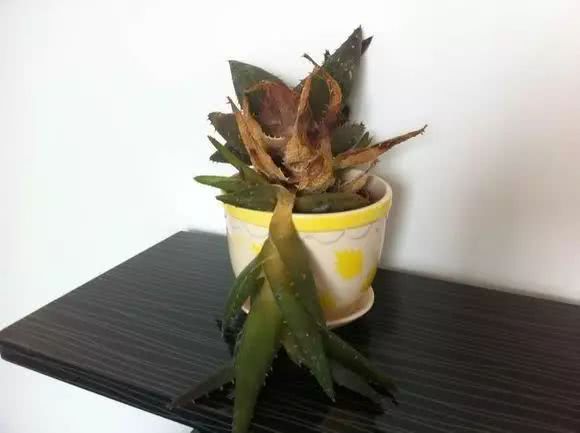
Case 1:
The plant lover below does not really know how to care for plants, but she loves aloe vera and nothing else. She bought this pot and placed it next to her computer, where it kept her company day and night, and she watered it sparingly as the flower shop owner instructed.
However, some time ago the leaves turned yellow. She thought the aloe might be thirsty and dry, so she gave it a cup of clean water, and within two days it turned out like this! She was heartbroken.
Aloe death analysis:
Netizens praised her as a "finishing-blow expert." By the time an aloe's leaves turn yellow, it is actually already beyond saving. Hers had been kept next to a computer for a long time and had never seen sunlight. Yellow leaves were a result of long-term lack of light, and the leaves had already become soft.
At this point, instead of giving it sunlight, she watered it, which successfully ended the aloe's life quickly. With an owner like this, it really is hard to survive.
Case 2:
The plant lover below often has to go on business trips. She heard that aloe vera can go for a long time without water, so you can see the aloe below: dried out and rotten.
When she came back from her trip and was about to throw it out, she accidentally touched a leaf, and before it died the aloe squirted a mouthful of brown liquid onto her. It felt like the aloe was so sad!
Analysis of aloe wilting and stem rot
Keeping it in a sealed space with no sunlight and no air circulation is fatal to aloe, because it likes plenty of sunlight and needs a ventilated environment, with the potting soil slightly dry, but not overly dry.
3. Questions plant lovers often ask about growing aloe
1. A plant lover asks: Is sunlight a must for aloe?
Aloe is a tropical desert-type plant, so of course it needs sunlight most of all. Some plant lovers praise it as a "tough nut" that actually does worse when pampered too much. Except during the scorching summer heat, it can get plenty of light in all other seasons. If the aloe leaves are sunburned brown or red, that means the sunlight is too strong, and it needs to be moved to indirect light or a slightly shaded spot.
2. A plant lover asks: My aloe leaves have turned red, the leaf tips have turned brown, and they are slightly shriveled. Will it die?
The turning red sometimes means the plant is getting too much sun. Make sure there is good drainage. If it is in a pot, do not let it stay too dry. It is not a cactus.
An aloe that turns red like this proves it is getting too much light and the leaves lack chlorophyll. It needs slight shading, or moving to indirect light. Make sure the soil drains well, and do not let it stay dry for too long. When the potting soil is completely dry (the top 3 to 5 cm of soil is dry), give it water.
3. A plant lover asks: Why do my aloe leaves curl toward the center of the leaf rosette?
This plant is not getting enough water. When the leaves curl inward, the plant, wanting to survive, absorbs water from its own leaves.
This is because the aloe is not getting enough water. When aloe leaves curl inward, the aloe, wanting to survive, desperately absorbs water from the leaves. The leaves then have no water, look less plump, and curl inward.
Check whether the potting soil has become compacted, loosen it appropriately, and do not let the potting soil get too dry; keep it slightly dry.
4. A plant lover asks: The center of my aloe leaves seems to be turning a bit yellow, with signs of rot. How should I save it?
This is the bad situation of overwatering aloe. The stem at the center of the leaf rosette has already rotted, and once the root stem rots it will slowly spread to the leaves. In this case there is basically no saving it. If the center of the leaf rosette has only just started to turn yellow, then you can keep the potting soil dry and give it appropriate light, and there is still a chance of recovery. But now that the stem has rotted, there is no saving it.
5. A plant lover asks: What type of soil should aloe plants be planted in?
Aloe leaves are full of water, and it also counts as a succulent, so it likes loose, sandy soil. You can use leaf mold + fine sand at a 2:1 ratio, or garden soil + fine sand at a 2:1 ratio. If you need to buy soil yourself, you can use peat soil + perlite/fine sand at a 1:1 ratio.
6. A plant lover asks: My aloe has been growing for many years and is already very old. The stem has become woody, the stem has turned white, it is very dry, and it often peels and flakes off. Is this normal?
After an aloe has been grown for many years, the stem will become woody, and the lower leaves will wither and fall off. This is all normal. The small shoots growing from the root stem area can be used for propagation by division.