Pruning orchids after they bloom is very important, and the flower spikes will sprout quickly year after year.
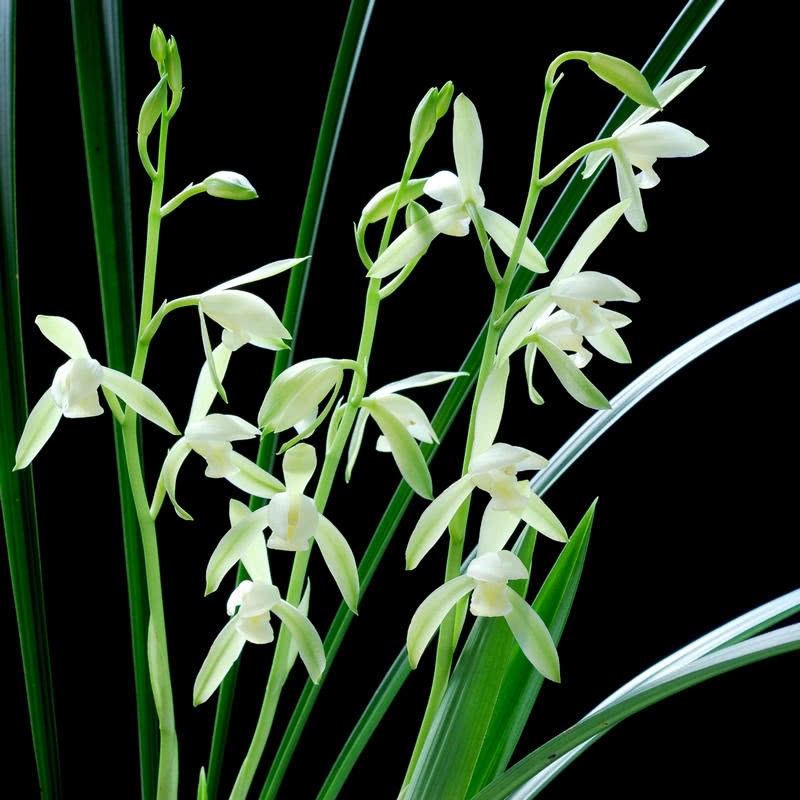
After an orchid finishes blooming, do the flower spikes need to be pruned off, and how should they be cut? Today we will talk about this issue, using Cymbidium ensifolium as an example.
The flower stems of Cymbidium ensifolium can absolutely be cut off after blooming.
Not only should they be cut off, but they should also be cut off a bit earlier. Of course, this does not apply only to Cymbidium ensifolium; other orchid varieties should also have their spent flower stalks (flower spike stems and branches) cut off as early as possible after blooming.
Why? The main reason is to preserve more nutrients in the plant to supply the normal growth of other shoots and seedlings, and the next normal blooming. Therefore, in order to reduce excessive consumption of nutrients in the plant, prompt the current year's fresh seedlings to mature earlier, and lay a good foundation for blooming the following year, the flower stalk should definitely be cut off within a short time after blooming. Not only should it be completely cut off, but the flower stalk should be cut off within a short time after the last flower opens.
If they are allowed to bloom freely, under suitable temperature conditions, from the first flower to the last one takes about more than a month, and some blooming periods are even longer, which will inevitably cause excessive consumption of nutrients in the plant. Therefore, in order to make it produce more seedlings, produce good seedlings, and bloom better the following year, do not be reluctant to cut. When cutting, the cut should be 1.5 cm to 2 cm away from the pseudobulb or the soil surface, to prevent harmful pathogens from invading through the wound.
In orchid seedling farms or orchid gardens of a certain scale, how is management carried out during the flowering period? When it is already known what a variety's flowers look like, these orchid seedlings are generally not allowed to bloom (for example, the Cymbidium ensifolium variety Xiaotaohong). Not long after these orchid seedlings' flower spikes emerge from the soil, they are cut off. The purpose is to reduce the plant's nutrients and let the plant produce more seedlings and grow good seedlings. If a certain batch of flowering seedlings is about to be sold, in this situation the flower spikes are generally not cut.
In addition, for some rare and precious varieties and some varieties whose flowers have never been seen, during management, excess flower spikes and flower buds are usually thinned out, leaving only one flower spike and one or two flower buds per plant. They are allowed to bloom so that the flower color and flower shape can be observed and the floral fragrance smelled. This is mainly to observe the blooming quality of that orchid variety. An even greater purpose is still to reduce nutrient consumption in the plant, so as to facilitate the normal nutrient supply for the plant's newly emerging seedlings. Therefore, after orchids bloom, the spent flowers and spent branches very much need to be completely cut off as early as possible, so as to benefit the normal development and growth of the orchid seedlings.