The finest quality snow fungus takes three months to grow, worlds apart from the 35-day fast-grown kind
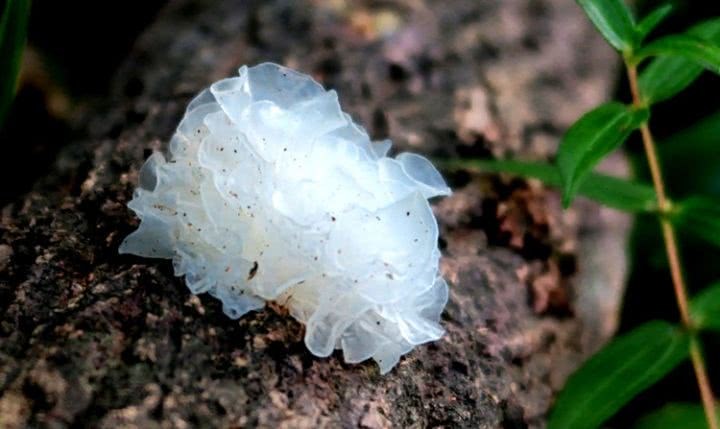
I used to always feel that snow fungus had a texture like a bath loofah when eaten, just like how Squirrel Jun felt as a child that eating beef tripe was like chewing on a wet towel. So snow fungus had no place in Squirrel Jun's diet back then. In recent years, there was a sudden change of heart, and now I've come to love eating snow fungus, for a very simple reason: sweet in taste without being cloying. Squirrel Jun recently met a remarkable old man who is quite knowledgeable about snow fungus, and thus gained a new understanding of snow fungus in life.
Did you know there is also a finest-grade among snow fungus?
Tongjiang snow fungus is prized as the finest of all snow fungus. Tongjiang is in Tongjiang County, Bazhong, Sichuan, and has long been known as the "Hometown of Chinese Snow Fungus." There it enjoys a subtropical monsoon climate that snow fungus loves: warm springs and crisp autumns, hot summers and cold winters, four distinct seasons, and year-round mist and clouds. Local fungus farmers always like to say: "Our snow fungus comes from heaven-born mist, mist-born dew, dew-born fungus," describing the growing environment of Tongjiang snow fungus as something like a fairyland.
The cradle that nurtures snow fungus
As early as 2005, at the 2nd China Western International Agricultural Expo, Tongjiang mushrooms and fungi were rated gold award by experts, earning the praise of "two fungi and one mushroom, somewhat famous." In 2013, Tongjiang County completed the construction of "5 times 50,000 mu" industrial bases, developing 1.115 million mu of various under-forest economies including edible fungi, tea, walnuts, and Chinese medicinal herbs. The output value of edible fungi alone reached 1.82 billion yuan, including the snow fungus that Squirrel Jun wants to talk about.
The difference between the finest grade born in three months and the 35-day fast-grown product!
Tongjiang snow fungus can stand out among all snow fungus. One reason is its unique climatic conditions, and another reason lies in the different cultivation methods. Please remember the log cultivation method, because the packaged snow fungus we buy in supermarkets is all mass-produced by substitute material cultivation. These two methods are completely different, like the difference between a cow cooped up in a shed eating feed and one listening to music while eating fresh green grass.
Mass-produced snow fungus from substitute materials
Log cultivation of snow fungus brings us to the second plant Squirrel Jun wants to mention: Oriental oak, a plant in the Fagaceae family. In some parts of southwest China it is even called a dominant tree species, and in mixed forests it becomes the tree species with the largest proportion of growing stock. Local people for generations have used only Oriental oak as the host tree for snow fungus spawn. So every year in early spring in March, to find host trees, fungus farmers cut Oriental oak from the mountains. There are requirements for selecting Oriental oak material: usually trees grown on sunny slopes, 7 years old, with a trunk diameter of more than 8 cm and a length of about 1 m. Fungus farmers call this "sit at seven, cut at eight," fully reflecting the pursuit of economic value while paying attention to the sustainability of natural resources.
After the Oriental oak is dried and drilled, spawn inoculation must be completed in early April. The prepared logs are arranged in a "person" shape or a "well" shape and placed in a fungus house (fungus room) carefully built by the fungus farmers. Water is sprayed to maintain moisture while waiting for the spawn to develop mycelium and grow fungus buds.
Logs arranged in a "person" shape
During the long three-month growth process, the mycelium gradually spreads into the logs, slowly chewing on the wood. The fungus base slowly unfurls bit by bit, eventually growing into flower-like snow fungus. For substitute material cultivation, these processes are much faster: 35 days complete a three-month process. You can imagine the snow fungus mycelium in substitute material feasting on artificially prepared "feed." By 60 days it has already become dried goods in packaging bags.
The recorded history of snow fungus cultivation is not even as long as American history!
China's first recorded cultivation of snow fungus was in 1800, only about two hundred years ago, not even as long as American history. During the Guangxu period of the Qing Dynasty, people began exploring a semi-artificial, semi-wild cultivation method for snow fungus. Because this cultivation method depended almost entirely on the weather, the market price of snow fungus was extremely high: one complete piece of snow fungus cost several dozen taels of silver. Moreover, even if you were a wealthy official or noble, spending money did not necessarily get you good snow fungus. At that time, the best snow fungus was already monopolized by officials and specially supplied to the royal family. In particular, Tongjiang snow fungus was famous far and wide as early as the Guangxu period of the Qing Dynasty. In the late Qing period it was especially favored by Empress Dowager Cixi and became a delicacy on the Qing court's imperial meals.
Snow fungus went through three cultivation stages. With each advance in cultivation technology, snow fungus finally achieved mass production and entered ordinary households. At first, natural spore inoculation was adopted, a simple and crude method: logs were placed near wild snow fungus to receive some naturally falling snow fungus spores and wait for fungus to emerge, completely handing the right of inoculation to nature. As a result, the inoculation rate could not be controlled artificially, and snow fungus yield was very low.
The second technological innovation adopted spore suspension culture: spores were collected in advance, a culture solution was prepared and mixed with the spores, fully stirred, and finally made into a spore suspension of a certain density. In this way, yield per unit increased by nearly 7 times compared with before.
Finally, modern technology became even more advanced. Through isolation of snow fungus spawn, strains with strong stress resistance and relatively stable genetic traits were obtained, then breeding and domestication were carried out. This greatly shortened the cultivation cycle and was vigorously promoted across the country, which led to the emergence of Gutian in Fujian as a major mass-production province.
The finest snow fungus comes with a double texture!
At Squirrel Jun's current age, I'm afraid I've eaten over a thousand bowls of snow fungus soup. Throughout the four seasons, when out and about, there is nothing more soothing to the lungs and satisfying to the craving than ordering a bowl of snow fungus soup. Meeting the remarkable old man, I also had the good fortune to try Tongjiang snow fungus. This snow fungus was a compressed soup block, ready to brew and eat right after opening the bag. Usually it is paired with goji berries and red dates, but this was just a small block with nothing else, so it truly lacked a bit of anticipation.
When soaked in hot water, Tongjiang snow fungus is smaller than ordinary snow fungus, but the difference soon becomes clear. The water quickly becomes thick and viscous, showing rich gelatinous substance. Overall it is white as jade and translucent, with thick fungus pieces. Another point is that the fungus base is small. Ordinary snow fungus always has a clump of yellowed fungus base that eats hard, like a dough lump with a poor texture. This one's yellow fungus base portion is very small. It tastes sweet and pleasant. The most interesting part is that in the mouth it has two textures: it is clearly thick and gelatinous, yet it does not completely melt; chewing to the edge of the fungus pieces instead gives a little springy surprise, as the final experience of the taste buds.
Welcome to follow Plant Fan, Squirrel Jun will chat about flowers and plants with you!