Why is the water in the fish tank cloudy? Hangtai Aquarium explains
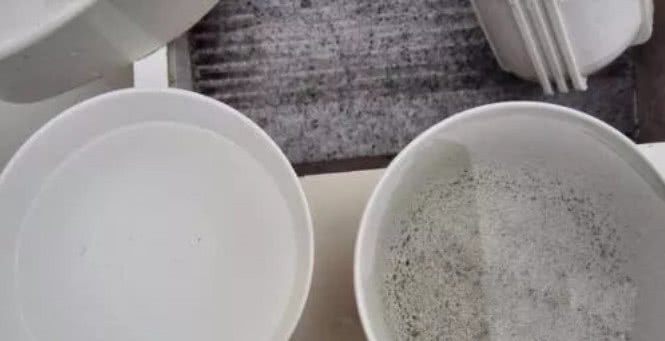
When refined salt is dissolved in water, the resulting solution is clear and does not appear cloudy. If refined sugar is dissolved in water, the same result can be obtained. When substances of this kind are completely dissolved in water, the resulting solution is quite clear, because these substances spread evenly through the water in very small units (atoms or molecules), just as ordinary tap water also has nitric acid, chlorine and other substances dissolved in it, yet the water we see is as clear as a mirror.
If flour is added to water and stirred with a spoon, the water appears white and cloudy. After a period of time, most of the flour will settle to the bottom, and the clarified part is separated from the sediment, because flour cannot dissolve in water, thus producing a cloudy phenomenon.
So-called turbidity is a state in which particles of a certain size (1μm or larger) float in water. The tap water we use has no turbidity, but lakes or rivers in nature will more or less have cloudy conditions, because the water contains many suspended substances that produce turbidity. Suspended substances include organic matter, inorganic matter, living organisms and non-living matter, and the causes of turbidity are not fixed.
The turbidity phenomenon in a planted tank also has no specific factors; it is just that compared with the wild, there are fewer influencing variables, so it is easier to find the cause.
Why is the water cloudy?
In a planted tank, aquatic plants, fish and shrimp, and microorganisms coexist with one another. When the ecology reaches a good balance, the water quality presents sparkling, transparent water. When water quality changes in an old tank, or when the ecology of a newly set up tank is not yet sound, water turbidity is likely to occur. Although the water quality will clear up for a period after a water change, after several hours it still appears cloudy. The reason is that when untreated new water is poured in, or when new fish or new aquatic plants are introduced, the attached plankton, algae, algae spores, protozoa, etc. enter the tank; or when fish food is added in excess, and settled decaying organic matter and bacteria suddenly increase, the normal amount of microbial community in the original tank cannot decompose the excessive organic matter for a time, causing water quality to deteriorate and leading to turbidity. In severe cases, it even gives off an odor into the air.
Cloudy water manifests in many ways. Today we will talk about several of the more common ones.
1. Milky white water quality
1. Milky white water quality usually appears when a tank is first set up. It is generally caused by the reproduction of protozoa, resulting in milky white water, but a small portion is also caused by the lime content in the sand and gravel used.
2. The general situation is that from the day after the tank is first set up, because the aquatic ecology has not been established, the water appears white. If it is not treated promptly, by the fourth day the water quality becomes a moving (water-flow) white cloud-like mist.
2. Biological milky white turbidity
When a tank is first set up, if fish food is added excessively and the nitrifying bacteria in the filter are scarce, they cannot decompose a large amount of organic matter within the same period of time, causing an excess of remaining organic matter. This makes plankton that feed on organic matter reproduce. When plankton reproduce in large quantities, protozoa that prey on plankton appear. When the number of protozoa reproduced is large, the protozoa throughout the entire tank present a milky white water color. This is the factor that causes milky white turbidity in water quality.
In addition, plankton attached to sand grains will reproduce in large quantities upon contact with water, and therefore the protozoa that prey on this plankton will also reproduce in large quantities, which is also a cause of water turbidity.
Others, such as fresh frozen red earthworms, live water fleas or live sludge worms, etc., if added as bait into the tank without disinfection, will bring in plankton that reproduce, causing an increase in the number of protozoa, which is also one of the causes of turbidity.
When milky white water quality caused by biological factors occurs, the following solutions are provided:
1. Add EM groups to decompose organic matter in the water and convert it into nutrients for aquatic plants (biological method).
2. Install strongly adsorbent filter cotton in the filter (such as wool felt, extremely fine-pore foam, wood charcoal powder blocks/bags, etc.) to quickly adsorb organic matter in the water. The best method is to rely on a filter with good tank ecology (with many beneficial microorganisms attached to the filter material), which has an even better effect (biological method + physical method).
3. Add enzymes to the water. They can quickly decompose organic matter in the water. After elimination, plankton in the water cannot survive and are reduced. When beneficial nitrifying bacteria reproduce, the water quality will clear up. (Water clarifiers include EM, enzymes, particle-binding coagulating precipitants, etc.; please do not confuse them.)
4. When water quality is severely malodorous, use ozone (O3) aeration to oxidize the marsh gas, eliminate the malodor and sterilize, which can clarify the water quality.
5. UV sterilization: For turbidity caused by the large-scale reproduction of ciliates attached to fish bodies placed in the tank, in addition to frequent water changes, an aquarium ultraviolet sterilizing lamp can be used to kill ciliates and plankton in the water and clarify the water quality. (Physical method)
6. During periods of turbid water quality, do not forget that frequent water changes are the best policy.
3. Calcareous milky white turbidity
Although the bottom sand of a newly set up tank is washed before being put into the tank, after the sand grains originally exposed to air in the packaging bag oxidize, the remaining lime content enters the tank. After water is added, some sand grains continue to dissolve the lime content in the sand, causing water turbidity.
The turbidity usually caused can be divided into three types of particles:
Large particle suspension: usually settles on its own.
Small particle suspension: suspended in water, must rely on water changes to dilute it so the water quality clears.
Colloidal particle suspension: cannot settle on its own, and good results cannot be obtained even by water changes. At this time, a chemical molecular coagulating clarifier must be used to clarify the water quality. (Usually the colloidal particle suspension is caused by the sand and gravel used.)
When using a chemical molecular coagulating clarifier, after the water quality clears, the sediment settled on the bottom bed must be siphoned out cleanly with a hose.
When the water quality pH is higher than 7.2, adding chemical fertilizer (especially chemical chelated potassium) will still temporarily make the water appear white and misty (milky white turbidity), and it will naturally clear after six hours.
4.Green and brown turbidity
Generally, water in lowland swamps or lakes appears light tea-colored or green and cloudy. This is caused by floating algae (plant plankton) in the water. In eutrophic lakes, the amount of plant plankton increases sharply.
The same is true in planted tanks. Too many fish, poor filtration function, direct sunlight exposure or excessive light will all cause rapid reproduction of plant plankton (algae) and may cause "green water" or "yellow-green water." If this happens, thorough water changes must be carried out, the number of fish must be effectively controlled, and direct or indirect sunlight exposure must be prevented.
The water used in planted tanks generally comes from tap water, mountain spring water or river water. If the algae or spores floating in the raw water are not killed before the raw water is poured into the tank, and it is directly poured into the planted tank, the algae spores will reproduce due to the light source in the tank combined with the absorption of nutrients, causing the water quality to become turbid, green or yellow-brown.
If unfortunately the water poured in contains a large amount of toxic algae, it will cause the death of fish, shrimp and aquatic organisms, but many people are unaware of it. Toxic algae include typical green flagellates, brown flagellates, yellow flagellates, blue-green algae (not all blue-green algae are toxic; only some varieties of blue-green algae are toxic), dinoflagellates, etc.
5. Sources of phosphorus (P)
The growth of algae in planted tanks is the greatest trouble for aquatic plant enthusiasts, and the main food source of algae is "phosphorus" (P). To avoid algae growth, one should first understand the sources of "P," the staple food of algae, in order to eliminate algae reproduction. The following are the sources of P:
What is frightening is that laypeople sell or buy hydroponic-formula macroelement fertilizers, whose contents of n, p, k (nitrogen, phosphorus, potassium) include n and p, both of which are the chief culprits for algae in planted tanks.
When river water is used, the water may still contain phosphorus from synthetic detergents used for washing (bleaching clothes), or the same applies when domestic wastewater flows into rivers. When artificial feeds contain excessive phosphorus components such as fish bone meal and shrimp shell meal, algae are likely to grow.
To eliminate turbidity caused by algae, the following methods can be considered:
1. Use an ultraviolet sterilizing lamp to kill algae in the water, etc.
2. The phosphorus content in the water should be as close to 0 as possible, or should be lower than 0.02mg/L; at the highest it should not exceed 0.2mg/L p, otherwise it is difficult to control algae growth.
3. Chemical agents, such as copper elements, can kill algae. When the amount is large, it will affect aquatic plants, causing them to stop growing or causing beneficial microorganisms in the tank to die. (If not absolutely necessary, use is not recommended.)
4. Use diatomaceous earth as filter material to filter and strongly adsorb algae in the water. Pay attention to the detection and control of COD (chemical oxygen demand).
5. After adding live bait (including frozen live bait or live red earthworms, etc.), remember to siphon up the feed that sinks to the bottom afterward and change the water.
6. Use peat moss as filter material, which can lower high pH.
7. Use an ozone machine for aeration, which can oxidize excess nitrogen and phosphorus fertilizer in the water. After the water quality clears, add proper liquid fertilizer. O3 can sterilize, kill algae, oxidize heavy metals and pesticide components, and remove ammonia (hair algae, blue-green algae) and NO2 (brown algae).