10 kinds of flowers that must never be sprayed with water on their leaves - spray one and it dies!
Wax begonia (Begonia semperflorens-cultorum) - don't spray water, spray it and the leaves rot!
The leaves of wax begonia have many fine, dense little hairs. If you spray water on the leaves, the water droplets will stay on the leaves and cannot slide off or evaporate - they all get stuck on the hairs, and over time this causes the leaves to rot.
How to water correctly?
In spring, water about once every 3-5 days. When watering, slowly pour along the edge of the pot, don't pour from the top; you can spray water into the surrounding air to ensure sufficient humidity. In summer and winter, it enters dormancy - wait until the soil cracks before watering.
Gloxinia (Sinningia speciosa) - don't spray water, spray it and the leaves rot!
Like wax begonia, gloxinia also has hairs on its leaves. Once water is sprayed on the leaves, it will also cause the leaves to rot.
How to water correctly?
Before watering, you can dig about 2cm into the surface of the potting soil. If you find the soil is on the dry side, then water. When watering, slowly pour along the edge of the pot until the soil is thoroughly soaked. The time can be chosen before 10 am.
Cyclamen - don't spray water, spray it and the buds rot!
Cyclamen's leaf buds are very afraid of water. Once water is accidentally sprayed on them, the leaf buds will rot directly. During the flowering period, you absolutely must not spray water, otherwise it will cause the flowers to rot and then fall off directly.
How to water correctly?
Normally, water when you see the flower stems become slightly soft. It is best to use the soaking method for watering, adding a little 0.2% potassium dihydrogen phosphate solution to the water; to avoid root rot, you can choose a breathable, loose sandy soil.
Gerbera daisy (Gerbera jamesonii) - don't spray water, spray it and the buds rot!
Like cyclamen, gerbera daisy's flower buds are also especially afraid of getting wet. Once they touch water, the flower buds will rot, causing the buds to drop - let alone wanting them to bloom!
How to water correctly?
Normally you can touch the leaves with your hand. If the leaves are slightly soft but not wilted, it basically means it's time to water. When watering, it's best to water until water leaks out from the bottom of the pot, then wait half an hour and touch the leaves again - they will have become firm. If the leaves haven't improved half an hour after watering, it may be root rot!
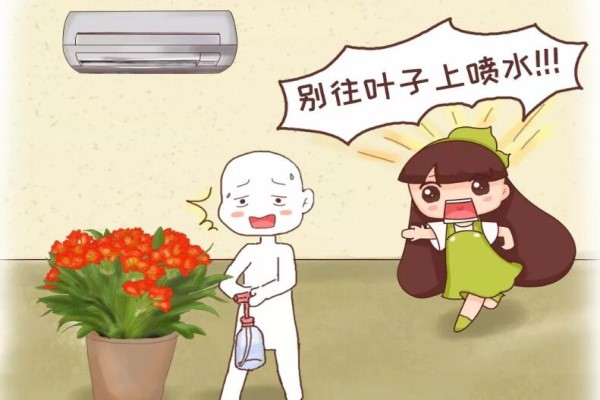
Clivia (Clivia miniata) - don't spray water, spray it and the core rots!
Although clivia's leaves don't have hairs, if you spray water toward the leaves, the water droplets will flow along the leaf veins toward the center, gathering at the leaf core. If the water cannot evaporate for a long time, the core will rot!
How to water correctly?
In spring, water clivia about once every 5-8 days, and absolutely don't wait until the potting soil is completely dry before watering. If the potting soil is too dry, you can use the soaking method, with the water depth at 1/3 of the flower pot. If you feel the leaves are really too dirty, you can gently wipe the leaves with a damp cloth.
Succulents with hairy leaves - don't spray water, one pot of water and they rot!
Besides the flowers in your home, many succulents also have hairs on their leaves. Once water is accidentally poured on the leaves, it will cause black rot. For example, bear's paw (Cotyledon tomentosa), Echeveria pulvinata, rabbit ear (Kalanchoe tomentosa), etc.
1. Bear's paw (Cotyledon tomentosa)
Bear's paw leaves have hairs. Absolutely don't directly use a spray bottle to spray water on the leaves, otherwise they will easily rot.
How to water correctly?
In spring, watering about once a week is enough. If there are many rainy days, causing the air humidity to increase, it's best to choose a watering interval of 1.5-2 weeks.
2. Echeveria pulvinata
Echeveria pulvinata has fine, short hairs on its leaves. If water accidentally touches the leaves and cannot be dealt with in time, it will cause rot.
How to water correctly?
In spring, watering about once every 10 days is enough. When watering, slowly pour along the edge of the pot, and absolutely don't let it touch the leaves.
Succulents with powdery leaves - don't spray water, spray it and they rot!
Besides hairs, some succulents also have a powdery substance on their leaves. This substance not only makes the succulent cuter but also protects the succulent's leaves. Therefore, this type of succulent also cannot be sprayed with water, such as Pachyveria 'Clavifolia', Saussurea involucrata, and Echeveria 'Carola', etc.
1. Pachyveria 'Clavifolia'
The surface of Pachyveria 'Clavifolia' has a layer of white powder that comes off when you touch it with your hand. So when watering, be sure not to let water touch the leaves.
How to water correctly?
In spring, watering about once every 7-10 days is fine. When watering, slowly pour along the edge of the pot. If you accidentally get water on the leaves, it's best to take a tissue and quickly absorb the water droplets on the leaves.
2. Saussurea involucrata
Saussurea involucrata also has a light pink layer on its surface. Every time you water, be sure to pay attention not to spray water on the leaves.
How to water correctly?
In spring, watering about once a week is enough. Each time you water, try to pour along the edge of the pot, being careful to avoid the leaves.
Cactus (ball cactus) - absolutely don't spray water, spray it and it rots!
The last one Huahua will introduce is, naturally, the ball cactus. The surface of a ball cactus is full of pits and bumps. If a flower lover sprays water on it, the water cannot evaporate in time and it will quickly rot!
How to water correctly?
Ball cacti are relatively drought-tolerant, so watering about once every 7-10 days is no problem. If a flower lover feels the ball cactus is rather dirty, you can choose a windy day, rinse the ball cactus thoroughly, and then let the wind dry the water droplets as quickly as possible.
PS: When Huahua says you can't spray water, it mainly refers to those flowers kept indoors with little ventilation. If the flowers are kept outdoors all the time, then there's no such worry at all!
That's all for today from Huahua!
If you flower lovers have any other questions,
feel free to leave a message for Huahua below!