What is the difference between calla lily and giant taro? A quick guide to tell them apart
I. Calla lily
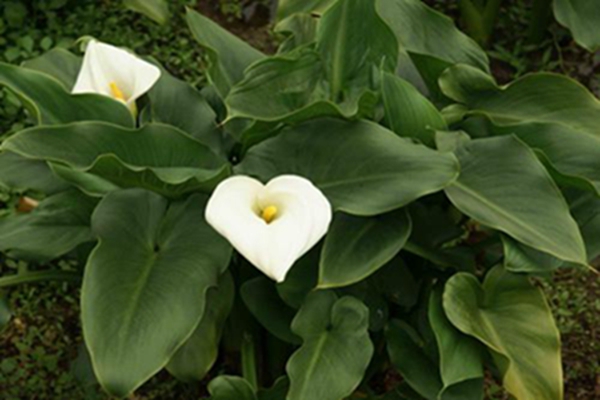
It also has another name, Guanyin lotus, and belongs to the Araceae family. It can live for many years as a rootstock plant, growing to about 100 cm tall, with a very large, fleshy stem. The leaves are basal, very emerald green, arrow-shaped, and very large, spreading out fully. The petioles are very thick, but compared with giant taro, its leaves are somewhat smaller and smoother. Its flower is spathe-shaped, very white, and very large, closely resembling the shape of a horse's hoof, which is how it got its name. Its inflorescence is bright yellow, with male flowers growing on top and female flowers below.
II. Giant taro
It is a plant of the Araceae family, can live for many years, and stays green all year round. It is a herbaceous plant originating from the subtropics. It likes warm, moist areas, preferably a semi-shaded environment, and fears the cold. If it is planted in areas north of the Yangtze River basin, it must be brought indoors before the cold winter arrives. It generally can grow over 2 m tall, with a very thick, round, fleshy stem. The leaves are very large, also arrow-shaped, with very prominent veins that are lighter in color than the leaf tissue. The petioles are very long and robust. The flower is yellow-green and also resembles a spathe in shape.
III. Differences
1. Shape
The former's petals surround the spadix, shaped like a cup. The top of the petals curves away from the spadix. The latter's petals resemble an eagle's beak, with the top of the petals curving along the spadix.
2. Spadix ⟧11⟧The latter's spadix is much thicker and sturdier than the former's. After the latter's flower fades, it produces red fruit that closely resembles a corn cob, while the former rarely sets fruit.
The stamens of the latter are much thicker and sturdier than those of the former. After the latter's flowers fade, they produce red fruits that look very much like corn cobs, while the former rarely manages to set fruit.