Comparison of three propagation methods for Four-season Osmanthus, spring is the right time for flower lovers to get started
Four-season Osmanthus is the most suitable variety among all osmanthus cultivars for potted ornamental cultivation. Its crown is elliptical, its branches grow robustly, the plant is relatively short with many divisions, the leaves are green or greenish-yellow, the flowers are lemon-yellow or yellowish-white, and the flowering period is long. It can bloom in all seasons except during severe cold and extreme heat, but most profusely in autumn. There are two cultivated types: large-leaf Four-season Osmanthus and sand-leaf Four-season Osmanthus.
Four-season Osmanthus can be propagated by cuttings, air layering and grafting. But in recent years, cuttings propagation has been the most commonly used.
Osmanthus: several key steps to master for potted osmanthus
I. Cutting method
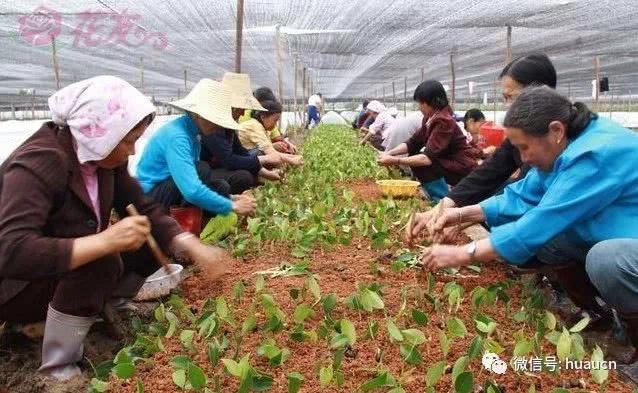
Before spring sprouting, cut one-year-old well-developed branches into 5 cm long cuttings, keep only the upper two or three green leaves, then insert them into a river sand or vermiculite bed (pot), with shade above.
You can also cut green branches of the current year after the summer shoot growth stops and insert them in the same way. If you soak the base of the cuttings in butyric acid solution for about 5 minutes, let them dry and then insert them, the survival rate can be improved and rooting can be greatly advanced.
Four-season Osmanthus nursery leaf cuttings
After cutting, water promptly and cover with plastic film and a sunshade net or straw curtain. If no water droplets are found inside the film and the bed surface is dry and the topsoil is grayish-white, spray water promptly to maintain moisture. Water thoroughly, but not too much, otherwise it easily causes soil compaction, breeds bacteria and causes the cuttings to rot. After insertion, uncover the film every 5-6 days to replenish water, and spray 0.1% thiophanate-methyl or carbendazim at the same time. Spray 2000 times carbendazim solution once every 7 days to prevent the cuttings from being infected by bacteria and causing cortex rot. Always maintain the permeability of the nursery site to prevent the young roots of the cuttings from rotting due to lack of oxygen. After rain, loosen the soil promptly to ensure the soil is loose and breathable, which is good for rooting, but be careful not to touch the cuttings. Spray 0.2% urea or potassium dihydrogen phosphate solution once every 10 days to promote the growth of the cutting roots and new shoots. For one- to two-year-old branches, make a notch or ring-bark them, then use a split bamboo tube, flower pot, thick paper tube or plastic film to wrap around the notched part, fill the gap inside with rice husk ash, moss, culture soil, perlite and other materials, and keep it moist frequently, but the water should not be excessive. After rooting, it can be cut off from the mother plant. The high-pressure bag made of plastic film generally has an inner diameter of 4-5 cm and a length of 8-10 cm. The notch and ring-bark site is below the node, where rooting is easy, and the width of the removed phloem is 1-2 cm.
II. Air layering method
It is mostly carried out before spring sprouting, and can also be carried out during summer growth. Carrying it out during the plum rain season also has very good results. According to experiments, wintersweet roots in 40-50 days, and Chinese rose roots in 20-30 days. During air layering propagation, the rooting time is generally longer, about 3-4 months. After cutting off from the mother plant, it must be placed in a cool place and maintained for a period before transplanting.
Note that the soil used for layering must be loose, moist and rich in organic matter, and must be pressed firmly against the layer. After layering, keep it moist frequently. The soil must not lack water or be dry, otherwise survival and rooting will be affected. In severely cold winter areas, it must be wrapped with rice straw, cotton wadding, etc. for cold protection, and the layer must not be frozen. The rootstocks used for grafting Four-season Osmanthus mainly include privet, white ash, clove and fringetree. The disadvantage of privet as a rootstock is that its root system is too developed and it is not suitable for potting, and it blooms late. The disadvantage of white ash as a rootstock is its short lifespan, and it easily sheds leaves in winter and blooms less. With clove as a rootstock, the trunk is thick at the top and thin at the bottom, making the tree shape top-heavy. Fringetree as a rootstock has good compatibility, drought and cold resistance, strong adaptability and a long lifespan, with a tree age of over a hundred years. Therefore, the most suitable rootstock for potted osmanthus grafting propagation is fringetree.
III. Grafting techniques
1. Bud grafting method
This method is especially suitable when the rootstock is thick and both the rootstock and scion are not easy to peel.
2. Branch grafting method
Branch grafting can be carried out during the dormant period, but is usually carried out in spring and autumn, mostly using cut grafting and cleft grafting. According to the different grafting positions, it can also be divided into soil grafting (ground grafting) and side grafting.
3. Approach grafting method
Bring the main trunk of the rootstock close to a suitable osmanthus branch for grafting, and cut a smooth cut surface of about 3 cm on a suitable part of each, with a depth of about 1/3 of the diameter. Put the two cut surfaces against each other, with at least one side's cambium aligned, and bind firmly with plastic film strips. This method is suitable for the peak growth season, generally from June to July. After grafting, it can heal in about 30 days, but it is best to separate it from the mother body after the flower buds are plump.
Four-season Osmanthus approach grafting
IV. Management and care
For potted Four-season Osmanthus, it is best to use sun-dried fish pond mud crushed into a granular structure as pot soil. When planting, it is best to apply some dry chicken manure as base fertilizer and water thoroughly to settle the roots.
In management and care, accumulated water in the pot should be drained promptly during the rainy season. Do not water too much during the flowering season, otherwise flowers easily drop. Usually adhere to the principle of "water when dry, stop when wet", and in winter appropriately control watering and just keep it moist. In addition to applying sufficient base fertilizer, regular topdressing should be applied, and normally liquid fertilizer mainly based on nitrogen fertilizer can be applied.
·END·
An interactive platform for flower growing, flower planting and green plant enthusiasts to communicate, show off and brag. An online home for sharing flower cultivation methods and home flower growing tips. A fresh flower subscription platform.
Fresh flowers: hyacinth|stock|plum blossom|carnation|camellia|kalanchoe|jasmine|gardenia|peach blossom|balloon flower|osmanthus|calla lily|lily|forget-me-not|clivia|apricot blossom|honeysuckle|milan|peony|sunflower|chrysanthemum|serissa|crown of thorns|tulip|narcissus
Green plants: poinsettia|money tree|pothos|spider plant|peace lily|lucky bamboo|asparagus fern|aloe|English ivy|anthurium|monstera|bougainvillea|silk tree|spathiphyllum|schefflera|boxwood|sago palm|rubber plant|maidenhair fern|snake plant|
huau.cn
……
Search the public account " " or " huaucn " to get the latest information
Business cooperation, promotion. Please contact WeChat private ID:ihuaucn