What are the effects and benefits of plantain (Plantago asiatica)?
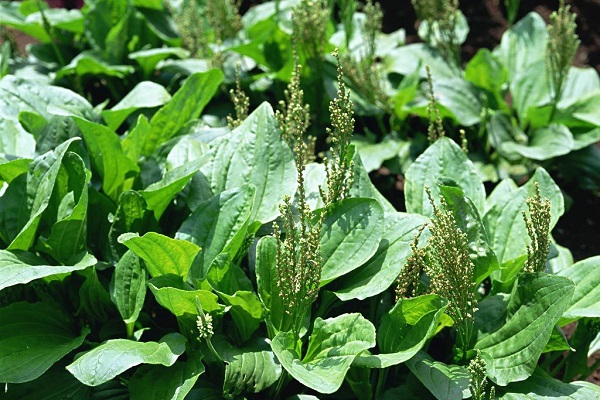
1. Medicinal benefits:
This plant provides fairly good relief for symptoms such as carbuncles, swellings and sores, sore swollen throat, red eyes due to liver heat, blood in the urine, nosebleeds, summerheat-damp diarrhea and dysentery, strangury with turbid discharge and leukorrhea, difficult urination, and heat binding in the bladder.
2. How to use:
(1) Dysentery: this mainly refers to the type caused by bacteria. Take fresh plantain leaves, rinse them clean, then boil them in clear water. Drink 60 ml to 120 ml per day, and you may drink it 3 times a day; results are usually seen in about 7 to 10 days;
(2) Acute glomerulonephritis: take 15 g corn silk, 15 g Eclipta prostrata (false daisy), 15 g Cirsium setosum (small thistle), and 15 g plantain with seeds, boil them in clear water and drink; just drink it once a day;
(3) Childhood enuresis: take 60 g plantain, 60 g Angelica sinensis (danggui), and 10 g Ephedra (mahuang), boil them in clear water down to 200 ml; drink once a day right before bedtime, for about 7 consecutive days;
(4) Pyelonephritis: take 30 g plantain, 12 g Viola philippica (purple flower violet), 12 g Phellodendron amurense (Amur cork tree bark), 12 g Coptis chinensis (goldthread), 12 g Lonicera japonica (Japanese honeysuckle), 20 g Houttuynia cordata (fish mint), 20 g dandelion, and 6 g licorice, boil them in clear water, and drink once each in the morning and in the evening;
(5) Mumps: take 30 g to 60 g plantain, rinse it clean, then boil it in clear water and drink; if using the dried form, take 15 g to 30 g.
3. Other uses:
As food: from April to May, pick its fresh young seedlings, rinse off the soil on them, blanch them in water, and then they can be used as an ingredient; whether served as a cold salad, stir-fried, or made into soup, all are fine.