Grow these 9 flowers on the balcony: they sprout fast and grow into a cascade in 3 months
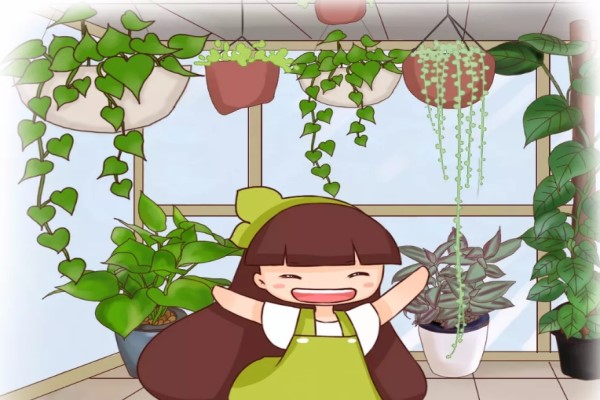
Inchplant (Tradescantia zebrina)
Inchplant does not like strong light, so it should be placed indoors in bright, indirect light. It likes a humid environment; when the surrounding air is too dry, the tips tend to dry out and the leaf edges scorch.
Inchplant tolerates moisture but not drought. In spring it does not need much watering; just keep the soil moist.
Golden pothos (Epipremnum aureum)
Golden pothos is fairly shade-tolerant and grows well in indirect light. If conditions allow, it can also be moved to the balcony to bask for two or three hours.
Golden pothos is a water-loving plant. Water it after the surface of the potting soil dries; too much water easily causes root rot. As for fertilizer, you can use fermented rice-washing water, cake fertilizer water, etc., but remember to apply light fertilizer frequently.
Air plant (Tillandsia)
Air plants do not need to be planted in soil or water; they survive as long as you mist the plant regularly. Mist with a spray bottle 2-3 times a week.
Air plants do not like strong light; placing them in indirect light is most suitable.
Hoya (Hoya carnosa)
Hoya needs indirect light to grow and is suitable for growing indoors with good ventilation.
Hoya has little demand for water; watering once every 1 or 2 weeks is enough.
Jinping vine (Cissus sicyoides)
Jinping vine likes sun and is suitable for planting outdoors, or indoors and on balconies with plenty of light. When planting, choose a smaller plant and prune it regularly.
Jinping vine only needs a light fertilizing once every 2-3 months.
Besides green plants, some succulents can also become a "natural curtain" when grown well~
Purple moon (Othonna capensis)
Purple moon likes a warm, airy environment with plenty of sunshine; hanging it on the balcony is very suitable.
During the growing season, purple moon has a high demand for water and fertilizer. Keep the potting soil moist but not waterlogged, and apply cake fertilizer liquid once every half month at a concentration that is not too high.
String of pearls (Senecio rowleyanus)
String of pearls is suited to an environment with high air humidity and indirect light; place it near a window. In summer, avoid high temperatures and high humidity to prevent root rot.
String of pearls holds plenty of water itself and does not need much watering. When the weather is dry, you can mist the leaves, but never overwater, which causes root rot.
Burro's tail (Sedum morganianum)
Burro's tail has little demand for light and is suitable for growing on semi-shaded windowsills, balconies, etc. In spring, summer and winter it can be grown in full sun; in summer, place it in indirect light.
Burro's tail likes well-aerated soil. Water only when the soil has dried out completely. It has little demand for fertilizer; applying once a quarter is enough.
String of hearts (Ceropegia woodii)
String of hearts likes indirect light and dislikes being scorched by the sun. Just place it in indirect light, such as on the inner side of a balcony.
String of hearts does not like much water or fertilizer. Because its rhizomes store a lot of water, keeping the potting soil moist is enough; also avoid applying fertilizer high in phosphorus and potassium.
After seeing these beautiful "natural curtains"
are you tempted?
If you think the article is good,
share it with others to take a look!