Mining Act amendment stalled for two years; environmental groups criticize the Ministry of Economic Affairs for worrying only about the interests of mining operators and disregarding human life and ecology
The Legislative Yuan's Economics Committee reviewed the draft amendment to the Mining Act on the 9th, but no consensus could be reached on whether mining rights extensions require re-application for mining land approval, and whether mining rights extensions require obtaining Indigenous consent. Committee chair Liao Kuo-tung announced that the review would be rescheduled.
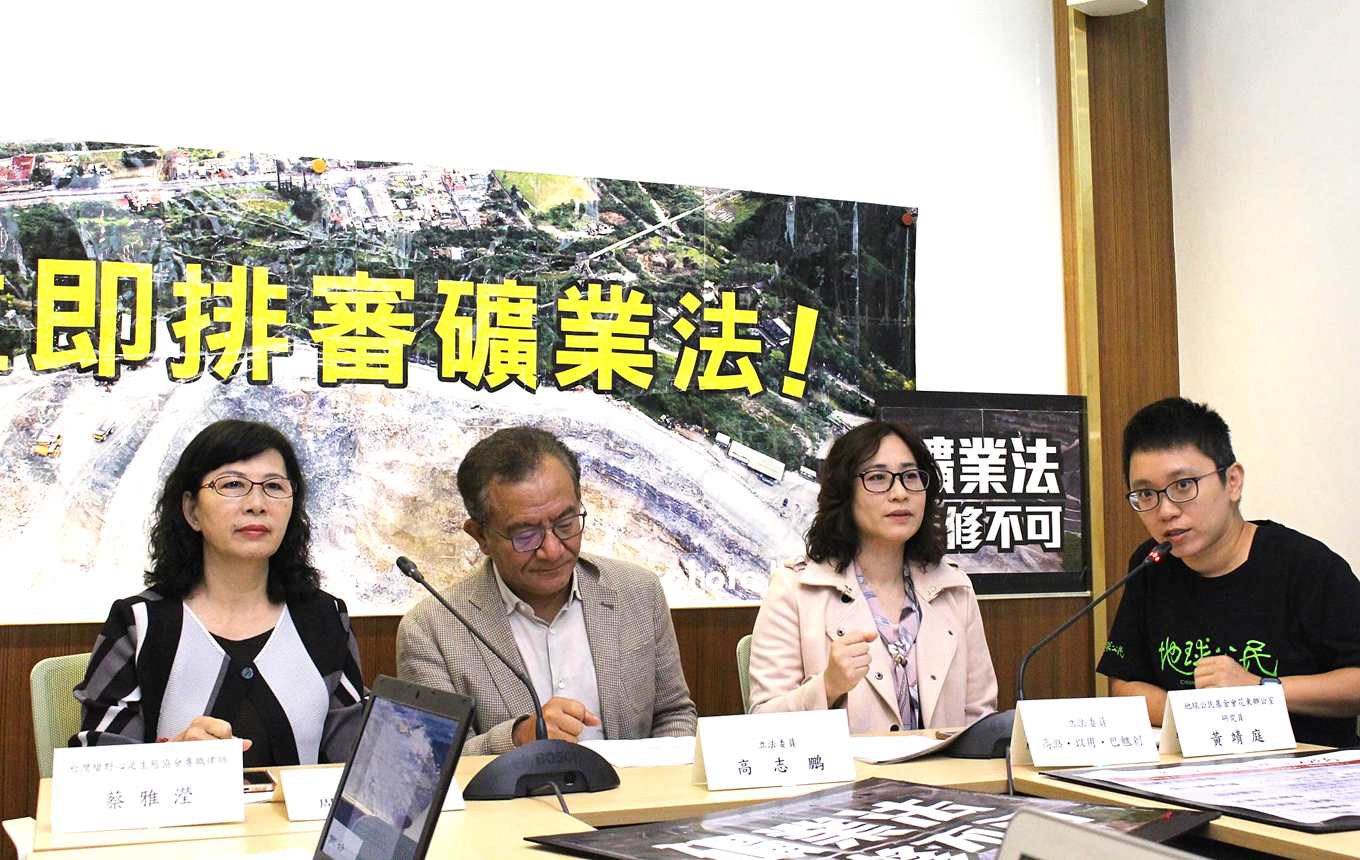
In response to the outcome of the draft Mining Act amendment the day before, the Citizens of the Earth Foundation held a press conference yesterday and directly criticized that although legislators from both the ruling and opposition parties had consensus, the Executive Yuan and the Ministry of Economic Affairs still considered only the interests of mining operators. They ignored that this amendment was intended to revise hegemonic provisions allowing unlimited extensions with "no environmental impact assessment," "no notification," and "no consent." Amid major controversy, the articles were still reserved, and the clause-by-clause review was not completed.
In June 2016, people marched on Ketagalan Boulevard demanding amendment of the Mining Act, but the Asia Cement mine still dug deeper and deeper. In June 2017, after director Chi Po-lin passed away, 210,000 people signed a petition to amend the Mining Act. Citizens of the Earth Foundation specialist Huang Jing-ting pointed out directly, "All of this shows the public consensus for reform, but it has now been two years and the amendment is still stuck in the Legislative Yuan's Economics Committee, while the Ministry of Economic Affairs will not make concessions on the key articles." They demanded that the Legislative Yuan schedule review of the draft Mining Act amendment as soon as possible in this session so that clause-by-clause discussion can be more thorough; and that before the amendment is completed, extension cases must be frozen, and the Ministry of Economic Affairs must not permit extensions.
Mining rights extensions require re-approval of mining land
In addition to the dispute over Indigenous consultation and consent, whether mining rights extensions require re-application for mining land approval also sparked considerable discussion. Legislator Chou Chen Hsiu-hsia directly criticized that during review of the Mining Act, all committee members agreed that mining land approval needed to be more rigorous and re-approved, but in the end all articles were still reserved. "This is simply the ruling party insisting on shielding it."
During review of the legal articles, the Ministry of Economic Affairs pointed out that re-approving mining land once would be time-consuming and unnecessary. The Citizens of the Earth Foundation said, "This shows that the Ministry of Economic Affairs is still standing from the perspective of worrying about the interests of mining operators, with no consideration at all for landowners affected by mining, the safety of tribal residents, or the mountain forest, water, soil, and ecological environment."
Huang Jing-ting emphasized that mine extensions must require re-approval of mining land, and that at the mining land approval stage, operators should also be required to submit a mine closure plan; obtain consent from landowners and building owners and other rights holders; consult environmental protection, soil and water conservation, land use, and other relevant competent authorities; obtain consent from the land use competent authority (Ministry of the Interior); conduct an environmental impact assessment if located in an environmentally sensitive area or reaching a certain scale; and implement Article 21 of the Indigenous Peoples Basic Law if located on Indigenous land.
Before the Mining Act amendment is completed, extension cases should remain frozen
With the Mining Act amendment still far off, mining operators may rush to apply for extensions first. Therefore, legislators and environmental groups have also proposed that before the Mining Act amendment passes, approval of extension cases should be frozen. At present, the freeze on extension cases lasts until May 30 of this year, and today a temporary proposal will be made in the Legislative Yuan to freeze them until the end of this year.
Tsai Ya-ying pointed out that a freeze on extension cases was proposed in December last year, and at that time it had not yet passed, but Asia Cement had already rushed to apply for a 20-year extension. "We finally spent time amending the law, wanting to resolve the unreasonable situation, but real change will have to wait 20 years." She emphasized that a freeze on extension cases should be proposed in the temporary proposal.
Legislator Kao Chih-peng also said that the Executive Yuan's version of the Mining Act is "going backwards." Not only are the conditions for retroactive environmental impact assessments heavily discounted, but Indigenous consent rights also have no mandatory effect. He emphasized that in addition to the Executive Yuan version, legislators can also propose legislator versions. "There is no requirement to pass the Executive Yuan version. The committee has many legislator versions and will choose the best one to pass; it will not accept everything wholesale." Kao also promised to schedule review in the shortest possible time and to have the Economics Committee today freeze extension cases until the end of the year.