Italian organic free-range eggs successfully exported, balancing revenue, food safety and animal welfare
An egg is a self-sufficient fortress for nurturing new life, and also a source of human nutrition and gastronomy. However, one after another outbreak of avian flu, dioxin and fipronil contamination has exposed the flaws of Taiwan's poultry industry. Transformation is necessary, but which direction to take? How can we balance nutritional food safety, animal welfare, ecological protection and producers' income, so that both consumers and producers win? "Upstream and Downstream" visited European chicken farms to find a good egg.
10,000 to 12,000 organically free-range chickens, annual turnover of 54 million, eggs sold to supermarkets in Hong Kong, China and Shanghai
Without a sense of direction, finding the way makes one panic. Today, however, I was not afraid. When getting off the car, a high school girl traveling with us pointed the way. Even if I could not tell east from west, I thought, three thousand free-range hens could not hide their smell. Unexpectedly, they had no odor at all. Fortunately, they were quite noisy, clucking "gugu gugu" to remind me that the chicken farm had arrived.
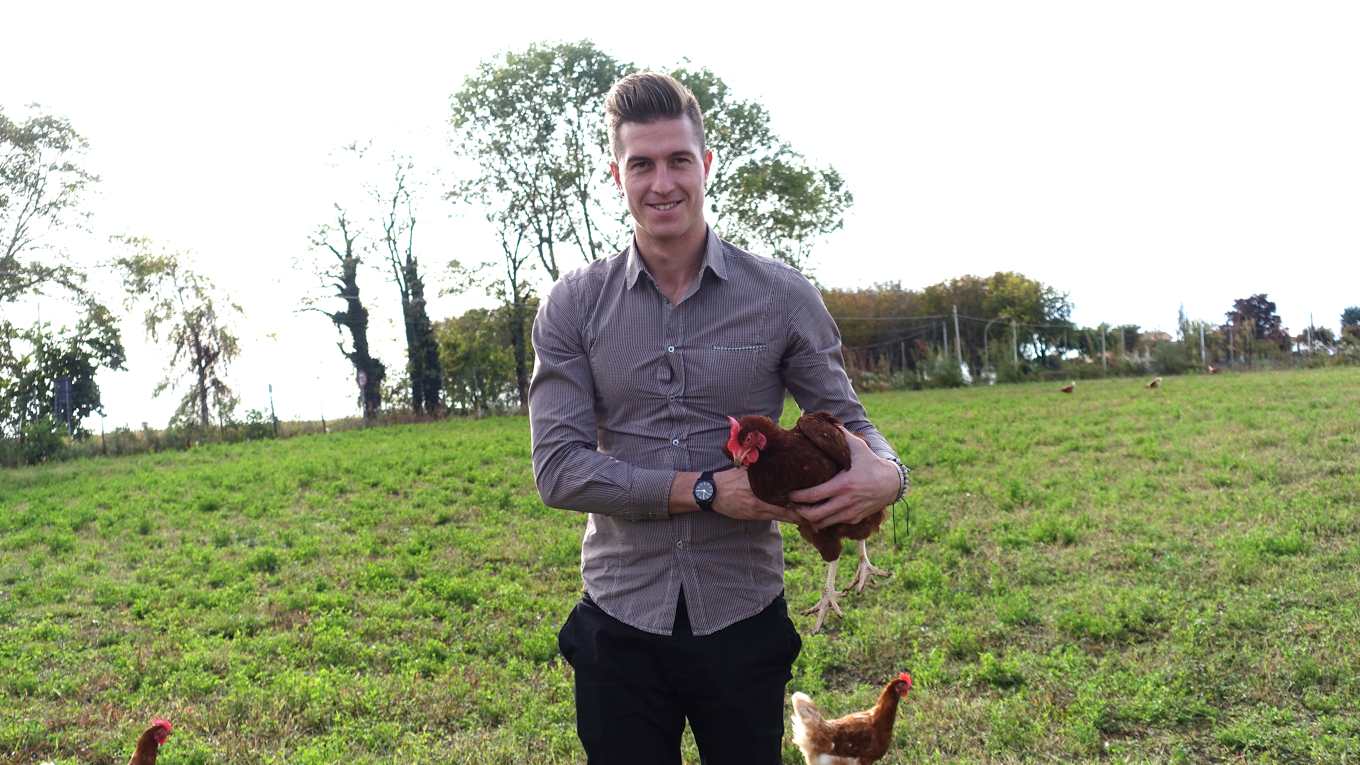
The Alps stand guard at the end of the horizon; crossing over the peaks to the north is Austria. The distant mountains seem to smile, the autumn breeze blows gently, and hens stroll leisurely on a farm in Udine in northeastern Italy. They are not shy of strangers, and like nosy gossips, they come one after another to the fence. "They are very curious. If we walk to the other end, they immediately follow." The owner, Sebastiano Pascolo, has meticulously combed hair, like a male model stepping out of a fashion magazine.
Sebastiano's surname "Pascolo" means "pasture" or "grazing" in Italian. True to his surname, his grandfather, besides growing corn and soybeans, also raised cattle. After inheriting the family business, Sebastiano's father Sergio became a pioneer in Italy in 1997 by commercially raising organic laying hens. From ideals to practice, from pasture to market, step by step, after 20 years they now raise 10,000 to 12,000 chickens across 4 farms, with a conservative estimate of annual turnover exceeding 1.5 million euros (about 54 million New Taiwan dollars), and sales to Hong Kong, China and Shanghai, proving that organic free-range farming is not theory, but practical experience that can reach considerable scale and has passed the market test.
Starting with strengthening immunity, organic is easier than conventional
Organic free-range farming requires equipment, vast land, feed that cannot be skimped on, and dedicated staff to tend the chickens. "The cost is indeed higher, but contrary to what many people think, organic farming is actually easier than conventional." Sebastiano pointed out the core difference right away. "Intensively raised laying hens are very weak. At the slightest disturbance they get sick, and one infection often affects the whole factory, so they need vaccines and antibiotics. By contrast, we start with strengthening immunity. Healthier hens actually save trouble."
Before entering the chicken pen, Sebastiano asked me to put on shoe covers, so as not to pick up chicken manure. Even though avian flu caused the deaths of a million chickens in Lombardy, he remained confident in the health of his own hens, and avian flu had never spread to Udine.
EU bans washing eggs; washing away the protective film makes eggs more likely to spoil
There is no odor in the coop where three thousand hens rest, because wood shavings and wheat straw are sprinkled in the manure collection trough at the bottom. Layer upon layer of chicken manure, wood shavings and wheat straw form natural fertilizer. Whenever the whole flock of hens is replaced, workers shovel it out and sell it to farmers, which is an extra income.
Sebastiano emphasizes hygiene and cleanliness but does not promote washing eggs. In the EU, washing eggs on chicken farms is even illegal. There is also a scientific explanation for this. "There are tiny pores on the eggshell for the chick to breathe, but to prevent bacteria and moisture, there is also a film on the shell. If washed, the protective film is washed off, and the egg is more likely to spoil. If there really is a dirty egg, just wipe it with a dry cloth." Then consumers wash it before use.
By contrast, the United States mandates washing eggs. After this unnecessary step, unless a layer of mineral oil is applied, the eggs must be refrigerated throughout the entire process at great expense. The eggs Sebastiano sells in Italy are placed on room-temperature supermarket shelves. Making tiramisu with raw eggs is no problem either. Only eggs exported long-distance to Asia are refrigerated throughout the process to keep them fresh.
Not a contract chicken-farming factory, but mastering brand and quality
In the packaging room comes a steady rhythm of "clang, clang." Eggs stand neatly in cartons like little soldiers wearing steel helmets. Workers pick them up with suction cups, place them into the machine, and one by one stamp them with numbers representing category and origin. They advance along the assembly line, are packaged, labeled, and await shipment. Electricity for the coop, packaging and office all comes from solar panels on the roof.
Blending ecology and modern technology, Sebastiano knows both production and sales. "Starting with my father, we decided to build our own brand and not be a contract chicken-farming factory." Besides avoiding control by middlemen, more importantly it avoids "bad eggs." "Middlemen or big brands sign contracts with many chicken farms, and the purchase price is the same regardless of egg quality. Some chicken farmers cut costs opportunistically, and the result is lowering overall quality. Anyway, there is no reward for doing well."
His farm has only two brands. The egg cartons supplied to 180 stores of the Italian Naturasì organic fresh supermarket chain are labeled "Old Farmers" (Contadini Vecchi), while those sold to other stores feature "Pasture Eggs" (Uova Pascolo). "This is also our surname. It concerns reputation, so of course we care greatly about quality."
Twenty years of persistence has earned customer loyalty. "We did not persuade anyone. Instead, people who want to buy high-quality eggs come to us." When other egg farms suffered bleak business due to fipronil and avian flu, Sebastiano's eggs were in short supply. "Like-minded channels are very important, because their customers already want to buy these products." Because of the care taken, even ordinary eggs can enter top supermarkets City Super in Hong Kong, China and Shanghai with a premium image.
Facing challenges, the only limitation is self-limitation
Facing a series of conventional challenges such as "for the hens' own good, they should be locked up to avoid infection and contamination," Sebastiano countered move by move, using practical experience to debunk myths.
Like a nitpicking oral examiner, I finally brought up inherent conditions and questioned the feasibility of this organic farming model in the subtropics. Sebastiano acknowledged regional differences. "But we also had setbacks. At first, my father invested in organic salami, but 20 years ago it was too advanced, and most organic supporters are vegetarians, so it ended in failure."
Even eggs were not a smooth path all the way. "At that time no one in Italy was doing it. My father even went to Austria to learn, but the scale there was very small. After returning, he gradually improved it and adapted it to the environment here."
Entering a country where people do not wear shoes, pessimists say, "There is no market, because there is no demand." Optimists say, "This market is huge, because no one sells shoes at all." The Pascolo family belongs to the latter. Hatching organic eggs from nothing, Sebastiano said, "Facing challenges, the only limitation is self-limitation."
European Bad Egg Revelation | Lowering costs, cheap consumption, government cover-up | What can Taiwan learn?
After 1.24 million laying hens were affected, how to prevent the next unexploded bomb? | How can traditional cage hen houses face the difficulties?