Don't throw away old pipes - stand them up and grow a whole strawberry patch
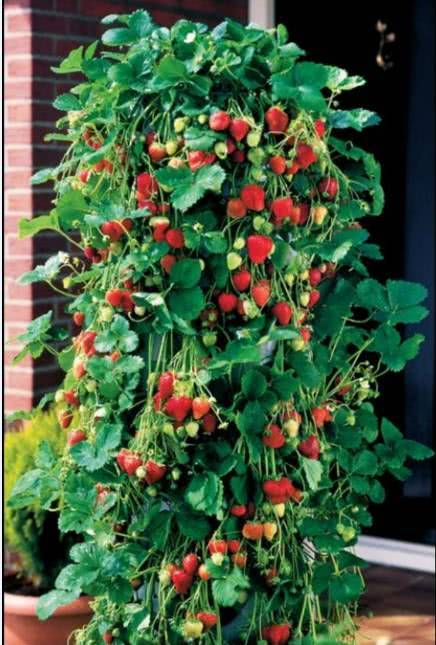
Strawberries can be grown in hanging baskets, as many people know, but growing strawberries in pipes - do you think that's feasible? Yet the gardener below has grown a whole patch, and I can only envy them.
These PVC pipes can be seen everywhere, and home renovations will certainly leave plenty of them behind. If you have decent DIY skills, then making one yourself is no problem at all.
1. Materials you need to prepare
An electric drill with a 5-7 cm hole-cutting bit (plus a small 3-5 mm drill bit)
Two pipes, one large and one small (the large one for planting, the small one for channeling water)
A saw, a cork, tape, hemp rope, potting soil (slightly acidic, fertile soil) and coarse sand.
You also need a pressurized irrigation water pump.
Step 1: Drill the holes
Leave a suitable gap between each hole, generally around 8-10 cm, and plan the arrangement of the holes properly - which side gets more sunlight is something you need to consider.
Step 2: Drill holes in the small pipe
Only drill holes in the upper 2/3 of the small pipe, because the water will be channeled up there and will drip down from the top.
You can drill more holes as vent holes, and the soil drainage will also be better.
Step 3: Finish the watering pipe
Thoughtful gardeners will realize that if the small pipe is simply slipped inside the large pipe, soil will seep in through the holes of the small pipe. So you need to prepare burlap or non-woven fabric to wrap around the small pipe to keep the soil from clogging the small holes, then just tie it securely with hemp rope.
Seal the small pipe first, otherwise soil will accidentally get in when you add it. After that, add soil and plant the strawberries. With each layer of soil you add, add a layer of gravel to prevent the soil from clogging - that's a little trick too.
Step 4: Plant the strawberry seedlings
You can add soil and gravel to the pipe while planting the strawberry seedlings. It's best to plant them with their root ball intact - they recover quickly and the survival rate is high.
Generally you only plant on the side that gets plenty of sunlight. It's impossible to plant on all sides, since they definitely wouldn't get enough light that way.
Step 5: Positioning
There's an art to positioning this pipe too. You can place it against a wall or at an angle, it doesn't matter - what matters is adjusting the direction so it gets plenty of light.
Of course, the bottom of the pipe needs the water pipe inserted - this is a great tool for watering the strawberries, very convenient. The bottom of the pipe also needs about 10 cm of gravel as a base layer, not only for drainage but also to make the bottom heavier so it doesn't tip over easily.
Step 6: The benefits of growing in pipes
Growing in pipes not only saves space, but also prevents pests from climbing up. Everyone knows what the most annoying pest is when growing strawberries - that's right, slugs. Grown on pipes, they have a hard time climbing up. Spreading a layer of crushed eggshells under the pipe gives double protection.
When it's time to pick strawberries, you'll need to bring a ladder!
Step 7: A pipe strawberry patch in a greenhouse
Don't think growing in pipes is just for fun - it can really be done on a large scale! Look at this big patch - I bet you've never visited a strawberry patch like this!
Of course, you can also grow other vegetables, such as herbs, bok choy, lettuce, cilantro and so on - all are possible.
Some gardeners also use it to grow small varieties of tomatoes, and they grow quite well too!