The difference between common succulents and expensive succulents is huge; the most expensive can sell for 100,000, so don't care for them blindly
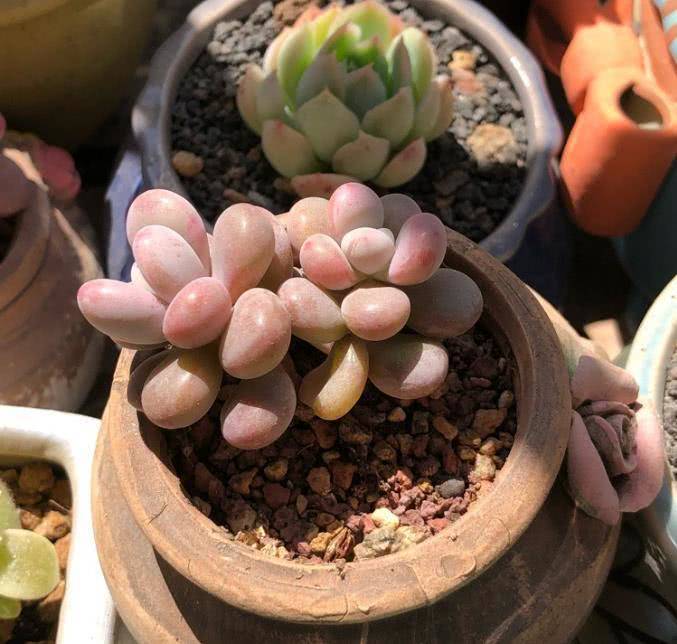
Succulents are also called succulent plants or fleshy plants, and in horticulture they are sometimes called succulent flowers, but the name "succulents" is the most commonly used. Succulents refer to a type of plant in which a part of the vegetative organ, such as the stem, leaves, or roots (a few species have two parts at the same time), has developed parenchyma tissue used to store water, making it appear thick and juicy in appearance. Most of them grow in arid regions or areas that have a dry period at some point in the year, and for a long period each year their roots cannot absorb water, so they rely only on the water stored in their bodies to sustain life.
Common succulents refer to plants that are relatively common and relatively easy to grow and propagate, such as the succulents Huangli, White Peony, Thousand Buddha Hands, Purple Pearl, and so on. Common goods, that is, street goods or cheap goods, do not mean they are not beautiful or are of humble origin; in fact, common goods even embody the wisdom and effort of horticultural breeders. In recent years, succulents have become very popular in China, and market prices have climbed all the way. After buying quite a few common succulents, succulent enthusiasts inevitably turn their thoughts to expensive ones. Expensive ones are mostly imported goods, entered the domestic market relatively late, and are relatively rare. Today, let us look at the splendid origins of a few common succulents. Perhaps from this we can also understand why, in mature markets abroad, our common goods are not cheap, and our expensive goods are not expensive.
For flower lovers who are new to the hobby, the difference between common succulents and expensive succulents may be one of the most troubling questions. A succulent that looks quite good to one person becomes a worthless common succulent in another flower lover's words. In fact, there is no strict definition of common succulents and expensive succulents. To the wealthy, expensive goods simply do not exist in the world; originally all kinds of plants are equal in nature, and it is people who divide them into different grades.
In recent years the succulent market has been very hot, leading to the import of many horticultural varieties of succulents. Generally, newly imported ones are very expensive; things are precious when they are rare, so this type of plant can indeed be called expensive goods, but as they become widespread, the price will also become cheaper and cheaper, and in the end they are reduced to common goods. Why are they reduced to common goods? The reason is simple: if this variety is easy to propagate, then after repeated cycles the market retention rate of this variety becomes very high, so the price will naturally drop, and therefore it is reduced to a common good.
Previously I saw a top-grade succulent Haworthia truncata with a starting selling price of 100,000. Note that top-grade means rare. The variegated Haworthia truncata, when examined closely, has firm and imposing variegation patterns, evenly distributed across the entire plant like a landscape painting, and is truly a feast for the eyes. Due to limitations, the accompanying photo of this Haworthia truncata can only be shared with everyone next time.
The leaves of succulents are plump, and many people like them and call them "chubby." Generally, people who grow succulents pay attention to pairing; if paired properly, a pot of flowers will be very beautiful. Succulents are relatively sensitive to water. In the spring and autumn growing seasons, the method of watering thoroughly after drying out can generally be used (usually once every 3-7 days). In winter, when the temperature is low and growth is slow, after the soil dries out you can choose a sunny morning and water a small amount along the edge of the pot (usually once every two weeks). Without sufficient sunlight, too much water easily causes leggy growth and greening. In addition, when watering, avoid water accumulating on the leaves, otherwise after sunlight exposure it can easily cause leaf burn or even black rot in the leaf center.
This is a gathering place for succulent plant enthusiasts, sharing succulent care tips; welcome to follow and exchange ideas.