Recommended flowering green plants: suitable both as potted bonsai and for courtyard gardening
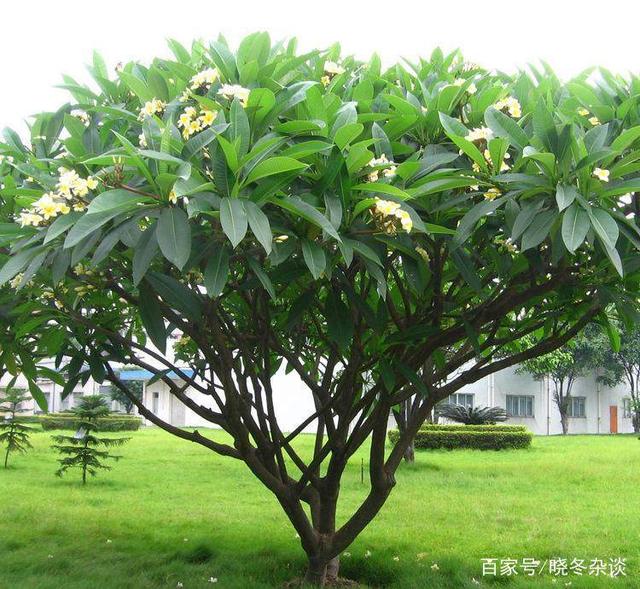
Frangipani
Frangipani, also known as Burmese gardenia, egg-yolk flower, Indian jasmine, and dajihua, is a deciduous shrub or small tree of the genus Plumeria in the Apocynaceae family. The branchlets are thick and fleshy. The leaves are large, thick and papery, mostly clustered at the tips of the branches, with veins joining into a marginal vein near the leaf edge. Several flowers cluster at the tip of the branches; the corolla is tubular, about 5-6 cm in diameter, with 5 lobes. The outside is milky white and the center is bright yellow, extremely fragrant. The flowering period is from May to October. Frangipani blooms in summer, with a delicate fragrance and elegance. After the leaves fall, the bare trunk curves naturally, and its form is very beautiful. It is suitable for planting in courtyards and on lawns, and can also be grown in pots and used as medicine. It is native to the Americas and has been introduced and cultivated in China. In Xishuangbanna, China, and some Southeast Asian countries, frangipani is designated by Buddhist temples as one of the "Five Trees and Six Flowers" and is widely planted, hence it is also called "temple tree" or "pagoda tree". Its tree form is attractive and oddly shaped, and the entire stem contains milky sap. When cultivated in a greenhouse, it will drop its leaves in winter, which is a sign of its poor cold tolerance, but after the leaves fall, the bare trunk curves naturally like a bonsai, and it also has strong ornamental value.
Frangipani is a sun-loving species and prefers a high-temperature, humid environment with plenty of sunlight. But it can also grow in semi-shaded conditions; however, in a shaded environment the branches become leggy, with few flowers or with leaves growing but no flowers; while yellow frangipani in a shaded, humid environment will grow aerial roots on the branches. The soil suitable for planting frangipani is preferably deep, fertile, well-drained, organic-rich acidic sandy loam; plants grown in this way are robust, with a large number of flowers and bright flower colors. When the soil is poor, frangipani grows and develops poorly, with small flowers and dull flower colors. Frangipani is drought-tolerant, dislikes waterlogging, and has good stress resistance. However, drought is not conducive to plant development, and in severe cases leads to poor growth; waterlogging easily causes root rot. Frangipani has poor cold tolerance, and the most suitable growth temperature is 20-26°C; during overwintering, prolonged periods below 8°C make it prone to cold damage. In the vast number of towns south of the Tropic of Cancer in China, open-field cultivation can generally overwinter safely; in central and northern China, it is only suitable for pot cultivation, and in winter it must be moved into a greenhouse to overwinter.
Wisteria
Wisteria, also known as tengluo, zhuteng, and huanghuan. It belongs to the Fabaceae family and the genus Wisteria, and is a deciduous climbing and twining large woody vine. The bark is dark gray and does not split; it blooms in spring, with blue-purple pea-like corollas, and the flowers are purple or deep purple, very beautiful. Wisteria is a warm-temperate and temperate plant with strong adaptability to the growing environment. It is produced south of Hebei in the Yellow River and Yangtze River basins, as well as in Shaanxi, Henan, Guangxi, Guizhou, and Yunnan. Among the people, the purple flowers are either blanched and served cold, or coated in batter and deep-fried, to make flavored wheat foods such as "ziluo cake" and "ziluo pastry". Wisteria is a warm-temperate and temperate plant with strong adaptability to climate and soil, relatively cold-tolerant, able to withstand moisture and poor soil, sun-loving, and relatively shade-tolerant. It is most suitable for cultivation in places with deep soil layers, good drainage, and facing the sun while sheltered from wind. The main root is deep and the lateral roots are shallow, and it does not tolerate transplanting. It grows relatively quickly and has a very long lifespan. It has strong twining ability and has a strangling effect on other plants.
Wisteria has strong adaptability and is heat-tolerant and cold-tolerant, and is cultivated from south to north in China. Therefore, in Guangdong, it can adapt to the temperature of wisteria in all four seasons. During overwintering, it should be placed in a low-temperature area at around 0°C, keeping the potting soil slightly moist, so that the plant can fully enter dormancy. In ancient times it was also called tengluo and zhaodouteng. It is native to China, and is also distributed in Korea and Japan. It is widely distributed in northern China, and is most commonly seen in Hebei, Henan, Shanxi, and Shandong. It is cultivated in eastern, central, southern, northwestern, and southwestern China. In China, as far south as Guangdong, it is commonly cultivated in gardens for ornamental purposes. Common varieties include multflower wisteria, silver wisteria, red jade wisteria, white jade wisteria, Nanjing wisteria, and others. Shanghai has Wisteria Town and Wisteria Garden, and Suzhou also has ancient wisteria. The main cultivation and propagation bases are in Jiangsu, Zhejiang, Hunan, and other places.
Silk tree flower
Silk tree, also known as ronghua tree and mayinghua. It is a deciduous tree that blooms in summer, with capitulum inflorescences, gamopetalous corollas, and many stamens, light red in color. The pods are linear, flat, and do not split. It is 4-15 m tall. The crown is spreading; the branchlets are angular, and the young branches, inflorescences, and leaf rachises are covered with tomentum or short pubescence. The stipules are linear-lanceolate; the capitulum inflorescences are arranged in panicles at the branch tips; the flowers are pink; the calyx is tubular, the flowering period is June-, and the fruiting period is August-October. It is sun-loving and tolerant of dry, poor soil. The wood is reddish brown, with straight grain and fine structure, and easily cracks when dry; it can be used to make furniture, sleepers, and so on. The bark can be used to extract tannin. It is native to China, Japan, South Korea, and North Korea. It is the city tree of Weihai.
Silk tree is usually propagated by sowing. Seeds are collected between September and October. When collecting seeds, choose plump pods free of pests and diseases, dry them in the sun and thresh them, then store them dry in a dry, ventilated place to prevent mildew. For spring seedling raising, soak the seeds for 8-10 h before sowing, then take them out and sow. Sow in drills in furrows, with a furrow spacing of 60 cm, cover with 2-3 cm of soil, and keep the bed soil moist after sowing; they germinate in about 10 d. The seeding rate is about 150 kg per 1 ha. After the seedlings emerge completely, management work such as weeding, loosening the soil, and topdressing should be strengthened. Transplant in the second spring or autumn, with a plant spacing of 3-5 m. For 2-3 years after transplanting, weed and loosen the planting holes every spring and autumn to promote growth. In March-April of the following year, the seeds can be sown only after treatment. Because the seed coat of silk tree is hard, in order to make the seeds germinate uniformly and emerge quickly, 2 weeks before sowing, soak them in a 0.5% potassium permanganate cold water solution for 2 h, remove them, rinse them clean with clear water, and soak the seeds in hot water at about 80°C for 30 s; after 24 h they can be sown. Using this method to accelerate germination, the germination rate can reach 80%-90%, and after emergence the seedlings grow robustly and are not prone to disease.