Can't tell peonies and herbaceous peonies apart? Figure out the difference before heading out to enjoy the spring flowers
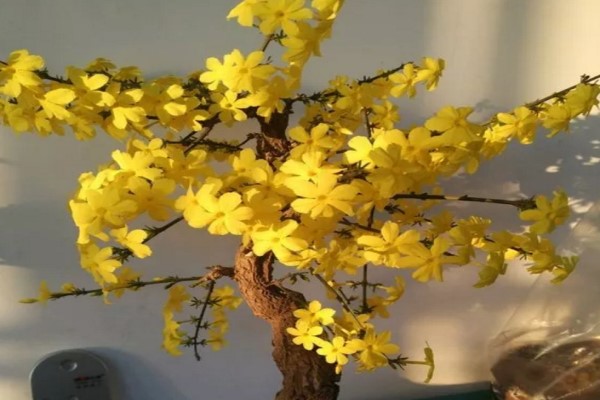
Winter jasmine VS Forsythia
Winter jasmine and forsythia can be called "twin sisters," and most people confuse the two. However, winter jasmine and forsythia still have clear differences.
1. Winter jasmine
Winter jasmine is a small shrub, with soft, slender branches that grow in an arching, drooping form.
Each winter jasmine flower has 6 petals, sometimes 5, and when viewed from the front the flowers sit tightly together.
The old branches of winter jasmine are grayish brown, while the young branches are green.
2. Forsythia
Forsythia is a deciduous shrub that grows upright, with fine branches that curve and droop.
Each forsythia flower has 4 petals, and the petals are slender and separated.
Forsythia branches are round and yellowish brown, with raised dots on the branches.
Chinese rose VS Rosa multiflora VS Rose
Many friends really can't tell Chinese roses, Rosa multiflora, and roses apart, and at flower markets there are often cases of Chinese roses being passed off as roses. So it is very necessary to correctly distinguish the three.
1. Chinese rose
The Chinese rose is an upright shrub, with thick, sturdy stems that are cylindrical and have short, thick hooked prickles.
The base of the Chinese rose leaf is nearly round, with serrated edges; the leaf surface is dark green, smooth and glossy.
Chinese roses generally bear a single flower terminally, the flower colors are bright and there are many varieties, and they bloom in all four seasons.
2. Rosa multiflora
Rosa multiflora is a deciduous shrub; the leaf surface is dark green, hairless on both sides, glossy but duller than that of the Chinese rose; the branches are slender, mostly with prickles and hairless.
The flowers are small, numerous and dense, blooming 1 to 2 times a year, with a faint fragrance, and are often used as flower hedges.
3. Rose
The leaflets in the compound leaves of the rose are numerous and thick, with 5-9 leaflets on one petiole; the leaf surface is shiny and wrinkled, and the leaf underside is whitish with small prickles.
Rose flowers are borne singly or in clusters of 1-3, with short flower stalks; the flower stem is roughly the same as that of Rosa multiflora, and it blooms only once a year, in summer.
Plum blossom VS Wintersweet
Many friends have always thought that wintersweet is a type of plum blossom, but that is actually not the case. Although their names are similar, each has its own characteristics.
1. Plum blossom
The plum blossom is a tree, with alternate leaves that are broadly ovate to ovate.
The flower colors include white, pink, purplish red, deep red, and various other colors, and the flowering period is in the second month of the lunar calendar each year.
2. Wintersweet
Wintersweet is a shrub, with clustered and upright branches. The leaves are opposite, oblong-elliptical in shape, with a rough green upper surface and a smooth gray underside.
Wintersweet flowers are mainly wax-yellow, with other colors relatively rare, and they mostly open around the twelfth month of the lunar calendar.
Tree peony VS Herbaceous peony
The tree peony is called the "king of flowers," while the herbaceous peony even has the fine names "flower fairy" and "May flower god." Both have a noble and elegant posture.
1. Tree peony
The tree peony is a shrub plant, with hard and sturdy flower branches, spreading leaves that are smooth and hairless, and a white powder on the underside.
The tree peony's floral disc (the enlarged part of the receptacle) is very well developed, wrapping more than one third of the carpels.
2. Herbaceous peony
The herbaceous peony is an herbaceous plant, with a thick main root that is yellowish brown, clustered stems, and leaves that are elliptical to lanceolate.
The floral disc of the herbaceous peony is not well developed, only wrapping the base of the carpels.
After reading this, have you sorted them out?
It's okay if you can't tell them apart clearly
Just focus on enjoying the flowers~
If you find it interesting, share it with your friends
Test whether your friends are "flower identification masters"!