Master these 8 key points in growing flowers, and your potted plants will multiply
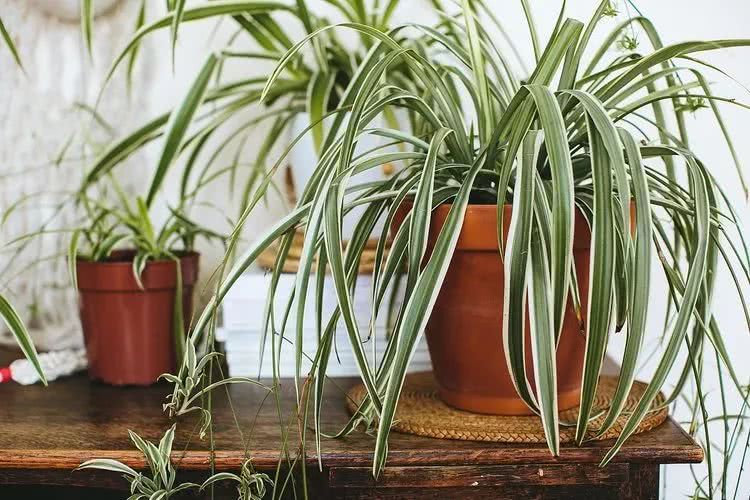
If you want to keep your indoor plants healthy and green all year round, you need to master some proper care techniques. Most potted plants at home are very easy to care for, and their ability to adapt to the environment is quite good. During care, pay attention to these eight key points, and very few flowers will end up dying. Let's take a look.
1. How to propagate
Most plants grown indoors are very easy to propagate, such as the common pothos, spider plant, or English ivy.
The plant above is a spider plant, and I have already propagated several pots beside it. You can see that it grows some trailing offshoots. Just cut these offshoots off, insert them into the soil, place them in a warm, shaded spot, keep the soil slightly moist, and maintain the temperature at around 20°C. They will quickly take root and sprout. Most other plants can also be propagated by cutting off some stems and inserting them into the soil.
2. Repotting tips
If you are not sure whether your potted plant needs to be repotted, you can check whether the roots have grown out of the bottom of the pot, or lift the pot up. If the roots are relatively few, do not repot it yet.
Indoor potted plants generally need to be repotted once every 2 to 3 years. Choose a time when the temperature is stable at around 18°C, repot in a shaded place, cut off any withered roots and rotten roots, add fresh soil, then water thoroughly, and place it in a shaded, ventilated spot to slowly recover.
3. Regular cleaning
After indoor plants have been grown for a while, dust will collect on the leaves. At this point, you can spray them with room-temperature clean water. If the plant's leaves are fuzzy, you can use a soft-bristled brush to sweep the dust off the leaves.
Regularly cleaning the leaves and stems of plants allows them to better absorb sunlight and water, which is good for growth. Some people's plants do not grow for several years, and this may be because they were not cleaned regularly.
4. Pruning and pinching
If you want indoor plants to look better and grow more branches, you need to prune and pinch them regularly. If you see a relatively long branch growing, about 18 cm, you can pinch it off to encourage branching and more side shoots.
At the same time, if you see any diseased leaves or withered branches growing on the plant, cut them off promptly to avoid infection by pathogens. After cutting, keep the cut surface away from water.
The branches you cut off, about 9 to 12 cm long, can be used for propagation by cuttings. This way, you will have more and more plants at home.
5. Cut off diseased leaves and branches
If you find withered flowers on your plants at home, remove the spent flowers promptly. This preserves nutrients and also prevents fungal infections.
Usually, when you see yellow leaves, diseased leaves, and withered leaves on plants, cut them off with sharp scissors, and do not let the cut surface touch water at first.
6. Watering tips
Most indoor plants die because of overwatering. If you are not sure whether your plant needs watering, it is best to wait until the potting soil is completely dry before watering. To check whether the soil is dry, insert a dry wooden stick into the soil for a few minutes, then pull it out and look at whether the stick is dry or moist.
Of course, different indoor plants have different water needs. Pothos and nerve plant both prefer more water, so they need to be watered more frequently. Drought-tolerant plants such as money tree, aloe, snake plant, and ZZ plant do not need frequent watering, and too much water can easily kill them.
7. Proper fertilizer
Indoor plants do not need frequent fertilizing and have low fertilizer requirements. Plants growing indoors do not get much light and grow relatively slowly. Generally, fertilize in spring and summer, once every 2 to 3 weeks.
After it turns cold in autumn, stop fertilizing. Control the concentration of the fertilizer well. If the concentration is too high, it will not only fail to promote plant growth but also easily cause fertilizer burn.
For fertilizer, it is best to choose some slow-release organic fertilizers, or commonly used liquid fertilizers.
8. Pest and disease control
If indoor plants are not cared for properly, they are prone to pests and diseases. Too much water easily causes root rot and can also lead to fungal diseases. Just control the water promptly, cut off the diseased roots, and water with carbendazim or thiophanate-methyl to prevent fungal infection.
If pests are the problem, such as the common mealybugs or scale insects, you can directly dip a cotton swab in alcohol and apply it to the affected areas.
If it is aphids, you can directly wash them off with a strong stream of water or spray common insecticides.
In addition, promptly deal with diseased leaves and branches in the potting soil. Do not let fallen leaves remain in the flowerpot. Cut off diseased leaves and branches promptly, keep diseased plants separated from healthy plants to avoid spreading to each other. To control aphids, be sure to promptly eliminate ants indoors. Ants are the keepers of aphids, so they must be eliminated at the same time.