How Bonsai Beginners Should Correctly Prune the Trunk of Dug-Up or Purchased Tree Stumps
Plants all have two parts: the above-ground branches and leaves, and the root system below. To grow plants well, you must understand the relationship between the root system and the branches and leaves. There are four sayings that sum up this relationship: "Physiologically they nourish each other, morphologically they grow alternately, in vigor they balance each other, and anatomically they are symmetrical to each other."
The first three sayings are easy to understand; the last one is what we bonsai enthusiasts need to focus on understanding. To put it plainly, it can be understood this way: however long the branches and leaves are, the roots are just as long. When we work with bonsai material, the root system is rarely kept intact; especially for material collected from the mountains, the original roots are basically almost all gone, while the branches and leaves are easily preserved in full.
Few roots and full branches and leaves: planting a plant in this situation is basically certain death. The reason is that the plant's original balance has been broken; the roots cannot provide enough nutrients to the branches and leaves and cannot grow alternately with them, because the roots and the branches and leaves are closely linked. For example, when a plant's branches and leaves grow unevenly (that is, one side is lush and leafy while the other side has only sparse, lone branches and leaves), then the roots below the plant are also strong on one side and weak and thin on the other.
At this point, we must, based on the relationship between the roots and the branches and leaves, take measures both above and below at the same time to correct it:
First, prune the branches and leaves differently: prune the side with strong growth vigor heavily, leaving weak branches and thin buds at the cut, while pruning the weaker-growing side lightly, leaving strong branches and sturdy buds at the cut;
Second, supply different amounts of fertilizer and water to the roots: give less fertilizer and water to the side with strong growth vigor, and more fertilizer and water to the side with weak growth vigor. In this way, you can suppress the strong and support the weak, moving toward balance.
Based on this characteristic of plants, when working with bonsai material you must be willing to be ruthless and prune the branches and trunk heavily.
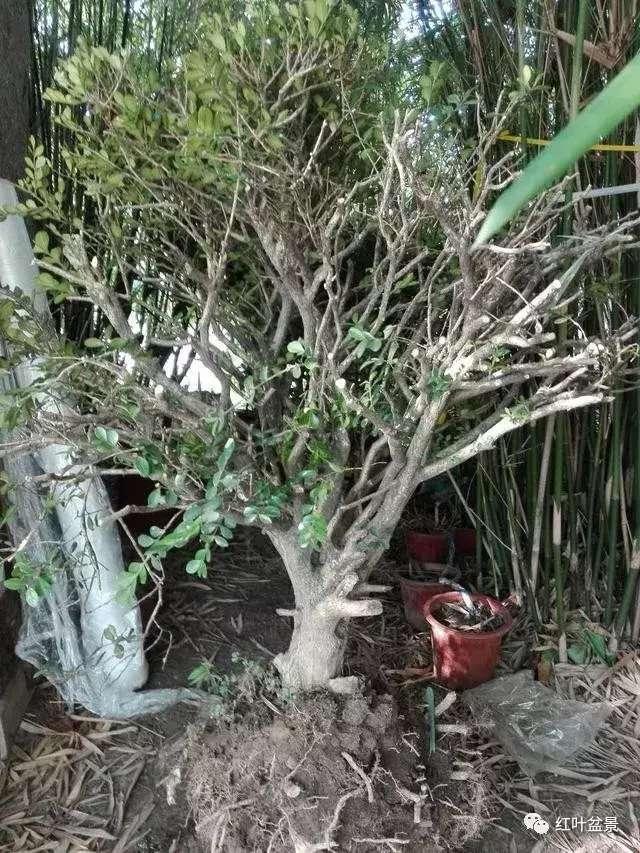
This is the pruning process for a landscape boxwood (Buxus).
Figure 1: The state of the boxwood when it was dug up
Figure 2: First pruning and potting